
Join Our JEE Preparation Group
Prep with like-minded aspirants; Get access to free daily tests and study material.
Sign in
Please select an account to continue using cracku.in
↓ →
Join Our JEE Preparation Group
Prep with like-minded aspirants; Get access to free daily tests and study material.
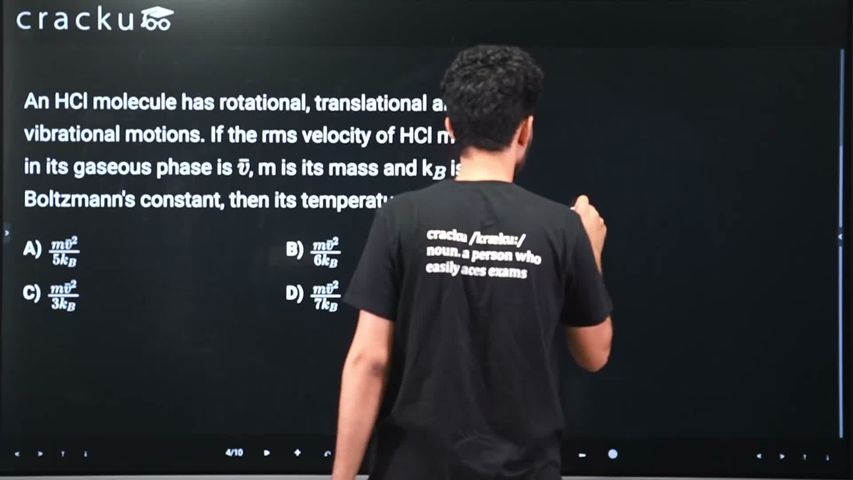
An HCl molecule has rotational, translational and vibrational motions. If the rms velocity of HCl molecules in its gaseous phase is $$\bar{v}$$, m is its mass and k$$_B$$ is Boltzmann's constant, then its temperature will be:
We begin with the statement of the equipartition theorem: “For every independent quadratic degree of freedom present in a molecule, the average energy possessed per molecule is $$\frac{1}{2}k_B T.$$”
An HCl molecule is linear, so it indeed possesses three kinds of motion:
• Translational motion along the three mutually perpendicular axes (x, y and z).
• Rotational motion about two axes that are perpendicular to the internuclear axis (a linear molecule cannot rotate about its own bond axis in the classical sense, so only two rotational degrees of freedom are counted).
• Vibrational motion along the bond, which contributes two quadratic terms (one kinetic and one potential) and hence amounts to two degrees of freedom.
Altogether, the molecule has $$3 + 2 + 2 = 7$$ quadratic degrees of freedom. However, the root-mean-square speed $$\bar v$$ is defined solely from the translational kinetic energy, because it involves only the centre-of-mass velocity of the molecule. Therefore, to relate temperature to $$\bar v$$ we need consider only the translational part of the energy.
For translation there are exactly three degrees of freedom, and by the equipartition theorem the average translational kinetic energy per molecule is therefore
$$E_{\text{trans}} \;=\; \frac{3}{2}\,k_B\,T.$$
By definition, the average translational kinetic energy may also be written in terms of the molecular mass $$m$$ and the root-mean-square speed $$\bar v$$ as
$$E_{\text{trans}} \;=\; \frac{1}{2}\,m\,\bar v^{\,2}.$$
Since both expressions represent the same physical quantity, we equate them:
$$\frac{1}{2}\,m\,\bar v^{\,2} \;=\; \frac{3}{2}\,k_B\,T.$$
Now, we cancel the common factor of $$\frac{1}{2}$$ from both sides to obtain
$$m\,\bar v^{\,2} \;=\; 3\,k_B\,T.$$
Solving for $$T$$ gives
$$T \;=\; \frac{m\,\bar v^{\,2}}{3\,k_B}.$$
Thus the temperature corresponding to the given root-mean-square speed is
$$\displaystyle \frac{m\bar{v}^{2}}{3k_B}.$$
Hence, the correct answer is Option C.
Was this solution helpful?
Click on the Email ☝️ to Watch the Video Solution
Create a FREE account and get:
_1.webp)

Educational materials for JEE preparation

Ask our AI anything

AI can make mistakes. Please verify important information.
AI can make mistakes. Please verify important information.
