
Join Our JEE Preparation Group
Prep with like-minded aspirants; Get access to free daily tests and study material.
Sign in
Please select an account to continue using cracku.in
↓ →
Join Our JEE Preparation Group
Prep with like-minded aspirants; Get access to free daily tests and study material.
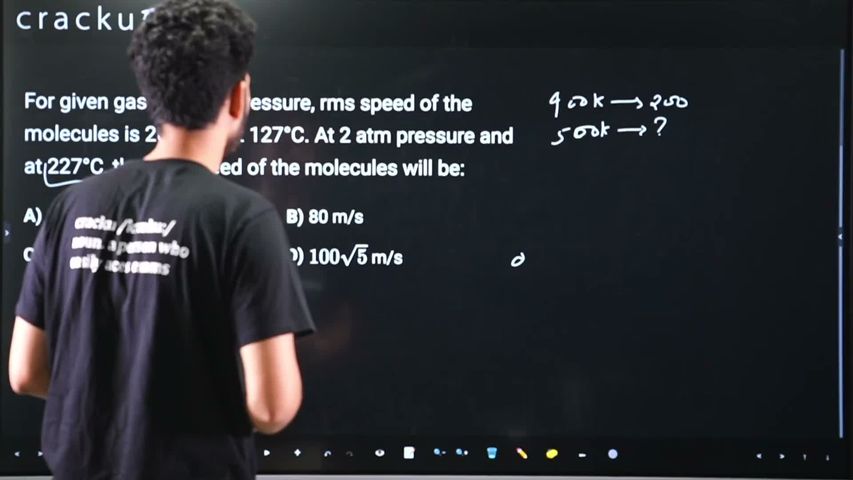
For given gas at 1 atm pressure, rms speed of the molecules is 200 m/s at 127°C. At 2 atm pressure and at 227°C, the rms speed of the molecules will be:
We begin by recalling the expression for the root-mean-square (rms) speed of the molecules of an ideal gas. For a gas of molar mass $$M$$ kept at absolute temperature $$T$$, the formula is
$$u_{\text{rms}}=\sqrt{\dfrac{3RT}{M}},$$
where $$R$$ is the universal gas constant. Clearly, for a given gas (that is, for fixed $$M$$), the rms speed depends only on the absolute temperature and is independent of the pressure. Hence, if the same gas is taken from one temperature to another, the ratio of the two rms speeds is simply the square root of the ratio of the two absolute temperatures. Symbolically,
$$\dfrac{u_2}{u_1}=\sqrt{\dfrac{T_2}{T_1}}.$$
We are supplied with the following data for the first state:
Initial pressure $$P_1 = 1 \text{ atm},$$
Initial temperature $$T_1 = 127^\circ\text{C}.$$
Because our formula demands absolute temperature, we convert Celsius to Kelvin by using $$T(\text{K}) = T(\!^\circ\text{C}) + 273$$. Thus,
$$T_1 = 127 + 273 = 400 \text{ K}.$$
The rms speed in this state is given as
$$u_1 = 200 \text{ m s}^{-1}.$$
For the second state we are told
Second pressure $$P_2 = 2 \text{ atm},$$
Second temperature $$T_2 = 227^\circ\text{C}.$$
Again converting to Kelvin, we get
$$T_2 = 227 + 273 = 500 \text{ K}.$$
Now we apply the proportionality relation between rms speeds and absolute temperatures. Writing it explicitly,
$$u_2 = u_1 \sqrt{\dfrac{T_2}{T_1}}.$$
Substituting the numerical values, we have
$$u_2 = 200 \times \sqrt{\dfrac{500}{400}}.$$
Simplify the fraction under the square root:
$$\dfrac{500}{400} = \dfrac{5}{4}.$$
Therefore,
$$u_2 = 200 \times \sqrt{\dfrac{5}{4}}.$$
Write the square root of a fraction as the fraction of the square roots:
$$\sqrt{\dfrac{5}{4}} = \dfrac{\sqrt{5}}{\sqrt{4}} = \dfrac{\sqrt{5}}{2}.$$
So,
$$u_2 = 200 \times \dfrac{\sqrt{5}}{2}.$$
Cancel the factor of 2 between 200 and the denominator 2:
$$u_2 = 100 \sqrt{5}\ \text{m s}^{-1}.$$
The numerical value $$100 \sqrt{5}$$ matches option D.
Hence, the correct answer is Option D.
Was this solution helpful?
Click on the Email ☝️ to Watch the Video Solution
Create a FREE account and get:
_1.webp)

Educational materials for JEE preparation

Ask our AI anything

AI can make mistakes. Please verify important information.
AI can make mistakes. Please verify important information.
