
Join Our JEE Preparation Group
Prep with like-minded aspirants; Get access to free daily tests and study material.
Sign in
Please select an account to continue using cracku.in
↓ →
Join Our JEE Preparation Group
Prep with like-minded aspirants; Get access to free daily tests and study material.
In a circuit shown in the figure, the capacitor $$C$$ is initially uncharged and the key $$K$$ is open. In this condition, a current of 1 A flows through the 1 $$\Omega$$ resistor. The key is closed at time $$t = t_0$$. Which of the following statement(s) is(are) correct?
[Given: $$e^{-1} = 0.36$$]
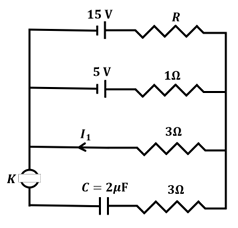
Kirchhoff's laws and Thevenin's theorem determine circuit behavior during transient and steady-state conditions of a charging $$R-C$$ branch.
Given: $$I_{1\Omega} = 1\text{ A}$$ (when $$K$$ is open), $$C = 2\ \mu\text{F}$$, $$e^{-1} = 0.36$$
At $$t < t_0$$ (Key $$K$$ open, bottom branch disconnected), using nodal analysis at the common right node relative to the left node ($$0\text{ V}$$):
$$I_{1\Omega} = \frac{V - 5}{1} = 1\text{ A} \implies V = 6\text{ V}$$
$$\frac{15 - V}{R} = \frac{V - 5}{1} + \frac{V - 0}{3} \implies \frac{15 - 6}{R} = 1 + \frac{6}{3} = 3 \implies R = 3\ \Omega$$
$$I_1 = \frac{V}{3} = \frac{6}{3} = 2\text{ A}$$
when $$K$$ is closed: $$R_{\text{total}} = 0.6 + 3 = 3.6\ \Omega$$
$$\tau = R_{\text{total}}C = 3.6 \times 2\ \mu\text{F} = 7.2\ \mu\text{s}$$
Evaluating capacitor branch current at $$t = t_0 + 7.2\ \mu\text{s}$$ ($$t - t_0 = \tau$$):
$$I_{\text{max}} = \frac{V_{\text{th}}}{R_{\text{total}}} = \frac{6}{3.6} = \frac{5}{3}\text{ A}$$
$$I(\tau) = I_{\text{max}}e^{-1} = \frac{5}{3} \times 0.36 = 0.6\text{ A}$$
Evaluating steady-state charge ($$t \rightarrow \infty$$): $$q_{\infty} = C V_{\text{th}} = 2\ \mu\text{F} \times 6\text{ V} = 12\ \mu\text{C}$$
Answer: Option (A), Option (B), Option (C), Option (D)
Was this solution helpful?
Create a FREE account and get:
_1.webp)

Educational materials for JEE preparation

Ask our AI anything

AI can make mistakes. Please verify important information.
AI can make mistakes. Please verify important information.
