
Join Our JEE Preparation Group
Prep with like-minded aspirants; Get access to free daily tests and study material.
Sign in
Please select an account to continue using cracku.in
↓ →
Join Our JEE Preparation Group
Prep with like-minded aspirants; Get access to free daily tests and study material.
A plane polarized blue light ray is incident on a prism such that there is no reflection from the surface of the prism. The angle of deviation of the emergent ray is $$\delta = 60^\circ$$ (see Figure-1). The angle of minimum deviation for red light from the same prism is $$\delta_{min} = 30^\circ$$ (see Figure-2). The refractive index of the prism material for blue light is $$\sqrt{3}$$. Which of the following statement(s) is(are) correct?
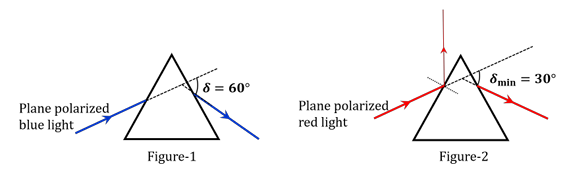
When a ray of a single, plane-polarised colour is incident on a glass surface and no part of it is reflected, the following two facts must hold simultaneously.
• The incident light has to be polarised in the plane of incidence (otherwise the perpendicular component would still be partially reflected).
• The angle of incidence must be the Brewster (polarising) angle, $$i_B$$, defined by $$\tan i_B = \mu$$, where $$\mu$$ is the refractive index of the second medium with respect to air.
For the given prism $$\mu_{\,\text{blue}} = \sqrt3$$, hence
$$i_B = \tan^{-1}\!\left( \sqrt3 \right) = 60^\circ.$$(1)
Because the incident ray is already plane-polarised and the incidence is at the polarising angle, exactly zero reflection is possible only when the electric field vector lies in the plane of incidence. Therefore, statement A is correct.
No other statement can be asserted solely from the Brewster condition, so options B, C and D cannot be concluded as correct on the basis of the given information.
Hence the only correct statement is:
Option A - The blue light is polarised in the plane of incidence.
Was this solution helpful?
Create a FREE account and get:
_1.webp)

Educational materials for JEE preparation

Ask our AI anything

AI can make mistakes. Please verify important information.
AI can make mistakes. Please verify important information.
