
Join Our JEE Preparation Group
Prep with like-minded aspirants; Get access to free daily tests and study material.
Sign in
Please select an account to continue using cracku.in
↓ →
Join Our JEE Preparation Group
Prep with like-minded aspirants; Get access to free daily tests and study material.
A slide with a frictionless curved surface, which becomes horizontal at its lower end, is fixed on the terrace of a building of height $$3h$$ from the ground, as shown in the figure. A spherical ball of mass m is released on the slide from rest at a height $$h$$ from the top of the terrace. The ball leaves the slide with a velocity $$\vec{u}_0 = u_0 \hat{x}$$ and falls on the ground at a distance $$d$$ from the building making an angle $$\theta$$ with the horizontal. It bounces off with a velocity $$\vec{v}$$ and reaches a maximum height $$h_1$$. The acceleration due to gravity is $$g$$ and the coefficient of restitution of the ground is $$1/\sqrt{3}$$. Which of the following statement(s) is(are) INCORRECT?
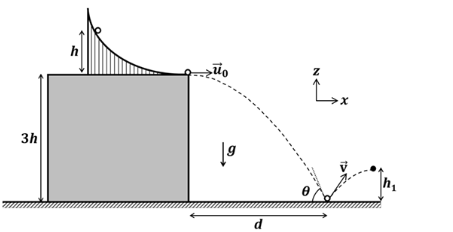
Given: $$\text{Height of terrace} = 3h$$, $$e = \frac{1}{\sqrt{3}}$$
From conservation of energy on the slide:
$$mgh = \frac{1}{2}mu_0^2 \implies u_0 = \sqrt{2gh} \implies \vec{u}_0 = \sqrt{2gh}\hat{x}$$
For the projectile motion before impact:
$$v_x = u_0 = \sqrt{2gh}$$
$$v_z^2 = 2g(3h) = 6gh \implies v_z = -\sqrt{6gh}$$
$$\tan\theta = \frac{\vert{}v_z\vert{}}{v_x} = \frac{\sqrt{6gh}}{\sqrt{2gh}} = \sqrt{3} \implies \theta = 60^\circ$$
After impact with the ground (elastic along $$\hat{x}$$, partially inelastic along $$\hat{z}$$):
$$v'_x = v_x = \sqrt{2gh}$$
$$v'_z = e\vert{}v_z\vert{} = \frac{1}{\sqrt{3}}\sqrt{6gh} = \sqrt{2gh}$$
$$\vec{v} = \sqrt{2gh}\hat{x} + \sqrt{2gh}\hat{z} = \sqrt{2gh}(\hat{x} + \hat{z})$$
Finding maximum height $$h_1$$ and distance $$d$$:
$$h_1 = \frac{(v'_z)^2}{2g} = \frac{2gh}{2g} = h$$
$$d = u_0 \cdot t_{\text{fall}} = \sqrt{2gh} \cdot \sqrt{\frac{2(3h)}{g}} = \sqrt{2gh} \cdot \sqrt{\frac{6h}{g}} = \sqrt{12}h = 2\sqrt{3}h$$
$$\frac{d}{h_1} = \frac{2\sqrt{3}h}{h} = 2\sqrt{3}$$
Was this solution helpful?

Click on the Email ☝️ to Watch the Video Solution
Create a FREE account and get:
_1.webp)

Educational materials for JEE preparation

Ask our AI anything

AI can make mistakes. Please verify important information.
AI can make mistakes. Please verify important information.
