Let $$S = (0, 1) \cup (1, 2) \cup (3, 4)$$ and $$T = \{0, 1, 2, 3\}$$. Then which of the following statements is(are) true?
Sign in
Please select an account to continue using cracku.in
↓ →
Join Our JEE Preparation Group
Prep with like-minded aspirants; Get access to free daily tests and study material.
Let $$S = (0, 1) \cup (1, 2) \cup (3, 4)$$ and $$T = \{0, 1, 2, 3\}$$. Then which of the following statements is(are) true?
Login to view the detailed solution.
Let $$T_1$$ and $$T_2$$ be two distinct common tangents to the ellipse $$E: \frac{x^2}{6} + \frac{y^2}{3} = 1$$ and the parabola $$P: y^2 = 12x$$. Suppose that the tangent $$T_1$$ touches P and E at the points $$A_1$$ and $$A_2$$, respectively and the tangent $$T_2$$ touches P and E at the points $$A_4$$ and $$A_3$$, respectively. Then which of the following statements is(are) true?
Loading solution...
Let $$f : [0, 1] \to [0, 1]$$ be the function defined by $$f(x) = \frac{x^3}{3} - x^2 + \frac{5}{9}x + \frac{17}{36}$$. Consider the square region $$S = [0, 1] \times [0, 1]$$. Let $$G = \{(x, y) \in S : y > f(x)\}$$ be called the green region and $$R = \{(x, y) \in S : y < f(x)\}$$ be called the red region. Let $$L_h = \{(x, h) \in S : x \in [0, 1]\}$$ be the horizontal line drawn at a height $$h \in [0, 1]$$. Then which of the following statements is(are) true?
Loading solution...
Let $$f : (0, 1) \to \mathbb{R}$$ be the functions defined as $$f(x) = \sqrt{n}$$ if $$x \in \left[\frac{1}{n+1}, \frac{1}{n}\right)$$ where $$n \in \mathbb{N}$$. Let $$g : (0, 1) \to \mathbb{R}$$ be a function such that $$\int_{x^2}^{x} \sqrt{\frac{1-t}{t}} \, dt < g(x) < 2\sqrt{x}$$ for all $$x \in (0, 1)$$. Then $$\lim_{x \to 0} f(x)g(x)$$
Loading solution...
Let Q be the cube with the set of vertices $$\{(x_1, x_2, x_3) \in \mathbb{R}^3 : x_1, x_2, x_3 \in \{0, 1\}\}$$. Let F be the set of all twelve lines containing the diagonals of the six faces of the cube Q. Let S be the set of all four lines containing the main diagonals of the cube Q; for instance, the line passing through the vertices (0, 0, 0) and (1, 1, 1) is in S. For lines $$\ell_1$$ and $$\ell_2$$, let $$d(\ell_1, \ell_2)$$ denote the shortest distance between them. Then the maximum value of $$d(\ell_1, \ell_2)$$, as $$\ell_1$$ varies over F and $$\ell_2$$ varies over S, is
Loading solution...
Let $$X = \left\{(x, y) \in \mathbb{Z} \times \mathbb{Z} : \frac{x^2}{8} + \frac{y^2}{20} < 1 \text{ and } y^2 < 5x\right\}$$. Three distinct points P, Q and R are randomly chosen from X. Then the probability that P, Q and R form a triangle whose area is a positive integer, is
Loading solution...
Let P be a point on the parabola $$y^2 = 4ax$$, where $$a > 0$$. The normal to the parabola at P meets the x-axis at a point Q. The area of the triangle PFQ, where F is the focus of the parabola, is 120. If the slope m of the normal and a are both positive integers, then the pair (a, m) is
Loading solution...
Let $$\tan^{-1}(x) \in \left(-\frac{\pi}{2}, \frac{\pi}{2}\right)$$, for $$x \in \mathbb{R}$$. Then the number of real solutions of the equation $$\sqrt{1 + \cos(2x)} = \sqrt{2} \tan^{-1}(\tan x)$$ in the set $$\left(-\frac{3\pi}{2}, \frac{\pi}{2}\right) \cup \left(-\frac{\pi}{2}, \frac{\pi}{2}\right) \cup \left(\frac{\pi}{2}, \frac{3\pi}{2}\right)$$ is equal to
Loading solution...
Let $$n \geq 2$$ be a natural number and $$f : [0, 1] \to \mathbb{R}$$ be the function defined by
$$f(x) = \begin{cases} n(1 - 2nx) & \text{if } 0 \leq x \leq \frac{1}{2n} \\ 2n(2nx - 1) & \text{if } \frac{1}{2n} \leq x \leq \frac{3}{4n} \\ 4n(1 - nx) & \text{if } \frac{3}{4n} \leq x \leq \frac{1}{n} \\ \frac{n}{n-1}(nx - 1) & \text{if } \frac{1}{n} \leq x \leq 1 \end{cases}$$
If n is such that the area of the region bounded by the curves $$x = 0$$, $$x = 1$$, $$y = 0$$ and $$y = f(x)$$ is 4, then the maximum value of the function f is
Loading solution...
Let $$\overset{r}{75...57}$$ denote the $$(r + 2)$$ digit number where the first and the last digits are 7 and the remaining r digits are 5. Consider the sum $$S = 77 + 757 + 7557 + \cdots + \overset{98}{75...57}$$. If $$S = \frac{\overset{99}{75...57} + m}{n}$$, where m and n are natural numbers less than 3000, then the value of $$m + n$$ is
Loading solution...
Let $$A = \left\{\frac{1967 + 1686i\sin\theta}{7 - 3i\cos\theta} : \theta \in \mathbb{R}\right\}$$. If A contains exactly one positive integer n, then the value of n is
Loading solution...
Let P be the plane $$\sqrt{3}x + 2y + 3z = 16$$ and let $$S = \left\{\alpha\hat{i} + \beta\hat{j} + \gamma\hat{k} : \alpha^2 + \beta^2 + \gamma^2 = 1 \text{ and the distance of } (\alpha, \beta, \gamma) \text{ from the plane P is } \frac{7}{2}\right\}$$. Let $$\vec{u}$$, $$\vec{v}$$ and $$\vec{w}$$ be three distinct vectors in S such that $$|\vec{u} - \vec{v}| = |\vec{v} - \vec{w}| = |\vec{w} - \vec{u}|$$. Let V be the volume of the parallelepiped determined by vectors $$\vec{u}$$, $$\vec{v}$$ and $$\vec{w}$$. Then the value of $$\frac{80}{\sqrt{3}}V$$ is
Loading solution...
Let a and b be two nonzero real numbers. If the coefficient of $$x^5$$ in the expansion of $$\left(ax^2 + \frac{70}{27bx}\right)^4$$ is equal to the coefficient of $$x^{-5}$$ in the expansion of $$\left(ax - \frac{1}{bx^2}\right)^7$$, then the value of $$2b$$ is
Loading solution...
Let $$\alpha$$, $$\beta$$ and $$\gamma$$ be real numbers. Consider the following system of linear equations
$$x + 2y + z = 7$$
$$x + \alpha z = 11$$
$$2x - 3y + \beta z = \gamma$$
Match each entry in List-I to the correct entries in List-II.
| List-I | List-II | ||
|---|---|---|---|
| (P) | If $$\beta = \frac{1}{2}(7\alpha - 3)$$ and $$\gamma = 28$$, then the system has | (1) | a unique solution |
| (Q) | If $$\beta = \frac{1}{2}(7\alpha - 3)$$ and $$\gamma \neq 28$$, then the system has | (2) | no solution |
| (R) | If $$\beta \neq \frac{1}{2}(7\alpha - 3)$$ where $$\alpha = 1$$ and $$\gamma \neq 28$$, then the system has | (3) | infinitely many solutions |
| (S) | If $$\beta \neq \frac{1}{2}(7\alpha - 3)$$ where $$\alpha = 1$$ and $$\gamma = 28$$, then the system has | (4) | $$x = 11, y = -2$$ and $$z = 0$$ as a solution |
| (5) | $$x = -15, y = 4$$ and $$z = 0$$ as a solution | ||
Loading solution...
Consider the given data with frequency distribution
| $$x_i$$ | 3 | 8 | 11 | 10 | 5 | 4 |
| $$f_i$$ | 5 | 2 | 3 | 2 | 4 | 4 |
Match each entry in List-I to the correct entries in List-II.
| List-I | List-II | ||
|---|---|---|---|
| (P) | The mean of the above data is | (1) | 2.5 |
| (Q) | The median of the above data is | (2) | 5 |
| (R) | The mean deviation about the mean of the above data is | (3) | 6 |
| (S) | The mean deviation about the median of the above data is | (4) | 2.7 |
| (5) | 2.4 | ||
The correct option is:
Loading solution...
Let $$\ell_1$$ and $$\ell_2$$ be the lines $$\vec{r}_1 = \lambda(\hat{i} + \hat{j} + \hat{k})$$ and $$\vec{r}_2 = (\hat{j} - \hat{k}) + \mu(\hat{i} + \hat{k})$$, respectively. Let X be the set of all the planes H that contain the line $$\ell_1$$. For a plane H, let d(H) denote the smallest possible distance between the points of $$\ell_2$$ and H. Let $$H_0$$ be the plane in X for which d($$H_0$$) is the maximum value of d(H) as H varies over all planes in X.
Match each entry in List-I to the correct entries in List-II.
| List-I | List-II | ||
|---|---|---|---|
| (P) | The value of d($$H_0$$) is | (1) | $$\sqrt{3}$$ |
| (Q) | The distance of the point (0, 1, 2) from $$H_0$$ is | (2) | $$\frac{1}{\sqrt{3}}$$ |
| (R) | The distance of origin from $$H_0$$ is | (3) | 0 |
| (S) | The distance of origin from the point of intersection of planes $$y = z$$, $$x = 1$$ and $$H_0$$ is | (4) | $$\sqrt{2}$$ |
| (5) | $$\frac{1}{\sqrt{2}}$$ | ||
The correct option is:
Loading solution...
Let z be complex number satisfying $$|z|^3 + 2z^2 + 4\bar{z} - 8 = 0$$, where $$\bar{z}$$ denotes the complex conjugate of z. Let the imaginary part of z be nonzero.
Match each entry in List-I to the correct entries in List-II.
| List-I | List-II | ||
|---|---|---|---|
| (P) | $$|z|^2$$ is equal to | (1) | 12 |
| (Q) | $$|z - \bar{z}|^2$$ is equal to | (2) | 4 |
| (R) | $$|z|^2 + |z + \bar{z}|^2$$ is equal to | (3) | 8 |
| (S) | $$|z + 1|^2$$ is equal to | (4) | 10 |
| (5) | 7 | ||
The correct option is:
Loading solution...
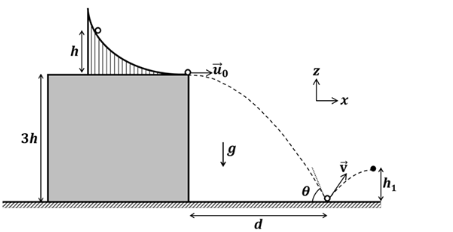
A slide with a frictionless curved surface, which becomes horizontal at its lower end, is fixed on the terrace of a building of height $$3h$$ from the ground, as shown in the figure. A spherical ball of mass m is released on the slide from rest at a height $$h$$ from the top of the terrace. The ball leaves the slide with a velocity $$\vec{u}_0 = u_0 \hat{x}$$ and falls on the ground at a distance $$d$$ from the building making an angle $$\theta$$ with the horizontal. It bounces off with a velocity $$\vec{v}$$ and reaches a maximum height $$h_1$$. The acceleration due to gravity is $$g$$ and the coefficient of restitution of the ground is $$1/\sqrt{3}$$. Which of the following statement(s) is(are) INCORRECT?

Loading solution...
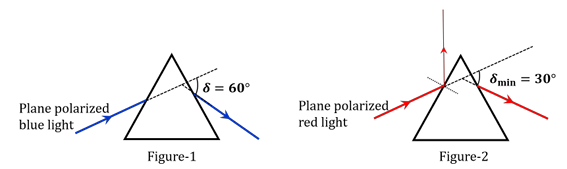
A plane polarized blue light ray is incident on a prism such that there is no reflection from the surface of the prism. The angle of deviation of the emergent ray is $$\delta = 60^\circ$$ (see Figure-1). The angle of minimum deviation for red light from the same prism is $$\delta_{min} = 30^\circ$$ (see Figure-2). The refractive index of the prism material for blue light is $$\sqrt{3}$$. Which of the following statement(s) is(are) correct?

Loading solution...
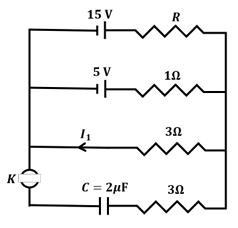
In a circuit shown in the figure, the capacitor $$C$$ is initially uncharged and the key $$K$$ is open. In this condition, a current of 1 A flows through the 1 $$\Omega$$ resistor. The key is closed at time $$t = t_0$$. Which of the following statement(s) is(are) correct?
[Given: $$e^{-1} = 0.36$$]

Loading solution...
A bar of mass $$M = 1.00$$ kg and length $$L = 0.20$$ m is lying on a horizontal frictionless surface. One end of the bar is pivoted at a point about which it is free to rotate. A small mass $$m = 0.10$$ kg is moving on the same horizontal surface with 5.00 m s$$^{-1}$$ speed on a path perpendicular to the bar. It hits the bar at a distance $$L/2$$ from the pivoted end and returns back on the same path with speed v. After this elastic collision, the bar rotates with an angular velocity $$\omega$$. Which of the following statement is correct?
Loading solution...
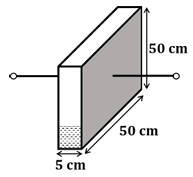
A container has a base of 50 cm $$\times$$ 5 cm and height 50 cm, as shown in the figure. It has two parallel electrically conducting walls each of area 50 cm $$\times$$ 50 cm. The remaining walls of the container are thin and non-conducting. The container is being filled with a liquid of dielectric constant 3 at a uniform rate of 250 cm$$^3$$ s$$^{-1}$$. What is the value of the capacitance of the container after 10 seconds?
[Given: Permittivity of free space $$\epsilon_0 = 9 \times 10^{-12}$$ C$$^2$$ N$$^{-1}$$m$$^{-2}$$, the effects of the non-conducting walls on the capacitance are negligible]

Loading solution...
One mole of an ideal gas expands adiabatically from an initial state $$(T_A, V_0)$$ to final state $$(T_f, 5V_0)$$. Another mole of the same gas expands isothermally from a different initial state $$(T_B, V_0)$$ to the same final state $$(T_f, 5V_0)$$. The ratio of the specific heats at constant pressure and constant volume of this ideal gas is $$\gamma$$. What is the ratio $$T_A/T_B$$?
Loading solution...
Two satellites P and Q are moving in different circular orbits around the Earth (radius $$R$$). The heights of P and Q from the Earth surface are $$h_P$$ and $$h_Q$$, respectively, where $$h_P = R/3$$. The accelerations of P and Q due to Earth's gravity are $$g_P$$ and $$g_Q$$, respectively. If $$g_P/g_Q = 36/25$$, what is the value of $$h_Q$$?
Loading solution...
A Hydrogen-like atom has atomic number $$Z$$. Photons emitted in the electronic transitions from level $$n = 4$$ to level $$n = 3$$ in these atoms are used to perform photoelectric effect experiment on a target metal. The maximum kinetic energy of the photoelectrons generated is 1.95 eV. If the photoelectric threshold wavelength for the target metal is 310 nm, the value of $$Z$$ is ______.
[Given: $$hc = 1240$$ eV-nm and $$Rhc = 13.6$$ eV, where $$R$$ is the Rydberg constant, $$h$$ is the Planck's constant and $$c$$ is the speed of light in vacuum]
Loading solution...
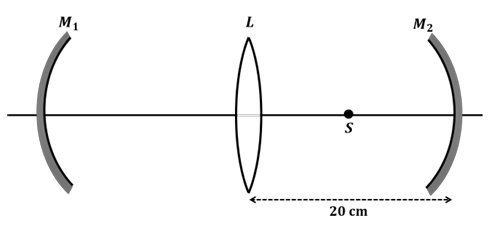
An optical arrangement consists of two concave mirrors M$$_1$$ and M$$_2$$, and a convex lens L with a common principal axis, as shown in the figure. The focal length of L is 10 cm. The radii of curvature of M$$_1$$ and M$$_2$$ are 20 cm and 24 cm, respectively. The distance between L and M$$_2$$ is 20 cm. A point object S is placed at the mid-point between L and M$$_2$$ on the axis. When the distance between L and M$$_1$$ is $$n/7$$ cm, one of the images coincides with S. The value of $$n$$ is ______.

Loading solution...
In an experiment for determination of the focal length of a thin convex lens, the distance of the object from the lens is $$10 \pm 0.1$$ cm and the distance of its real image from the lens is $$20 \pm 0.2$$ cm. The error in the determination of focal length of the lens is $$n$$ %. The value of $$n$$ is ______.
Loading solution...
A closed container contains a homogeneous mixture of two moles of an ideal monatomic gas ($$\gamma = 5/3$$) and one mole of an ideal diatomic gas ($$\gamma = 7/5$$). Here, $$\gamma$$ is the ratio of the specific heats at constant pressure and constant volume of an ideal gas. The gas mixture does a work of 66 Joule when heated at constant pressure. The change in its internal energy is ______ Joule.
Loading solution...
A person of height 1.6 m is walking away from a lamp post of height 4 m along a straight path on the flat ground. The lamp post and the person are always perpendicular to the ground. If the speed of the person is 60 cm s$$^{-1}$$, the speed of the tip of the person's shadow on the ground with respect to the person is ______ cm s$$^{-1}$$.
Loading solution...
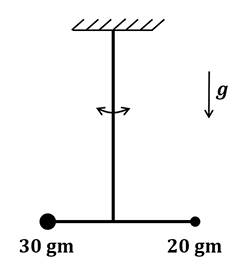
Two point-like objects of masses 20 gm and 30 gm are fixed at the two ends of a rigid massless rod of length 10 cm. This system is suspended vertically from a rigid ceiling using a thin wire attached to its center of mass, as shown in the figure. The resulting torsional pendulum undergoes small oscillations. The torsional constant of the wire is $$1.2 \times 10^{-8}$$ N m rad$$^{-1}$$. The angular frequency of the oscillations in $$n \times 10^{-3}$$ rad s$$^{-1}$$. The value of $$n$$ is ______.

Loading solution...
List-I shows different radioactive decay processes and List-II provides possible emitted particles. Match each entry in List-I with an appropriate entry from List-II, and choose the correct option.
| List-I | List-II | ||
|---|---|---|---|
| (P) | $${}^{238}_{92}U \to {}^{234}_{91}Pa$$ | (1) | one $$\alpha$$ particle and one $$\beta^+$$ particle |
| (Q) | $${}^{214}_{82}Pb \to {}^{210}_{82}Pb$$ | (2) | three $$\beta^-$$ particles and one $$\alpha$$ particle |
| (R) | $${}^{210}_{81}Tl \to {}^{206}_{82}Pb$$ | (3) | two $$\beta^-$$ particles and one $$\alpha$$ particle |
| (S) | $${}^{228}_{91}Pa \to {}^{224}_{88}Ra$$ | (4) | one $$\alpha$$ particle and one $$\beta^-$$ particle |
| (5) | one $$\alpha$$ particle and two $$\beta^+$$ particles | ||
Loading solution...
Match the temperature of a black body given in List-I with an appropriate statement in List-II, and choose the correct option.
[Given: Wien's constant as $$2.9 \times 10^{-3}$$ m-K and $$\frac{hc}{e} = 1.24 \times 10^{-6}$$ V-m]
| List-I | List-II | ||
|---|---|---|---|
| (P) | 2000 K | (1) | The radiation at peak wavelength can lead to emission of photoelectrons from a metal of work function 4 eV |
| (Q) | 3000 K | (2) | The radiation at peak wavelength is visible to human eye. |
| (R) | 5000 K | (3) | The radiation at peak emission wavelength will result in the widest central maximum of a single slit diffraction. |
| (S) | 10000 K | (4) | The power emitted per unit area is 1/16 of that emitted by a blackbody at temperature 6000 K. |
| (5) | The radiation at peak emission wavelength can be used to image human bones. | ||
Loading solution...
A series LCR circuit is connected to a 45 sin($$\omega t$$) Volt source. The resonant angular frequency of the circuit is $$10^5$$ rad s$$^{-1}$$ and current amplitude at resonance is $$I_0$$. When the angular frequency of the source is $$\omega = 8 \times 10^4$$ rad s$$^{-1}$$, the current amplitude in the circuit is 0.05 $$I_0$$. If $$L = 50$$ mH, match each entry in List-I with an appropriate value from List-II and choose the correct option.
| List-I | List-II | ||
|---|---|---|---|
| (P) | $$I_0$$ in mA | (1) | 44.4 |
| (Q) | The quality factor of the circuit | (2) | 18 |
| (R) | The bandwidth of the circuit in rad s$$^{-1}$$ | (3) | 400 |
| (S) | The peak power dissipated at resonance in Watt | (4) | 2250 |
| (5) | 500 | ||
Loading solution...
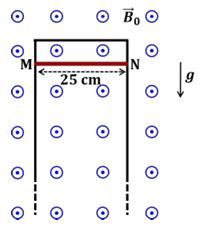
A thin conducting rod MN of mass 20 gm, length 25 cm and resistance 10 $$\Omega$$ is held on frictionless, perfectly conducting vertical rails as shown in the figure. There is a uniform magnetic field $$B_0 = 4$$ T directed perpendicular to the plane of the rod-rail arrangement. The rod is released from rest at time t = 0 and it moves down along the rails. Assume air drag is negligible. Match each quantity in List-I with an appropriate value from List-II, and choose the correct option.
[Given: The acceleration due to gravity $$g = 10$$ ms$$^{-2}$$ and $$e^{-1} = 0.4$$]
| List-I | List-II | ||
|---|---|---|---|
| (P) | At $$t = 0.2$$ s, the magnitude of the induced emf in Volt | (1) | 0.07 |
| (Q) | At $$t = 0.2$$ s, the magnitude of the magnetic force in Newton | (2) | 0.14 |
| (R) | At $$t = 0.2$$ s, the power dissipated as heat in Watt | (3) | 1.20 |
| (S) | The magnitude of terminal velocity of the rod in m s$$^{-1}$$ | (4) | 0.12 |
| (5) | 2.00 | ||
Loading solution...
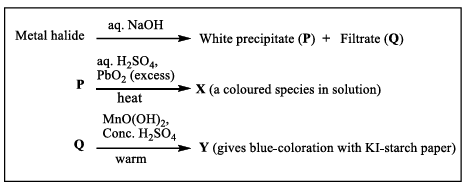
The correct statement(s) related to processes involved in the extraction of metals is(are)
Loading solution...
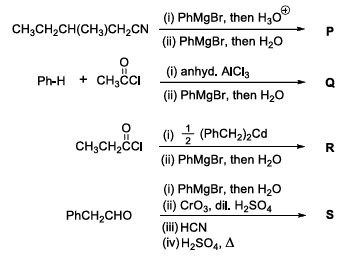
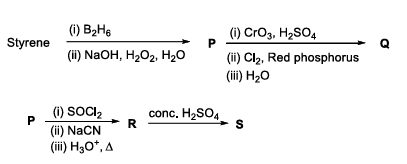
In the following reactions, P, Q, R, and S are the major products.
The correct statement(s) about P, Q, R, and S is(are)
Loading solution...
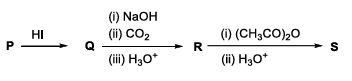
Consider the following reaction scheme and choose the correct option(s) for the major products Q, R and S.

Loading solution...
In the scheme given below, X and Y, respectively, are

Loading solution...
Plotting $$1/\Lambda_m$$ against $$c\Lambda_m$$ for aqueous solutions of a monobasic weak acid (HX) resulted in a straight line with y-axis intercept of P and slope of S. The ratio P/S is
[$$\Lambda_m$$ = molar conductivity, $$\Lambda_m^\circ$$ = limiting molar conductivity, c = molar concentration, $$K_a$$ = dissociation constant of HX]
Loading solution...
On decreasing the pH from 7 to 2, the solubility of a sparingly soluble salt (MX) of a weak acid (HX) increased from $$10^{-4}$$ mol L$$^{-1}$$ to $$10^{-3}$$ mol L$$^{-1}$$. The pK$$_a$$ of HX is:
Loading solution...
In the given reaction scheme, P is a phenyl alkyl ether, Q is an aromatic compound; R and S are the major products.
The correct statement about S is
Loading solution...
The stoichiometric reaction of 516 g of dimethyldichlorosilane with water results in a tetrameric cyclic product X in 75% yield. The weight (in g) of X obtained is ____.
[Use, molar mass (g mol$$^{-1}$$): H = 1, C = 12, O = 16, Si = 28, Cl = 35.5]
Loading solution...
A gas has a compressibility factor of 0.5 and a molar volume of 0.4 dm$$^3$$ mol$$^{-1}$$ at a temperature of 800 K and pressure x atm. If it shows ideal gas behaviour at the same temperature and pressure, the molar volume will be y dm$$^3$$ mol$$^{-1}$$. The value of x/y is ____.
[Use: Gas constant, R = $$8 \times 10^{-2}$$ L atm K$$^{-1}$$ mol$$^{-1}$$]
Loading solution...
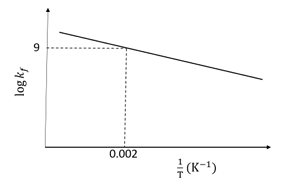
The plot of log $$k_f$$ versus $$1/T$$ for a reversible reaction A(g) $$\rightleftharpoons$$ P(g) is shown.
Pre-exponential factors for the forward and backward reactions are $$10^{15}$$ s$$^{-1}$$ and $$10^{11}$$ s$$^{-1}$$, respectively. If the value of log K for the reaction at 500 K is 6, the value of $$|\log k_b|$$ at 250 K is ______.
[K = equilibrium constant of the reaction,
$$k_f$$ = rate constant of forward reaction,
$$k_b$$ = rate constant of backward reaction]
Loading solution...
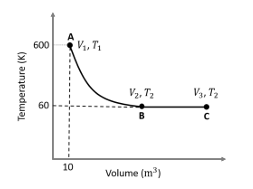
One mole of an ideal monoatomic gas undergoes two reversible processes (A $$\to$$ B and B $$\to$$ C) as shown in the given figure:
A $$\to$$ B is an adiabatic process. If the total heat absorbed in the entire process (A $$\to$$ B and B $$\to$$ C) is $$RT_2 \ln 10$$, the value of $$2 \log V_3$$ is ________.
[Use, molar heat capacity of the gas at constant pressure, $$C_{p,m} = \frac{5}{2}R$$]
Loading solution...
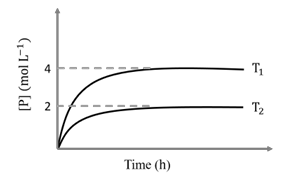
In a one-litre flask, 6 moles of A undergoes the reaction A(g) $$\rightleftharpoons$$ P(g). The progress of product formation at two temperatures (in Kelvin), $$T_1$$ and $$T_2$$, is shown in the figure:

If $$T_1 = 2T_2$$ and $$(\Delta G_2^\circ - \Delta G_1^\circ) = RT_2 \ln x$$, then the value of x is ______.
[$$\Delta G_1^\circ$$ and $$\Delta G_2^\circ$$ are standard Gibb's free energy change for the reaction at temperatures $$T_1$$ and $$T_2$$, respectively.]
Loading solution...
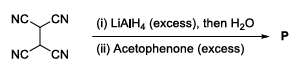
The total number of sp$$^2$$ hybridised carbon atoms in the major product P (a non-heterocyclic compound) of the following reaction is ______.

Loading solution...
Match the reactions (in the given stoichiometry of the reactants) in List-I with one of their products given in List-II and choose the correct option.
| List-I | List-II | ||
|---|---|---|---|
| (P) | $$P_2O_3 + 3H_2O \to$$ | (1) | $$P(O)(OCH_3)Cl_2$$ |
| (Q) | $$P_4 + 3NaOH + 3H_2O \to$$ | (2) | $$H_3PO_3$$ |
| (R) | $$PCl_5 + CH_3COOH \to$$ | (3) | $$PH_3$$ |
| (S) | $$H_3PO_2 + 2H_2O + 4AgNO_3 \to$$ | (4) | $$POCl_3$$ |
| (5) | $$H_3PO_4$$ | ||
Loading solution...
Match the electronic configurations in List-I with appropriate metal complex ions in List-II and choose the correct option.
[Atomic Number: Fe = 26, Mn = 25, Co = 27]
| List-I | List-II | ||
|---|---|---|---|
| (P) | $$t_{2g}^6 e_g^0$$ | (1) | $$[Fe(H_2O)_6]^{2+}$$ |
| (Q) | $$t_{2g}^3 e_g^2$$ | (2) | $$[Mn(H_2O)_6]^{2+}$$ |
| (R) | $$e^2 t_2^3$$ | (3) | $$[Co(NH_3)_6]^{3+}$$ |
| (S) | $$t_{2g}^4 e_g^2$$ | (4) | $$[FeCl_4]^{-}$$ |
| (5) | $$[CoCl_4]^{2-}$$ | ||
Loading solution...
Match the reactions in List-I with the features of their products in List-II and choose the correct option.
| List-I | List-II | ||
|---|---|---|---|
| (P) | (-)-1-Bromo-2-ethylpentane (single enantiomer) $$\xrightarrow[S_N2 \text{ reaction}]{\text{aq. NaOH}}$$ | (1) | Inversion of configuration |
| (Q) | (-)-2-Bromopentane (single enantiomer) $$\xrightarrow[S_N2 \text{ reaction}]{\text{aq. NaOH}}$$ | (2) | Retention of configuration |
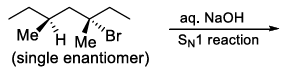
| (R) | (-)-3-Bromo-3-methylhexane (single enantiomer) $$\xrightarrow[S_N1 \text{ reaction}]{\text{aq. NaOH}}$$ | (3) | Mixture of enantiomers |
| (S) | ![]() | (4) | Mixture of structural isomers |
| (5) | Mixture of diastereomers | ||
Loading solution...
The major products obtained from the reactions in List-II are the reactants for the named reactions mentioned in List-I. Match List-I with List-II and choose the correct option.
| List-I | List-II | ||
|---|---|---|---|
| (P) | Etard reaction | (1) | Acetophenone $$\xrightarrow{Zn-Hg, HCl}$$ |
| (Q) | Gattermann reaction | (2) | Toluene $$\xrightarrow[\text{(ii) } SOCl_2]{\text{(i) } KMnO_4, KOH, \Delta}$$ |
| (R) | Gattermann-Koch reaction | (3) | ![]() |
| (S) | Rosenmund reduction | (4) | ![]() |
| (5) | Phenol $$\xrightarrow{Zn, \Delta}$$ | ||
Loading solution...
Educational materials for JEE preparation