
Join Our JEE Preparation Group
Prep with like-minded aspirants; Get access to free daily tests and study material.
Sign in
Please select an account to continue using cracku.in
↓ →
Join Our JEE Preparation Group
Prep with like-minded aspirants; Get access to free daily tests and study material.
In an experiment for determination of the focal length of a thin convex lens, the distance of the object from the lens is $$10 \pm 0.1$$ cm and the distance of its real image from the lens is $$20 \pm 0.2$$ cm. The error in the determination of focal length of the lens is $$n$$ %. The value of $$n$$ is ______.
Correct Answer: 1
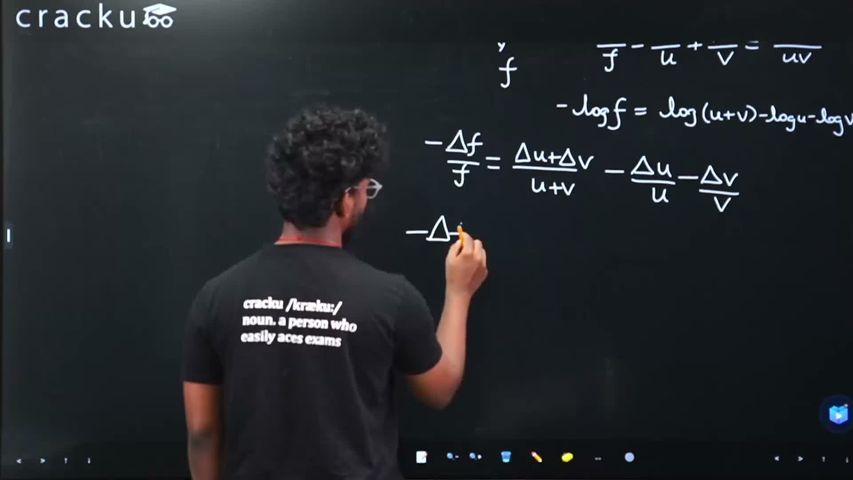
The focal length obtained from the measured object-distance $$u$$ and image-distance $$v$$ is found with the thin-lens formula
$$\frac{1}{f}= \frac{1}{u}+\frac{1}{v}\qquad\Longrightarrow\qquad f=\frac{uv}{u+v}\,.$$
The measured values and their maximum absolute errors are
$$u = 10\;\text{cm},\; \Delta u = \pm 0.1\;\text{cm}$$
$$v = 20\;\text{cm},\; \Delta v = \pm 0.2\;\text{cm}$$
To find the error in $$f$$, use logarithmic differentiation (propagation of errors).
Taking natural logarithm of $$f = \dfrac{uv}{u+v}$$:
$$\ln f = \ln u + \ln v - \ln(u+v)$$
Differentiating:
$$\frac{\Delta f}{f}= \frac{\Delta u}{u}+\frac{\Delta v}{v}-\frac{\Delta u+\Delta v}{u+v} \quad -(1)$$
Because $$\Delta u$$ and $$\Delta v$$ may be positive or negative, we are interested in the maximum possible fractional error. Equation $$(1)$$ can be rewritten as
$$\frac{\Delta f}{f}= \Delta u\!\left(\frac{1}{u}-\frac{1}{u+v}\right)+\Delta v\!\left(\frac{1}{v}-\frac{1}{u+v}\right).$$
Calculate the two coefficients once for the given $$u$$ and $$v$$:
$$\frac{1}{u}-\frac{1}{u+v}= \frac{1}{10}-\frac{1}{30}= \frac{2}{30}= \frac{1}{15}=0.0667,$$
$$\frac{1}{v}-\frac{1}{u+v}= \frac{1}{20}-\frac{1}{30}= \frac{1}{60}=0.0167.$$
Hence
$$\frac{\Delta f}{f}= 0.0667\,\Delta u + 0.0167\,\Delta v \quad -(2)$$
The numerical coefficients are positive, so the maximum fractional error occurs when both $$\Delta u$$ and $$\Delta v$$ take their maximum positive values (+0.1 cm and +0.2 cm):
$$\left|\frac{\Delta f}{f}\right|_{\text{max}} = 0.0667(0.1) + 0.0167(0.2) = 0.00667 + 0.00333 = 0.0100.$$
Thus the maximum percentage error in the focal length is
$$n = 0.0100 \times 100 = 1\%.$$
Therefore, the error in the determination of the focal length of the lens is 1 %.
Click on the Email ☝️ to Watch the Video Solution
Create a FREE account and get:
_1.webp)

Educational materials for JEE preparation

Ask our AI anything

AI can make mistakes. Please verify important information.
AI can make mistakes. Please verify important information.


