
Join Our JEE Preparation Group
Prep with like-minded aspirants; Get access to free daily tests and study material.
Sign in
Please select an account to continue using cracku.in
↓ →
Join Our JEE Preparation Group
Prep with like-minded aspirants; Get access to free daily tests and study material.
A container has a base of 50 cm $$\times$$ 5 cm and height 50 cm, as shown in the figure. It has two parallel electrically conducting walls each of area 50 cm $$\times$$ 50 cm. The remaining walls of the container are thin and non-conducting. The container is being filled with a liquid of dielectric constant 3 at a uniform rate of 250 cm$$^3$$ s$$^{-1}$$. What is the value of the capacitance of the container after 10 seconds?
[Given: Permittivity of free space $$\epsilon_0 = 9 \times 10^{-12}$$ C$$^2$$ N$$^{-1}$$m$$^{-2}$$, the effects of the non-conducting walls on the capacitance are negligible]
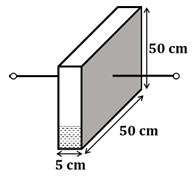
The two conducting walls act as parallel-plate capacitor plates.
Plate area: $$A = 50\ \text{cm} \times 50\ \text{cm} = 0.50\ \text{m} \times 0.50\ \text{m} = 0.25\ \text{m}^2$$
Plate separation (distance between the conducting walls): $$d = 5\ \text{cm} = 0.05\ \text{m}$$
The container is filled at a uniform rate of $$250\ \text{cm}^3\ \text{s}^{-1}$$.
In $$10\ \text{s}$$ the liquid volume is
$$V = 250 \times 10 = 2500\ \text{cm}^3 = 2.5 \times 10^{-3}\ \text{m}^3$$
Cross-sectional base area of the container (same as the overlap area of plates in the vertical cross-section):
$$A_{\text{base}} = 50\ \text{cm} \times 5\ \text{cm} = 0.50\ \text{m} \times 0.05\ \text{m} = 0.025\ \text{m}^2$$
Hence the height of the liquid column after 10 s is
$$h = \frac{V}{A_{\text{base}}} = \frac{2.5 \times 10^{-3}}{0.025} = 0.10\ \text{m} = 10\ \text{cm}$$
The plates therefore have two regions:
• Bottom region (height $$h = 0.10\ \text{m}$$) filled with liquid of dielectric constant $$k = 3$$.
• Top region (height $$50\ \text{cm} - 10\ \text{cm} = 40\ \text{cm} = 0.40\ \text{m}$$) filled with air (dielectric constant $$1$$).
Areas of these two regions on each plate:
Bottom (with dielectric): $$A_1 = 0.50\ \text{m} \times 0.10\ \text{m} = 0.05\ \text{m}^2$$
Top (with air): $$A_2 = 0.50\ \text{m} \times 0.40\ \text{m} = 0.20\ \text{m}^2$$
Since both regions experience the same potential difference, the two parts behave like capacitors in parallel. The equivalent capacitance is
$$C = \frac{\epsilon_0}{d}\,\bigl(k A_1 + A_2\bigr)$$
Substituting the values:
$$C = \frac{9 \times 10^{-12}}{0.05} \Bigl(3 \times 0.05 + 0.20\Bigr)$$
$$C = (9 \times 10^{-12} \times 20)\,(0.15 + 0.20)$$
$$C = 1.8 \times 10^{-10} \times 0.35 = 6.3 \times 10^{-11}\ \text{F}$$
Convert to picofarads: $$6.3 \times 10^{-11}\ \text{F} = 63\ \text{pF}$$
Therefore, the capacitance of the container after 10 s is
Option B which is: 63 pF
Was this solution helpful?
Create a FREE account and get:
_1.webp)

Educational materials for JEE preparation

Ask our AI anything

AI can make mistakes. Please verify important information.
AI can make mistakes. Please verify important information.
