
Join Our JEE Preparation Group
Prep with like-minded aspirants; Get access to free daily tests and study material.
Sign in
Please select an account to continue using cracku.in
↓ →
Join Our JEE Preparation Group
Prep with like-minded aspirants; Get access to free daily tests and study material.
A thin conducting rod MN of mass 20 gm, length 25 cm and resistance 10 $$\Omega$$ is held on frictionless, perfectly conducting vertical rails as shown in the figure. There is a uniform magnetic field $$B_0 = 4$$ T directed perpendicular to the plane of the rod-rail arrangement. The rod is released from rest at time t = 0 and it moves down along the rails. Assume air drag is negligible. Match each quantity in List-I with an appropriate value from List-II, and choose the correct option.
[Given: The acceleration due to gravity $$g = 10$$ ms$$^{-2}$$ and $$e^{-1} = 0.4$$]
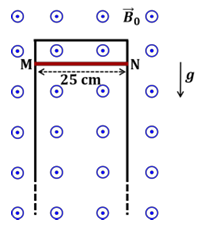
| List-I | List-II | ||
|---|---|---|---|
| (P) | At $$t = 0.2$$ s, the magnitude of the induced emf in Volt | (1) | 0.07 |
| (Q) | At $$t = 0.2$$ s, the magnitude of the magnetic force in Newton | (2) | 0.14 |
| (R) | At $$t = 0.2$$ s, the power dissipated as heat in Watt | (3) | 1.20 |
| (S) | The magnitude of terminal velocity of the rod in m s$$^{-1}$$ | (4) | 0.12 |
| (5) | 2.00 | ||
The rod of length $$l = 0.25\ \text{m}$$ slides vertically with speed $$v$$ in a uniform magnetic field $$B_0 = 4\ \text{T}$$ perpendicular to the plane of the rails. The rails are perfectly conducting, so the only resistance in the circuit is that of the rod, $$R = 10\ \Omega$$.
When a conductor of length $$l$$ moves with speed $$v$$ perpendicular to a field $$B$$, the motional emf is
$$\mathcal{E} = B l v$$.
The induced current is therefore
$$I = \frac{\mathcal{E}}{R} = \frac{B l v}{R}$$.
The magnetic force on the rod (direction upward, opposing its motion) is
$$F_B = B I l = B \left( \frac{B l v}{R} \right) l = \frac{B^2 l^2}{R}\,v$$.
Let $$m = 20\ \text{g} = 0.02\ \text{kg}$$. Applying Newton’s second law, downward positive:
$$m\,\frac{dv}{dt} = m g - \frac{B^2 l^2}{R}\,v \quad -(1)$$
Define the constant
$$k = \frac{B^2 l^2}{m R}.$$
With $$B^2 l^2 = 4^2 (0.25)^2 = 1.0,\; m R = 0.02 \times 10 = 0.2$$ we get
$$k = \frac{1.0}{0.2} = 5\ \text{s}^{-1}.$$
Equation $$-(1)$$ is a first-order linear ODE. With the initial condition $$v(0)=0$$ its solution is
$$v(t) = v_t\bigl(1 - e^{-k t}\bigr) \quad -(2)$$
where the terminal velocity $$v_t$$ is obtained from $$dv/dt=0$$ in $$-(1):$$
$$m g = \frac{B^2 l^2}{R}\,v_t \;\Longrightarrow\; v_t = \frac{m g R}{B^2 l^2}.$$
Substituting the numerical values:
$$v_t = \frac{0.02 \times 10 \times 10}{1.0} = 2.0\ \text{m s}^{-1}.$$
Thus List-II value 5 ($$2.00$$) matches item (S).
Now evaluate the quantities at $$t = 0.2\ \text{s}$$.
From $$-(2)$$:
$$v(0.2) = 2.0\bigl(1 - e^{-5 \times 0.2}\bigr) = 2.0\bigl(1 - e^{-1}\bigr).$$
Given $$e^{-1} = 0.4$$,
$$v(0.2) = 2.0(1 - 0.4) = 2.0 \times 0.6 = 1.2\ \text{m s}^{-1}.$$
Induced emf (List-I item P)
$$\mathcal{E}(0.2) = B l v = 4 \times 0.25 \times 1.2 = 1.20\ \text{V}.$$
This equals List-II value 3.
Magnetic force (List-I item Q)
Current $$I = \mathcal{E}/R = 1.20/10 = 0.12\ \text{A}.$$
$$F_B = B I l = 4 \times 0.12 \times 0.25 = 0.12\ \text{N}.$$
This equals List-II value 4.
Power dissipated as heat (List-I item R)
$$P_H = I^2 R = (0.12)^2 \times 10 = 0.0144 \times 10 = 0.144\ \text{W} \approx 0.14\ \text{W}.$$
This equals List-II value 2.
Collecting the matches:
P $$\to$$ 3, Q $$\to$$ 4, R $$\to$$ 2, S $$\to$$ 5.
Hence the correct option is
Option D: P $$\to$$ 3, Q $$\to$$ 4, R $$\to$$ 2, S $$\to$$ 5.
Was this solution helpful?
Create a FREE account and get:
_1.webp)

Educational materials for JEE preparation

Ask our AI anything

AI can make mistakes. Please verify important information.
AI can make mistakes. Please verify important information.
