
Join Our JEE Preparation Group
Prep with like-minded aspirants; Get access to free daily tests and study material.
Sign in
Please select an account to continue using cracku.in
↓ →
Join Our JEE Preparation Group
Prep with like-minded aspirants; Get access to free daily tests and study material.
The correct statement(s) related to processes involved in the extraction of metals is(are)
The question deals with the preliminary and refining steps used in winning metals from their ores. We check every statement against the standard principles used in metallurgy.
Case A:
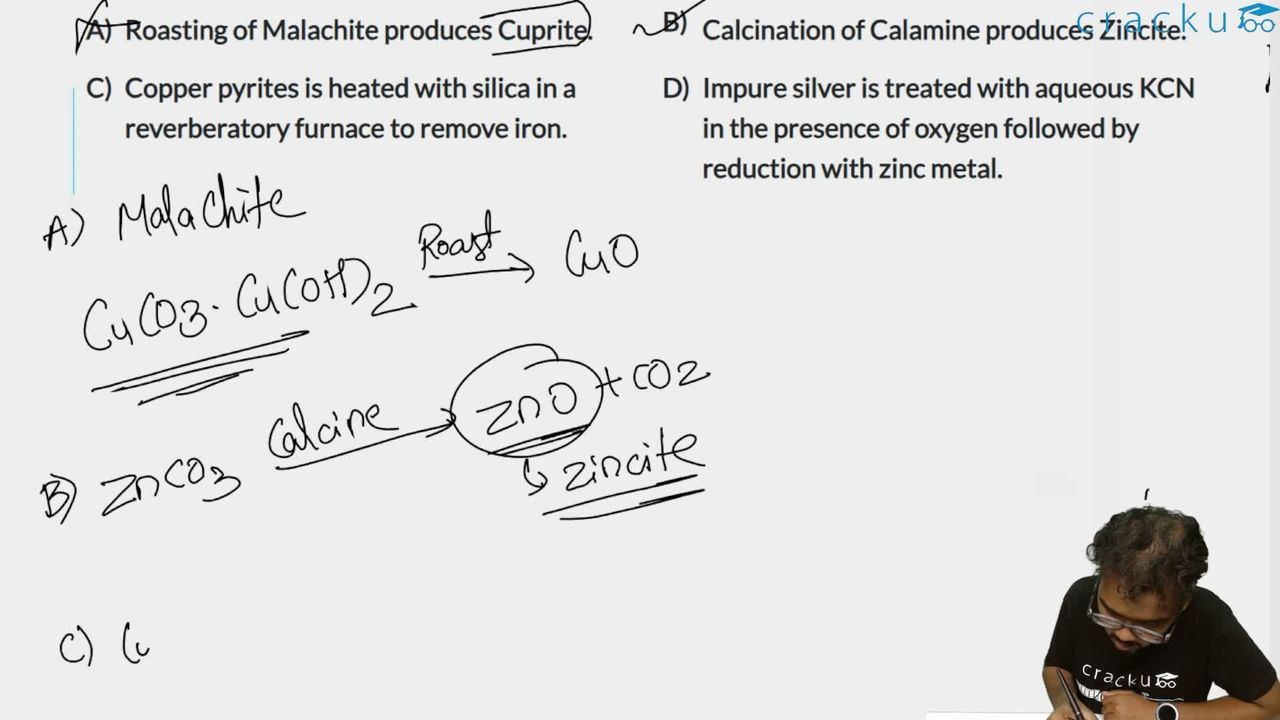
Malachite is $$CuCO_3\cdot Cu(OH)_2$$. On roasting (strong heating in excess air) it undergoes thermal decomposition:
$$CuCO_3\cdot Cu(OH)_2 \;\xrightarrow{\text{roast}}\; 2\,CuO + CO_2 + H_2O.$$
The oxide formed is cupric oxide $$CuO$$, not cuprous oxide $$Cu_2O$$ (cuprite). Hence statement A is incorrect.
Case B:
Calamine is $$ZnCO_3$$. Calcination means heating in the absence or limited supply of air so that volatile components leave:
$$ZnCO_3 \;\xrightarrow{\text{calcine}}\; ZnO + CO_2.$$
The oxide $$ZnO$$ obtained is called zincite. Therefore statement B is correct.
Case C:
Copper pyrites is $$CuFeS_2$$. During smelting, the ore is heated with silica (acidic flux) in a reverberatory furnace:
$$FeO + SiO_2 \;\rightarrow\; FeSiO_3\;(\text{slag}).$$
The iron present is thus removed as fusible ferrous silicate slag. Hence statement C is correct.
Case D:
Impure silver (or gold) can be purified by the cyanide process. The impure metal is treated with aerated aqueous potassium cyanide:
$$4\,Ag + 8\,KCN + O_2 + 2\,H_2O \;\rightarrow\; 4\,K[Ag(CN)_2] + 4\,KOH.$$
The complex $$[Ag(CN)_2]^-$$ is then reduced by adding zinc dust:
$$2\,K[Ag(CN)_2] + Zn \;\rightarrow\; K_2[Zn(CN)_4] + 2\,Ag\downarrow.$$
Thus pure silver is deposited, so statement D is correct.
Therefore the correct statements are:
Option B, Option C, and Option D.
Final Answer: Option A (incorrect), Option B (correct), Option C (correct), Option D (correct).
⟹ Option B, Option C, Option D are the right choices.
Was this solution helpful?
Click on the Email ☝️ to Watch the Video Solution
Create a FREE account and get:
_1.webp)

Educational materials for JEE preparation

Ask our AI anything

AI can make mistakes. Please verify important information.
AI can make mistakes. Please verify important information.
