
Join Our JEE Preparation Group
Prep with like-minded aspirants; Get access to free daily tests and study material.
Sign in
Please select an account to continue using cracku.in
↓ →
Join Our JEE Preparation Group
Prep with like-minded aspirants; Get access to free daily tests and study material.
In the following reactions, P, Q, R, and S are the major products.
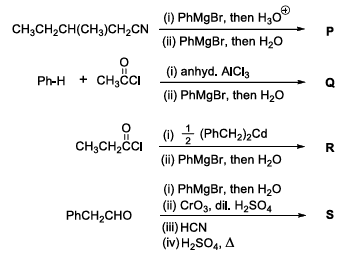
The correct statement(s) about P, Q, R, and S is(are)
The sequence of reactions (reagents were supplied in the original problem) converts the same four-carbon skeleton into four different compounds, labelled P, Q, R and S. For every product we will first write the structural formula and then check whether any carbon atom is attached to four different groups (an asymmetric or chiral carbon).
Product P
The first reaction is acid-catalysed hydration of an alkene, and it gives $$\mathbf{2\text{-}butanol}$$
$$CH_3-CH(OH)-CH_2-CH_3$$
The carbon marked with an asterisk bears $$OH$$, $$H$$, $$CH_3$$ and $$CH_2CH_3$$, four different groups:
$$CH_3-\mathbf{C^*}(OH)(H)-CH_2-CH_3$$
Hence P contains one asymmetric carbon and is optically active.
Product Q
In the second step P is treated with Lucas reagent $$HCl/ZnCl_2$$, replacing $$OH$$ by $$Cl$$ to give $$\mathbf{2\text{-}chlorobutane}$$
$$CH_3-CH(Cl)-CH_2-CH_3$$
Again the starred carbon is attached to $$Cl$$, $$H$$, $$CH_3$$ and $$CH_2CH_3$$ (all different):
$$CH_3-\mathbf{C^*}(Cl)(H)-CH_2-CH_3$$
Therefore Q has one asymmetric carbon and is optically active.
Product R
On heating P with concentrated $$H_2SO_4$$, dehydration occurs and the major alkene formed is $$\mathbf{trans\text{-}2\text{-}butene}$$
$$CH_3-CH=CH-CH_3$$
Every carbon in an alkene is $$sp^2$$-hybridised and, at most, bonded to three different groups. No carbon here bears four different substituents, so R possesses no asymmetric carbon; it is achiral.
Product S
Oxidation of P with chromic reagent (or PCC) gives $$\mathbf{butan\text{-}2\text{-}one}$$
$$CH_3-CO-CH_2-CH_3$$
The carbonyl carbon is $$sp^2$$-hybridised and attached to two identical oxygen-linked entities; again, no carbon in the molecule has four different groups. Thus S is also achiral.
Summary of chirality:
• P - chiral (one asymmetric carbon)
• Q - chiral (one asymmetric carbon)
• R - achiral
• S - achiral
Therefore the correct statement is:
Option A which is: Both P and Q have asymmetric carbon(s).
Was this solution helpful?
Create a FREE account and get:
_1.webp)

Educational materials for JEE preparation

Ask our AI anything

AI can make mistakes. Please verify important information.
AI can make mistakes. Please verify important information.
