
Join Our JEE Preparation Group
Prep with like-minded aspirants; Get access to free daily tests and study material.
Sign in
Please select an account to continue using cracku.in
↓ →
Join Our JEE Preparation Group
Prep with like-minded aspirants; Get access to free daily tests and study material.
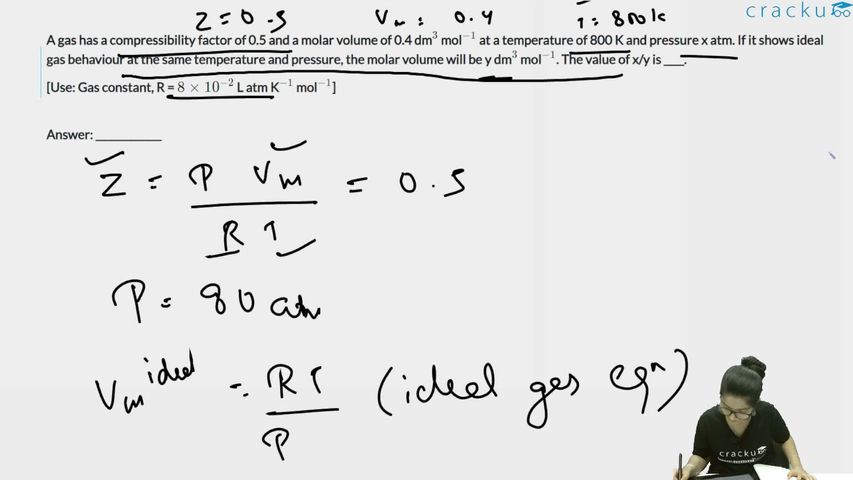
A gas has a compressibility factor of 0.5 and a molar volume of 0.4 dm$$^3$$ mol$$^{-1}$$ at a temperature of 800 K and pressure x atm. If it shows ideal gas behaviour at the same temperature and pressure, the molar volume will be y dm$$^3$$ mol$$^{-1}$$. The value of x/y is ____.
[Use: Gas constant, R = $$8 \times 10^{-2}$$ L atm K$$^{-1}$$ mol$$^{-1}$$]
Correct Answer: 100
The compressibility factor $$Z$$ is defined as $$Z=\dfrac{P\,V_m}{R\,T}$$, where
$$P$$ = pressure, $$V_m$$ = molar volume, $$R$$ = gas constant and $$T$$ = absolute temperature.
For the real gas (given data):
$$Z = 0.5,\; V_m = 0.4\;\text{dm}^3\text{ mol}^{-1}=0.4\;L\text{ mol}^{-1},\;T = 800\;K,\;R = 8\times 10^{-2}\;L\,\text{atm}\,K^{-1}\text{ mol}^{-1}=0.08\;L\,\text{atm}\,K^{-1}\text{ mol}^{-1}.$$
Substituting in the definition of $$Z$$:
$$0.5 = \dfrac{P\,(0.4)}{0.08 \times 800}$$
Simplifying the denominator:
$$0.08 \times 800 = 64$$
Therefore,
$$0.5 = \dfrac{0.4\,P}{64}$$
Rearranging for $$P$$:
$$P = \dfrac{0.5 \times 64}{0.4} = \dfrac{32}{0.4} = 80\;\text{atm}.$$
Thus $$x = 80\;\text{atm}.$$
For an ideal gas at the same $$T$$ and $$P$$, the compressibility factor is $$Z=1$$, so
$$V_m^{\text{ideal}} = \dfrac{R\,T}{P} = \dfrac{0.08 \times 800}{80}
= \dfrac{64}{80} = 0.8\;L = 0.8\;\text{dm}^3\text{ mol}^{-1}.$$
Hence $$y = 0.8\;\text{dm}^3\text{ mol}^{-1}.$$
Finally,
$$\dfrac{x}{y} = \dfrac{80}{0.8} = 100.$$
Therefore, the required value of $$x/y$$ is 100.
Click on the Email ☝️ to Watch the Video Solution
Create a FREE account and get:
_1.webp)

Educational materials for JEE preparation

Ask our AI anything

AI can make mistakes. Please verify important information.
AI can make mistakes. Please verify important information.


