
Join Our JEE Preparation Group
Prep with like-minded aspirants; Get access to free daily tests and study material.
Sign in
Please select an account to continue using cracku.in
↓ →
Join Our JEE Preparation Group
Prep with like-minded aspirants; Get access to free daily tests and study material.
One mole of an ideal monoatomic gas undergoes two reversible processes (A $$\to$$ B and B $$\to$$ C) as shown in the given figure:
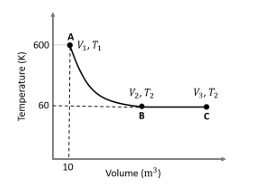
A $$\to$$ B is an adiabatic process. If the total heat absorbed in the entire process (A $$\to$$ B and B $$\to$$ C) is $$RT_2 \ln 10$$, the value of $$2 \log V_3$$ is ________.
[Use, molar heat capacity of the gas at constant pressure, $$C_{p,m} = \frac{5}{2}R$$]
Correct Answer: 7
Total heat absorbed in a multi-step process is the sum of heat transfers, where $$Q_{A \rightarrow B} = 0$$ for an adiabatic process and $$Q_{B \rightarrow C} = nRT\ln\left(\frac{V_f}{V_i}\right)$$ for an isothermal process.
Given: $$n = 1$$, $$V_1 = 10\text{ m}^3$$, $$T_1 = 600\text{ K}$$, $$T_2 = 60\text{ K}$$, $$C_{p,m} = \frac{5}{2}R \implies \gamma = \frac{5}{3}$$
Along adiabatic process $$A \rightarrow B$$:
$$T_1 V_1^{\gamma-1} = T_2 V_2^{\gamma-1}$$
$$600 \times 10^{2/3} = 60 \times V_2^{2/3} \implies 10 \times 10^{2/3} = V_2^{2/3} \implies V_2 = 10^{5/2}\text{ m}^3$$
$$Q_{A \rightarrow B} = 0$$
Along isothermal process $$B \rightarrow C$$:
$$Q_{B \rightarrow C} = nRT_2\ln\left(\frac{V_3}{V_2}\right) = RT_2\ln\left(\frac{V_3}{10^{5/2}}\right)$$
Equating to total heat absorbed:
$$RT_2\ln\left(\frac{V_3}{10^{5/2}}\right) = RT_2\ln 10 \implies \frac{V_3}{10^{5/2}} = 10 \implies V_3 = 10^{7/2}\text{ m}^3$$
$$\log V_3 = \log\left(10^{7/2}\right) = \frac{7}{2}$$
$$2\log V_3 = 2 \times \frac{7}{2} = 7$$
Was this solution helpful?
Click on the Email ☝️ to Watch the Video Solution
Create a FREE account and get:
_1.webp)

Educational materials for JEE preparation

Ask our AI anything

AI can make mistakes. Please verify important information.
AI can make mistakes. Please verify important information.
