
Join Our JEE Preparation Group
Prep with like-minded aspirants; Get access to free daily tests and study material.
Sign in
Please select an account to continue using cracku.in
↓ →
Join Our JEE Preparation Group
Prep with like-minded aspirants; Get access to free daily tests and study material.
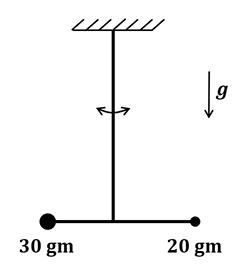
Two point-like objects of masses 20 gm and 30 gm are fixed at the two ends of a rigid massless rod of length 10 cm. This system is suspended vertically from a rigid ceiling using a thin wire attached to its center of mass, as shown in the figure. The resulting torsional pendulum undergoes small oscillations. The torsional constant of the wire is $$1.2 \times 10^{-8}$$ N m rad$$^{-1}$$. The angular frequency of the oscillations in $$n \times 10^{-3}$$ rad s$$^{-1}$$. The value of $$n$$ is ______.
Correct Answer: 10
Let the masses be $$m_1 = 20\ \text{g}=0.02\ \text{kg}$$ and $$m_2 = 30\ \text{g}=0.03\ \text{kg}$$. The distance between them is the length of the rod, $$L = 10\ \text{cm}=0.10\ \text{m}$$.
Since the suspension wire is fixed at the centre of mass (COM), we first locate that COM along the rod. Let the distances of $$m_1$$ and $$m_2$$ from the COM be $$r_1$$ and $$r_2$$ respectively.
By definition of the centre of mass, $$m_1 r_1 = m_2 r_2$$ $$-(1)$$ and $$r_1 + r_2 = L = 0.10\ \text{m}$$ $$-(2)$$.
From $$(1)$$, $$r_1 = \dfrac{m_2}{m_1}\,r_2 = \dfrac{0.03}{0.02}\,r_2 = 1.5\,r_2$$.
Substituting in $$(2)$$ gives $$1.5\,r_2 + r_2 = 2.5\,r_2 = 0.10$$, hence $$r_2 = 0.10/2.5 = 0.04\ \text{m}$$ and $$r_1 = 1.5 \times 0.04 = 0.06\ \text{m}$$.
The moment of inertia of the two-mass system about the COM is
$$I = m_1 r_1^2 + m_2 r_2^2$$
Substituting values:
$$I = 0.02\,(0.06)^2 + 0.03\,(0.04)^2$$
$$I = 0.02 \times 0.0036 + 0.03 \times 0.0016$$
$$I = 7.2 \times 10^{-5} + 4.8 \times 10^{-5}$$
$$I = 1.2 \times 10^{-4}\ \text{kg m}^2$$.
For a torsional pendulum, the angular frequency of small oscillations is
$$\omega = \sqrt{\dfrac{\kappa}{I}}$$
where $$\kappa$$ is the torsional constant of the wire.
Given $$\kappa = 1.2 \times 10^{-8}\ \text{N m rad}^{-1}$$ and $$I = 1.2 \times 10^{-4}\ \text{kg m}^2$$,
$$\dfrac{\kappa}{I} = \dfrac{1.2 \times 10^{-8}}{1.2 \times 10^{-4}} = 10^{-4}\ \text{s}^{-2}$$.
Therefore,
$$\omega = \sqrt{10^{-4}} = 10^{-2}\ \text{rad s}^{-1} = 0.01\ \text{rad s}^{-1}$$.
This can be written as $$\omega = 10 \times 10^{-3}\ \text{rad s}^{-1}$$, hence $$n = 10$$.
Final Answer: 10
Was this solution helpful?
Click on the Email ☝️ to Watch the Video Solution
Create a FREE account and get:
_1.webp)

Educational materials for JEE preparation

Ask our AI anything

AI can make mistakes. Please verify important information.
AI can make mistakes. Please verify important information.
