
Join Our JEE Preparation Group
Prep with like-minded aspirants; Get access to free daily tests and study material.
Sign in
Please select an account to continue using cracku.in
↓ →
Join Our JEE Preparation Group
Prep with like-minded aspirants; Get access to free daily tests and study material.
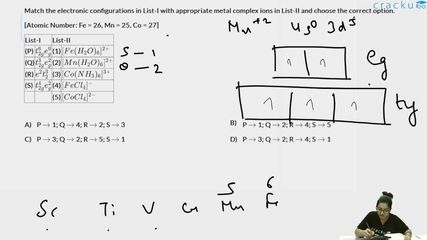
Match the electronic configurations in List-I with appropriate metal complex ions in List-II and choose the correct option.
[Atomic Number: Fe = 26, Mn = 25, Co = 27]
| List-I | List-II | ||
|---|---|---|---|
| (P) | $$t_{2g}^6 e_g^0$$ | (1) | $$[Fe(H_2O)_6]^{2+}$$ |
| (Q) | $$t_{2g}^3 e_g^2$$ | (2) | $$[Mn(H_2O)_6]^{2+}$$ |
| (R) | $$e^2 t_2^3$$ | (3) | $$[Co(NH_3)_6]^{3+}$$ |
| (S) | $$t_{2g}^4 e_g^2$$ | (4) | $$[FeCl_4]^{-}$$ |
| (5) | $$[CoCl_4]^{2-}$$ | ||
First find the oxidation state and hence the number of $$d$$-electrons present in every metal centre.
$$[Fe(H_2O)_6]^{2+}:$$
$$Fe = +2 \;\Rightarrow\; d^{6}$$
$$[Mn(H_2O)_6]^{2+}:$$
$$Mn = +2 \;\Rightarrow\; d^{5}$$
$$[Co(NH_3)_6]^{3+}:$$
$$Co = +3 \;\Rightarrow\; d^{6}$$
$$[FeCl_4]^{-}:$$
Total charge $$= -1$$, each $$Cl^{-}$$ contributes $$-1$$, therefore
$$x - 4 = -1 \;\Rightarrow\; x = +3$$
$$Fe = +3 \;\Rightarrow\; d^{5}$$
Next decide the geometry and the ligand field strength.
• $$[Fe(H_2O)_6]^{2+}$$ and $$[Mn(H_2O)_6]^{2+}$$ are octahedral with the weak-field ligand $$H_2O$$ ⇒ high-spin.
• $$[Co(NH_3)_6]^{3+}$$ is octahedral, but $$NH_3$$ is a stronger field ligand and, with the highly charged $$Co^{3+}$$, gives a low-spin complex.
• $$[FeCl_4]^{-}$$ is tetrahedral because the large ligand $$Cl^{-}$$ prefers tetrahedral geometry; $$Cl^{-}$$ is weak field, so the complex is always high-spin.
Write the electronic arrangements:
Case 1 - Octahedral high-spin $$d^{6}$$
$$t_{2g}^{4}\,e_g^{2}$$
Case 2 - Octahedral high-spin $$d^{5}$$
$$t_{2g}^{3}\,e_g^{2}$$
Case 3 - Octahedral low-spin $$d^{6}$$
$$t_{2g}^{6}\,e_g^{0}$$
Case 4 - Tetrahedral high-spin $$d^{5}$$
Level order reverses, so the lower set is $$e$$ and the higher set is $$t_2$$:
$$e^{2}\,t_{2}^{3}$$
Now match each complex with the patterns listed in List-I:
P : $$t_{2g}^{6} e_g^{0}$$ ⇒ octahedral low-spin $$d^{6}$$ ⇒ $$[Co(NH_3)_6]^{3+}\;(3)$$
Q : $$t_{2g}^{3} e_g^{2}$$ ⇒ octahedral high-spin $$d^{5}$$ ⇒ $$[Mn(H_2O)_6]^{2+}\;(2)$$
R : $$e^{2} t_2^{3}$$ ⇒ tetrahedral high-spin $$d^{5}$$ ⇒ $$[FeCl_4]^{-}\;(4)$$
S : $$t_{2g}^{4} e_g^{2}$$ ⇒ octahedral high-spin $$d^{6}$$ ⇒ $$[Fe(H_2O)_6]^{2+}\;(1)$$
Therefore
$$P \to 3,\; Q \to 2,\; R \to 4,\; S \to 1$$
The option showing this combination is
Option D which is: P → 3; Q → 2; R → 4; S → 1.
Click on the Email ☝️ to Watch the Video Solution
Create a FREE account and get:
_1.webp)

Educational materials for JEE preparation

Ask our AI anything

AI can make mistakes. Please verify important information.
AI can make mistakes. Please verify important information.


