
Join Our JEE Preparation Group
Prep with like-minded aspirants; Get access to free daily tests and study material.
Sign in
Please select an account to continue using cracku.in
↓ →
Join Our JEE Preparation Group
Prep with like-minded aspirants; Get access to free daily tests and study material.
Match the reactions in List-I with the features of their products in List-II and choose the correct option.
| List-I | List-II | ||
|---|---|---|---|
| (P) | (-)-1-Bromo-2-ethylpentane (single enantiomer) $$\xrightarrow[S_N2 \text{ reaction}]{\text{aq. NaOH}}$$ | (1) | Inversion of configuration |
| (Q) | (-)-2-Bromopentane (single enantiomer) $$\xrightarrow[S_N2 \text{ reaction}]{\text{aq. NaOH}}$$ | (2) | Retention of configuration |
| (R) | (-)-3-Bromo-3-methylhexane (single enantiomer) $$\xrightarrow[S_N1 \text{ reaction}]{\text{aq. NaOH}}$$ | (3) | Mixture of enantiomers |
| (S) | 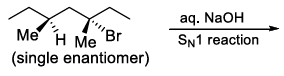 | (4) | Mixture of structural isomers |
| (5) | Mixture of diastereomers | ||
The given reactions involve substitution of bromine by the $$OH^{-}$$ ion. Whether the product keeps, inverts or partially loses the original configuration depends on (i) the mechanism ($$S_N2$$ or $$S_N1$$) and (ii) the position of the stereogenic centre(s) in the molecule.
Case P : $$(-)\text{-1-Bromo-2-ethylpentane}\xrightarrow[S_N2]{aq.\,NaOH}$$
• In $$S_N2$$ the attack is backside and therefore the carbon that bears the leaving group undergoes inversion.
• Here the leaving group is on C-1, which is not a stereogenic centre (it is $$CH_2Br$$).
• The only stereogenic centre is C-2. Because that carbon is not touched during the reaction, its configuration is retained.
Hence the optical purity of the starting material is preserved: the product shows retention of configuration.
⇒ P → (2)
Case Q : $$(-)\text{-2-Bromopentane}\xrightarrow[S_N2]{aq.\,NaOH}$$
• The bromine is on the stereogenic C-2.
• An $$S_N2$$ displacement on this carbon forces backside attack and gives one step inversion.
Therefore the configuration is converted into the opposite enantiomer: the product shows inversion of configuration.
⇒ Q → (1)
Case R : $$(-)\text{-3-Bromo-3-methylhexane}\xrightarrow[S_N1]{aq.\,NaOH}$$
• C-3 is tertiary; ionisation of $$C-Br$$ gives a planar carbocation.
• Nucleophilic attack by $$OH^{-}$$ is equally probable from either face.
• No other stereogenic centre is present. Thus the product is obtained as an equal (50 : 50) pair of enantiomers, i.e. a racemic mixture.
⇒ R → (3)
Case S : (The substrate possesses the leaving group on one stereogenic centre and contains at least one more untouched stereogenic centre.) In an $$S_N1$$ process the reacting centre racemises while the remote centre retains its configuration. Consequently the product set contains stereoisomers that are not mirror images but differ in the configuration of only one of the centres — they are diastereomers.
⇒ S → (5)
Collecting all matches:
P → 2; Q → 1; R → 3; S → 5
Therefore the correct option is
Option B which is: P → 2; Q → 1; R → 3; S → 5
Was this solution helpful?
Create a FREE account and get:
_1.webp)

Educational materials for JEE preparation

Ask our AI anything

AI can make mistakes. Please verify important information.
AI can make mistakes. Please verify important information.
