
Join Our JEE Preparation Group
Prep with like-minded aspirants; Get access to free daily tests and study material.
Sign in
Please select an account to continue using cracku.in
↓ →
Join Our JEE Preparation Group
Prep with like-minded aspirants; Get access to free daily tests and study material.
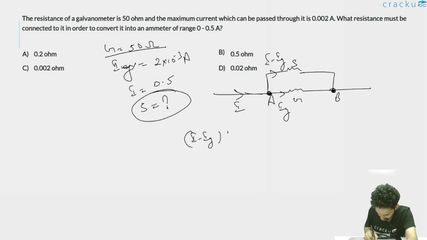
The resistance of a galvanometer is 50 ohm and the maximum current which can be passed through it is 0.002 A. What resistance must be connected to it in order to convert it into an ammeter of range 0 - 0.5 A?
We want to change the given galvanometer into an ammeter that can read currents up to $$0.5\ \text{A}$$. For this purpose a small resistance, called the shunt, is connected in parallel with the galvanometer. Because the galvanometer and the shunt are in parallel, the potential difference across both elements is the same.
Let us denote: $$G = 50\ \Omega$$ (resistance of the galvanometer) $$I_g = 0.002\ \text{A}$$ (maximum current that may pass through the galvanometer safely) $$I = 0.5\ \text{A}$$ (full-scale current of the desired ammeter) $$S = \text{shunt resistance to be found}$$
When the total current $$I$$ enters the parallel combination, a small part $$I_g$$ flows through the galvanometer while the remainder $$I - I_g$$ flows through the shunt. Since the potential difference across two parallel branches is identical, we can write Ohm’s law for each branch:
For the galvanometer branch $$V = I_g\,G$$
For the shunt branch $$V = (I - I_g)\,S$$
Because the voltages are equal, we equate the right-hand sides:
$$I_g\,G = (I - I_g)\,S$$
Now we solve step by step for $$S$$. First, write down the equality again for clarity:
$$I_g\,G = (I - I_g)\,S$$
Next, divide both sides by the current term $$(I - I_g)$$ to isolate $$S$$ on the right:
$$S = \dfrac{I_g\,G}{\,I - I_g\,}$$
Now substitute the numerical values one by one. We begin with the numerator:
$$I_g\,G = 0.002\ \text{A} \times 50\ \Omega = 0.1\ \Omega\text{·A}$$
Then compute the denominator:
$$I - I_g = 0.5\ \text{A} - 0.002\ \text{A} = 0.498\ \text{A}$$
Finally, form the quotient:
$$S = \dfrac{0.1}{0.498}\ \Omega$$
On performing the division we obtain
$$S \approx 0.2008\ \Omega$$
The shunt resistance is therefore approximately $$0.2\ \Omega$$. This matches option A.
Hence, the correct answer is Option A.
Was this solution helpful?
Click on the Email ☝️ to Watch the Video Solution
Create a FREE account and get:
_1.webp)

Educational materials for JEE preparation

Ask our AI anything

AI can make mistakes. Please verify important information.
AI can make mistakes. Please verify important information.


