
Join Our JEE Preparation Group
Prep with like-minded aspirants; Get access to free daily tests and study material.
Sign in
Please select an account to continue using cracku.in
↓ →
Join Our JEE Preparation Group
Prep with like-minded aspirants; Get access to free daily tests and study material.
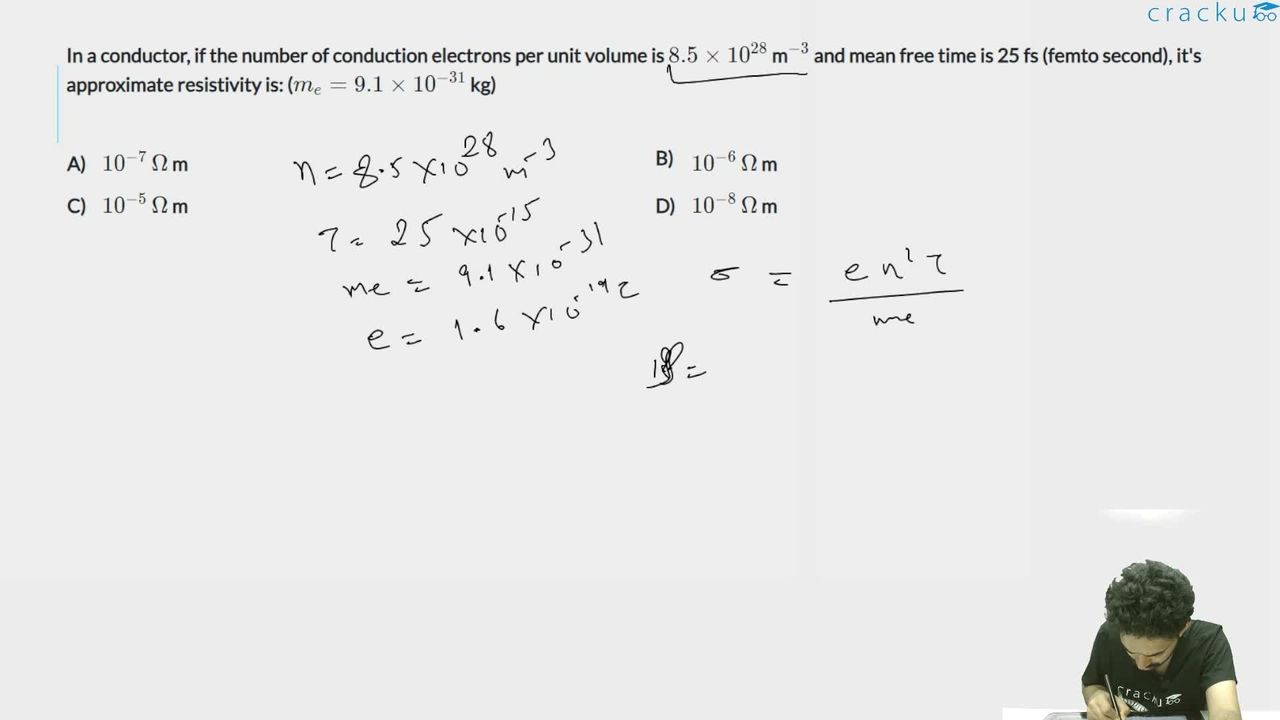
In a conductor, if the number of conduction electrons per unit volume is $$8.5 \times 10^{28}$$ m$$^{-3}$$ and mean free time is 25 fs (femto second), it's approximate resistivity is: ($$m_e = 9.1 \times 10^{-31}$$ kg)
We have to find the resistivity $$\rho$$ of the conductor. The basic relation connecting the microscopic quantities with conductivity is first stated.
Formula (Drude model): the electrical conductivity $$\sigma$$ of a metal is
$$ \sigma \;=\; \frac{n e^{2}\,\tau}{m_e}, $$
where
$$n = 8.5 \times 10^{28}\;{\rm m^{-3}},\quad e = 1.6 \times 10^{-19}\;{\rm C},\quad \tau = 25\;{\rm fs}=25 \times 10^{-15}\;{\rm s},\quad m_e = 9.1 \times 10^{-31}\;{\rm kg}. $$
The required resistivity is simply the reciprocal of conductivity:
$$ \rho = \frac{1}{\sigma}. $$
Now we start substituting the numbers step by step.
First, square the electronic charge:
$$ e^{2} = \left(1.6 \times 10^{-19}\right)^{2} = 2.56 \times 10^{-38}\;{\rm C^{2}}. $$
Multiply this by the electron number density $$n$$:
$$ n e^{2} = \left(8.5 \times 10^{28}\right) \left(2.56 \times 10^{-38}\right). $$
We separate the coefficients and the powers of ten:
Coefficient → $$8.5 \times 2.56 = 21.76,$$
Power of ten → $$10^{28} \times 10^{-38} = 10^{-10}.$$
So
$$ n e^{2} = 21.76 \times 10^{-10} = 2.176 \times 10^{-9}. $$
Next, multiply by the mean free time $$\tau$$:
$$ n e^{2} \tau = \left(2.176 \times 10^{-9}\right) \left(25 \times 10^{-15}\right). $$
Again treat the numerical and exponential parts separately:
Coefficient → $$2.176 \times 25 = 54.4,$$
Power of ten → $$10^{-9} \times 10^{-15} = 10^{-24}.$$
Therefore
$$ n e^{2} \tau = 54.4 \times 10^{-24} = 5.44 \times 10^{-23}. $$
Now divide by the electron mass $$m_e$$ to obtain conductivity:
$$ \sigma = \frac{n e^{2} \tau}{m_e} = \frac{5.44 \times 10^{-23}}{9.1 \times 10^{-31}}. $$
To divide, divide the coefficients and subtract the exponents:
Coefficient → $$\dfrac{5.44}{9.1} \approx 0.5989 \approx 0.6,$$
Power of ten → $$10^{-23} \div 10^{-31} = 10^{8}.$$
Thus
$$ \sigma \approx 0.6 \times 10^{8} = 6 \times 10^{7}\;{\rm S\,m^{-1}}. $$
Finally, resistivity is the reciprocal:
$$ \rho = \frac{1}{\sigma} = \frac{1}{6 \times 10^{7}} \approx 1.67 \times 10^{-8}\;{\rm \Omega\,m}. $$
Since $$1.67 \times 10^{-8}\;{\rm \Omega\,m}$$ lies closest to the option written as $$10^{-8}\;{\rm \Omega\,m},$$ we match it to that choice.
Hence, the correct answer is Option D.
Was this solution helpful?
Click on the Email ☝️ to Watch the Video Solution
Create a FREE account and get:
_1.webp)

Educational materials for JEE preparation

Ask our AI anything

AI can make mistakes. Please verify important information.
AI can make mistakes. Please verify important information.


