
Join Our JEE Preparation Group
Prep with like-minded aspirants; Get access to free daily tests and study material.
Sign in
Please select an account to continue using cracku.in
↓ →
Join Our JEE Preparation Group
Prep with like-minded aspirants; Get access to free daily tests and study material.
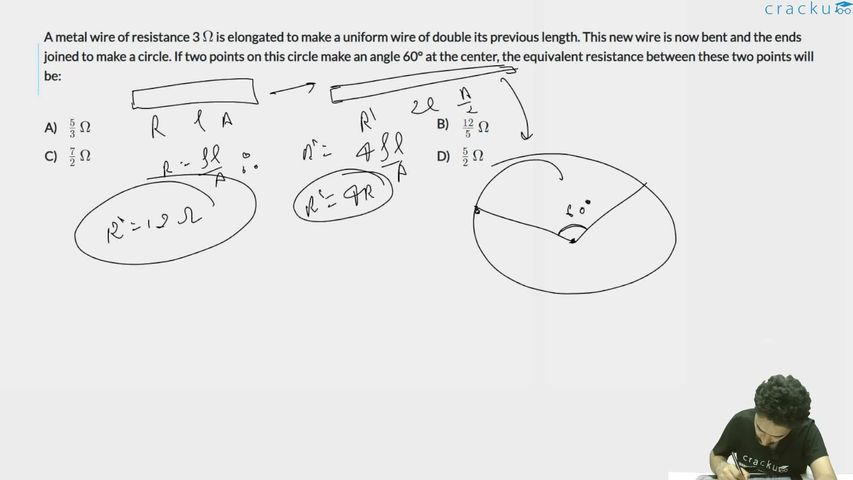
A metal wire of resistance 3 $$\Omega$$ is elongated to make a uniform wire of double its previous length. This new wire is now bent and the ends joined to make a circle. If two points on this circle make an angle 60° at the center, the equivalent resistance between these two points will be:
We know that the resistance of a uniform wire is governed by the relation $$R=\rho\frac{L}{A},$$ where $$\rho$$ is the resistivity of the material, $$L$$ is the length of the wire and $$A$$ is its cross-sectional area.
The original wire has resistance $$R_0 = 3\;\Omega$$ and let its original length and cross-sectional area be $$L_0$$ and $$A_0$$ respectively. So for the first wire we may write
$$R_0 = \rho\frac{L_0}{A_0}=3\;\Omega.$$
Now the wire is stretched so that its new length becomes double, that is
$$L_1 = 2L_0.$$
While stretching, the volume of the wire remains constant. Volume $$V$$ is given by $$V=L\times A$$, hence
$$L_0A_0 = L_1A_1 \quad\Longrightarrow\quad A_1=\frac{L_0}{L_1}A_0=\frac{L_0}{2L_0}A_0=\frac{A_0}{2}.$$
So the new cross-sectional area is one-half of the original. Substituting $$L_1$$ and $$A_1$$ in the resistance formula we obtain the resistance of the elongated straight wire:
$$R_1=\rho\frac{L_1}{A_1}=\rho\frac{2L_0}{A_0/2}=\rho\frac{2L_0}{A_0}\times2=4\,\rho\frac{L_0}{A_0}=4R_0=4\times3\;\Omega=12\;\Omega.$$
This wire of resistance $$12\;\Omega$$ is now bent into a complete circle. Because the material remains uniform, resistance is directly proportional to the length of any arc. The total circumference of the circle corresponds to $$12\;\Omega$$.
Two points on the circle are chosen such that the angle subtended at the centre is $$60^\circ$$. The circle has $$360^\circ$$ in all, so the fraction of the circumference between the two points along the shorter arc is
$$\frac{60^\circ}{360^\circ}=\frac16.$$
Therefore, the resistance of the shorter arc is
$$R_{\text{short}} = 12\;\Omega \times \frac16 = 2\;\Omega.$$
The longer arc spans the remaining angle $$360^\circ-60^\circ = 300^\circ$$, i.e. a fraction
$$\frac{300^\circ}{360^\circ}=\frac56,$$
so its resistance is
$$R_{\text{long}} = 12\;\Omega \times \frac56 = 10\;\Omega.$$
Between the chosen two points these two arcs provide two parallel conducting paths. For two resistances $$R_1$$ and $$R_2$$ in parallel, the equivalent resistance is given by the formula
$$R_{\text{eq}} = \frac{R_1R_2}{R_1+R_2}.$$
Putting $$R_1 = 2\;\Omega$$ and $$R_2 = 10\;\Omega$$, we get
$$R_{\text{eq}} = \frac{2\;\Omega \times 10\;\Omega}{2\;\Omega + 10\;\Omega} = \frac{20}{12}\;\Omega = \frac{5}{3}\;\Omega.$$
Hence, the correct answer is Option A.
Was this solution helpful?
Click on the Email ☝️ to Watch the Video Solution
Create a FREE account and get:
_1.webp)

Educational materials for JEE preparation

Ask our AI anything

AI can make mistakes. Please verify important information.
AI can make mistakes. Please verify important information.


