
Join Our JEE Preparation Group
Prep with like-minded aspirants; Get access to free daily tests and study material.
Sign in
Please select an account to continue using cracku.in
↓ →
Join Our JEE Preparation Group
Prep with like-minded aspirants; Get access to free daily tests and study material.
Three conductors of same length having thermal conductivity $$k_1, k_2 \text{ and } K_3$$ are connected as shown in figure.
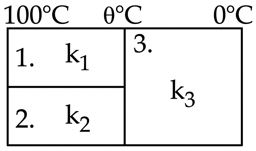
Area of cross sections of $$ 1^{st} \text{ and }2^{nd}$$ conductor are same and for $$3^{rd}$$ conductor it is double of the $$1^{st}$$ conductor. The temperatures are given in the figure. In steady state condition, the value of 0 is _______ $$^oC$$.
$$(\text{Given }:k_1=60Js^{-1}m^{-1}K^{-1},k_2= 120Js^{-1}m^{-1}K^{-1}, k_3= 135Js^{-1}m^{-1}K^{-1})$$
Correct Answer: 40
Treat it as two conductors $$k_1,k_2$$ in parallel, connected in series with conductor $$k_3$$
Let area of conductors 1 and 2 be A.
Given for conductor 3:
$$A_3=2A$$
All lengths are same l.
Thermal resistance:
$$R=\frac{l}{kA}$$
For conductor 1:
$$R_1=\frac{l}{60A}$$
For conductor 2:
$$R_2=\frac{l}{120A}$$
These are in parallel:
$$\frac{1}{R_p}=\frac{1}{R_1}+\frac{1}{R_2}=\frac{60A}{l}+\frac{120A}{l}=l60A+l120A$$
$$=\frac{180A}{l}$$
So
$$R_p=\frac{l}{180A}$$
Equivalent conductivity of left section:
$$k_{eq}=180$$
Now conductor 3:
$$R_3=\frac{l}{135(2A)}=\frac{l}{270A}$$
Suppose junction temperature is θ\thetaθ.
Heat flow through left section:
$$Q_1=\frac{(100-\theta)}{R_p}$$
$$=(100-\theta)\frac{180A}{l}$$
Heat flow through right section:
$$Q_2=\frac{\theta}{R_3}=\theta\frac{270A}{l}$$
Steady state:
$$Q_1=Q_2$$
$$180(100-\theta)=270\theta$$
$$18000=450\theta$$
$$\theta=40^{\circ}C$$
Was this solution helpful?
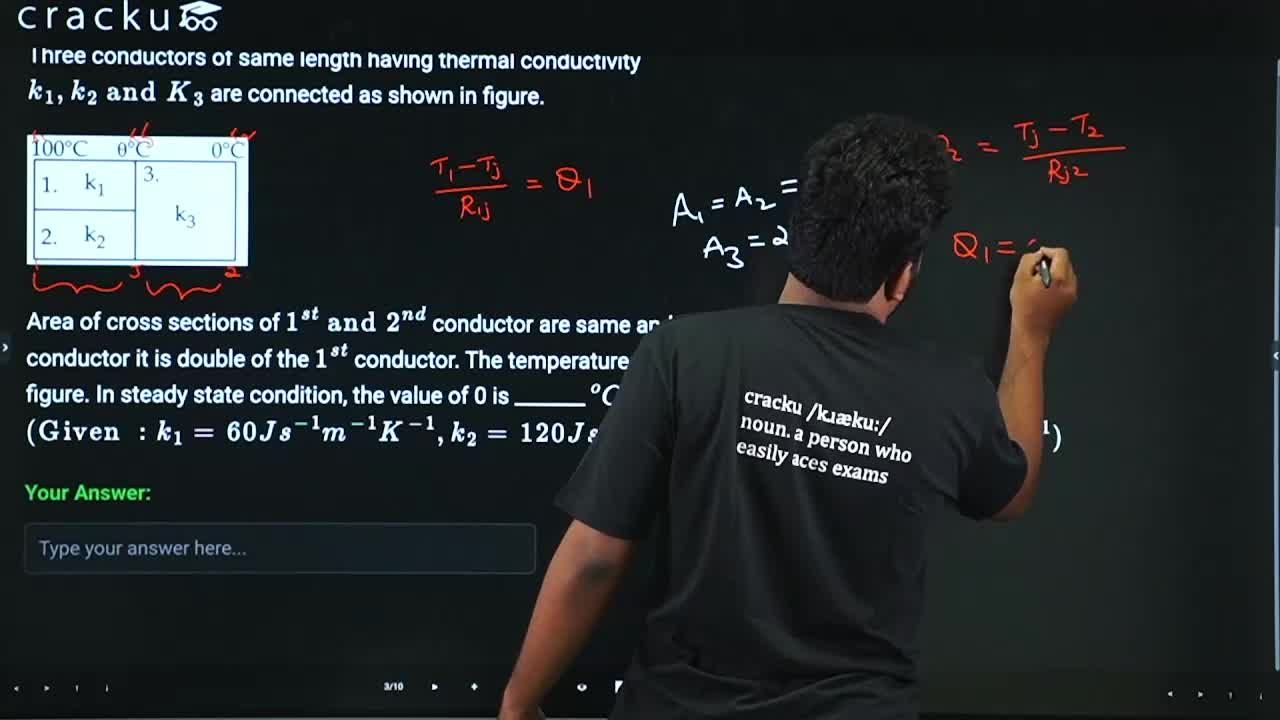
Click on the Email ☝️ to Watch the Video Solution
Create a FREE account and get:
_1.webp)

Educational materials for JEE preparation

Ask our AI anything

AI can make mistakes. Please verify important information.
AI can make mistakes. Please verify important information.
