
Join Our JEE Preparation Group
Prep with like-minded aspirants; Get access to free daily tests and study material.
Sign in
Please select an account to continue using cracku.in
↓ →
Join Our JEE Preparation Group
Prep with like-minded aspirants; Get access to free daily tests and study material.
One end of a thermally insulated rod is kept at a temperature $$T_1$$ and the other at $$T_2$$. The rod is composed of two sections of lengths $$\ell_1$$ and $$\ell_2$$ and thermal conductivities $$k_1$$ and $$k_2$$ respectively. The temperature at the interface of the two sections is
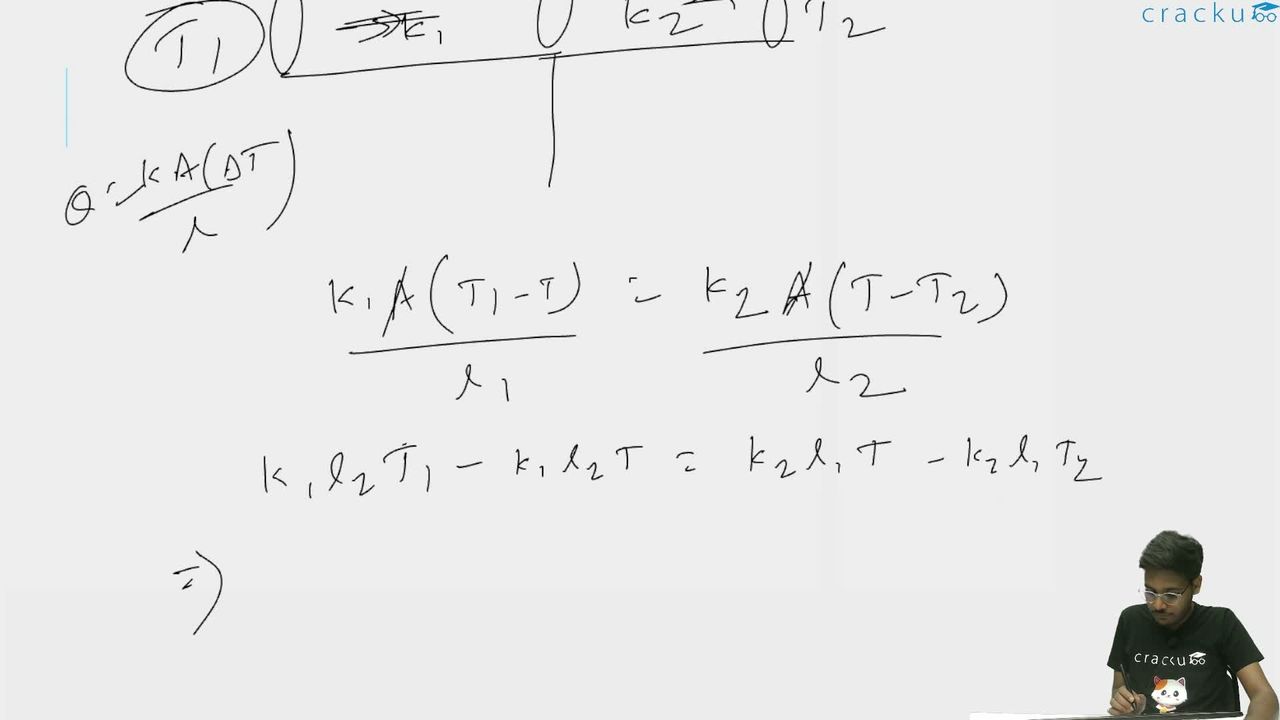
Let the common cross-sectional area of the rod be $$A$$ and let the steady-state temperature at the junction be $$T$$.
In steady state the heat current (rate of heat flow) through every cross-section of the rod is the same, because the lateral surface is perfectly insulated. Therefore, the heat current through the first section must equal the heat current through the second section.
Fourier’s law for each section is
$$Q = \frac{k A \,\Delta T}{\ell}$$
First section (length $$\ell_1$$, conductivity $$k_1$$):
$$Q \;=\; \frac{k_1 A\,(T_1 - T)}{\ell_1}$$ $$-(1)$$
Second section (length $$\ell_2$$, conductivity $$k_2$$):
$$Q \;=\; \frac{k_2 A\,(T - T_2)}{\ell_2}$$ $$-(2)$$
Equating $$-(1)$$ and $$-(2)$$ and cancelling the common factor $$A$$:
$$\frac{k_1\,(T_1 - T)}{\ell_1} \;=\; \frac{k_2\,(T - T_2)}{\ell_2}$$
Cross-multiply:
$$k_1\,\ell_2\,(T_1 - T) \;=\; k_2\,\ell_1\,(T - T_2)$$
Expand and collect the terms containing $$T$$ on one side:
$$k_1\,\ell_2\,T_1 \;-\; k_1\,\ell_2\,T \;=\; k_2\,\ell_1\,T \;-\; k_2\,\ell_1\,T_2$$
$$k_1\,\ell_2\,T \;+\; k_2\,\ell_1\,T \;=\; k_1\,\ell_2\,T_1 \;+\; k_2\,\ell_1\,T_2$$
Factor out $$T$$:
$$T\,\bigl(k_1\,\ell_2 + k_2\,\ell_1\bigr) \;=\; k_1\,\ell_2\,T_1 + k_2\,\ell_1\,T_2$$
Solve for $$T$$:
$$T \;=\; \frac{k_1\,\ell_2\,T_1 + k_2\,\ell_1\,T_2}{k_1\,\ell_2 + k_2\,\ell_1}$$
Comparing with the given options, this is exactly Option C.
Therefore, the temperature at the interface is
Option C which is: $$\displaystyle\frac{k_1 \ell_2 T_1 + k_2 \ell_1 T_2}{k_1 \ell_2 + k_2 \ell_1}$$
Was this solution helpful?
Click on the Email ☝️ to Watch the Video Solution
Create a FREE account and get:
_1.webp)

Educational materials for JEE preparation

Ask our AI anything

AI can make mistakes. Please verify important information.
AI can make mistakes. Please verify important information.
