
Join Our JEE Preparation Group
Prep with like-minded aspirants; Get access to free daily tests and study material.
Sign in
Please select an account to continue using cracku.in
↓ →
Join Our JEE Preparation Group
Prep with like-minded aspirants; Get access to free daily tests and study material.
A unit scale is to be prepared whose length does not change with temperature and remains $$20 \text{ cm}$$, using a bimetallic strip made of brass and iron each of different length. The length of both components would change in such a way that difference between their lengths remains constant. If length of brass is $$40 \text{ cm}$$ and length of iron will be ______ cm.
$$\alpha_{\text{iron}} = 1.2 \times 10^{-5} \text{ K}^{-1}$$ and $$\alpha_{\text{brass}} = 1.8 \times 10^{-5} \text{ K}^{-1}$$.
Correct Answer: 60
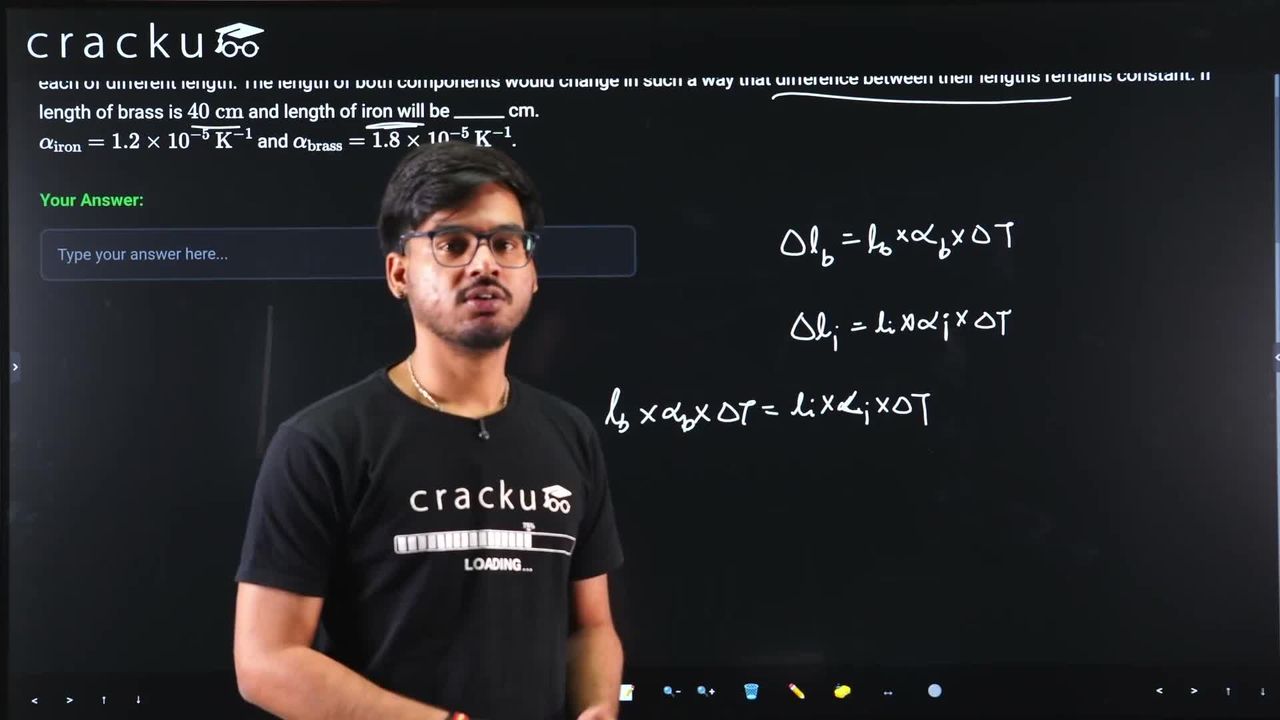
For the bimetallic strip to maintain a constant length difference (20 cm), both metals must expand by the same amount when the temperature changes.
The change in length for each material is:
$$\Delta L = L \alpha \Delta T$$
For the difference to remain constant, the expansions must be equal:
$$\Delta L_{\text{brass}} = \Delta L_{\text{iron}}$$
$$L_{\text{brass}} \times \alpha_{\text{brass}} \times \Delta T = L_{\text{iron}} \times \alpha_{\text{iron}} \times \Delta T$$
Cancelling $$\Delta T$$ from both sides:
$$L_{\text{brass}} \times \alpha_{\text{brass}} = L_{\text{iron}} \times \alpha_{\text{iron}}$$
$$40 \times 1.8 \times 10^{-5} = L_{\text{iron}} \times 1.2 \times 10^{-5}$$
$$L_{\text{iron}} = \dfrac{40 \times 1.8}{1.2} = \dfrac{72}{1.2} = 60 \text{ cm}$$
We can verify: The difference $$L_{\text{iron}} - L_{\text{brass}} = 60 - 40 = 20 \text{ cm}$$, which is the required scale length.
Therefore, the length of iron is $$\boxed{60}$$ cm.
Was this solution helpful?
Click on the Email ☝️ to Watch the Video Solution
Create a FREE account and get:
_1.webp)

Educational materials for JEE preparation

Ask our AI anything

AI can make mistakes. Please verify important information.
AI can make mistakes. Please verify important information.
