
Join Our JEE Preparation Group
Prep with like-minded aspirants; Get access to free daily tests and study material.
Sign in
Please select an account to continue using cracku.in
↓ →
Join Our JEE Preparation Group
Prep with like-minded aspirants; Get access to free daily tests and study material.
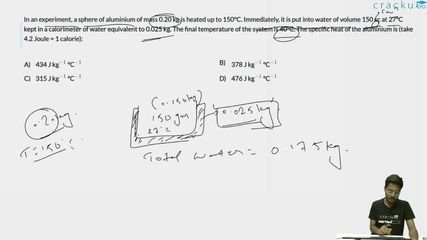
In an experiment, a sphere of aluminium of mass 0.20 kg is heated up to 150°C. Immediately, it is put into water of volume 150 cc at 27°C kept in a calorimeter of water equivalent to 0.025 kg. The final temperature of the system is 40°C. The specific heat of the aluminium is (take 4.2 Joule = 1 calorie):
We have to use the principle of calorimetry, namely that in an isolated system
$$\text{Heat lost by the hot body}= \text{Heat gained by the cold bodies}.$$
The heat absorbed or released by any body is given by the well-known formula
$$Q = m\,c\,\Delta T,$$
where $$m$$ is the mass, $$c$$ is the specific heat capacity and $$\Delta T$$ is the change in temperature.
Data for the aluminium sphere
Mass $$m_1 = 0.20\;\text{kg}$$, initial temperature $$T_1 = 150^{\circ}\text{C}$$, final temperature $$T_f = 40^{\circ}\text{C}$$.
So the temperature fall is
$$\Delta T_1 = T_1 - T_f = 150^{\circ}\text{C} - 40^{\circ}\text{C} = 110^{\circ}\text{C}.$$
Data for the water in the calorimeter
Volume given is $$150\;\text{cc}.$$ Because the density of water is $$1\;\text{g cm}^{-3},$$ the mass is
$$m_2 = 150\;\text{g} = 0.150\;\text{kg}.$$
Initial temperature $$T_2 = 27^{\circ}\text{C},$$ final temperature $$T_f = 40^{\circ}\text{C}$$; hence
$$\Delta T_2 = T_f - T_2 = 40^{\circ}\text{C} - 27^{\circ}\text{C} = 13^{\circ}\text{C}.$$
Data for the calorimeter itself
The water equivalent is $$0.025\;\text{kg}$$. This means its heat capacity is the same as that of $$0.025\;\text{kg}$$ of water. Therefore we can treat it as additional water of mass
$$m_3 = 0.025\;\text{kg},$$
with the same temperature rise
$$\Delta T_3 = \Delta T_2 = 13^{\circ}\text{C}.$$
Specific heat of water
For water we use $$c_w = 4200\;\text{J kg}^{-1}\,{}^{\circ}\text{C}^{-1}.$$ (The conversion given, $$4.2\;\text{J} = 1\;\text{cal},$$ is equivalent to this value.)
Heat gained by water
$$Q_2 = m_2\,c_w\,\Delta T_2 = 0.150\;\text{kg}\times 4200\;\text{J kg}^{-1}\,{}^{\circ}\text{C}^{-1}\times 13^{\circ}\text{C}.$$
First multiply the mass and specific heat:
$$0.150 \times 4200 = 630\;\text{J}\,{}^{\circ}\text{C}^{-1}.$$
Then multiply by the temperature rise:
$$630 \times 13 = 8190\;\text{J}.$$
Heat gained by the calorimeter
$$Q_3 = m_3\,c_w\,\Delta T_3 = 0.025\;\text{kg}\times 4200\;\text{J kg}^{-1}\,{}^{\circ}\text{C}^{-1}\times 13^{\circ}\text{C}.$$
Calculating similarly:
$$0.025 \times 4200 = 105\;\text{J}\,{}^{\circ}\text{C}^{-1},$$
and
$$105 \times 13 = 1365\;\text{J}.$$
Total heat gained by water plus calorimeter
$$Q_{\text{gained}} = Q_2 + Q_3 = 8190\;\text{J} + 1365\;\text{J} = 9555\;\text{J}.$$
Heat lost by the aluminium sphere
Let $$c$$ be the specific heat capacity of aluminium (in $$\text{J kg}^{-1}\,{}^{\circ}\text{C}^{-1}$$). Then
$$Q_{\text{lost}} = m_1\,c\,\Delta T_1 = 0.20\;\text{kg}\times c \times 110^{\circ}\text{C}.$$
Multiplying the numerical factors first:
$$0.20 \times 110 = 22,$$
so
$$Q_{\text{lost}} = 22\,c.$$
Applying the heat balance
Because no heat escapes the system,
$$Q_{\text{lost}} = Q_{\text{gained}}.$$
Therefore
$$22\,c = 9555.$$
Solving for $$c$$
$$c = \frac{9555}{22}\;\text{J kg}^{-1}\,{}^{\circ}\text{C}^{-1}.$$
Carrying out the division:
$$c = 434.318\;\text{J kg}^{-1}\,{}^{\circ}\text{C}^{-1}\;(\text{approximately}).$$
Rounding to three significant figures gives
$$c \approx 434\;\text{J kg}^{-1}\,{}^{\circ}\text{C}^{-1}.$$
Hence, the correct answer is Option A.
Was this solution helpful?
Click on the Email ☝️ to Watch the Video Solution
Create a FREE account and get:
_1.webp)

Educational materials for JEE preparation

Ask our AI anything

AI can make mistakes. Please verify important information.
AI can make mistakes. Please verify important information.


