
Join Our JEE Preparation Group
Prep with like-minded aspirants; Get access to free daily tests and study material.
Sign in
Please select an account to continue using cracku.in
↓ →
Join Our JEE Preparation Group
Prep with like-minded aspirants; Get access to free daily tests and study material.
1 kg of water, at 20°C is heated in an electric kettle whose heating element has a mean (temperature averaged) resistance of 20 Ω. The rms voltage in the mains is 200 V. Ignoring heat loss from the kettle, time taken for water to evaporate fully is close to
[Specific heat of water = 4200 J kg$$^{-1}$$ °C$$^{-1}$$ Latent heat of water = 2260 kJ kg$$^{-1}$$]
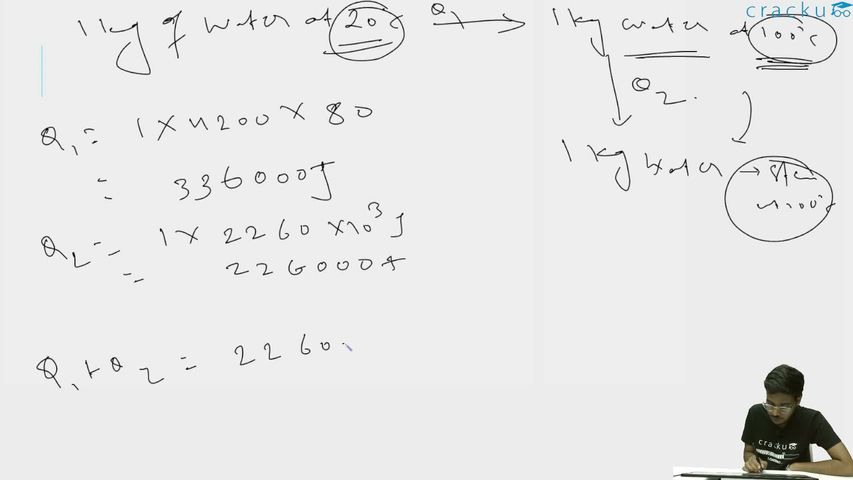
We have $$m = 1\ \text{kg}$$ of water whose initial temperature is $$20^\circ\text{C}$$. To evaporate it completely, two distinct amounts of heat are required:
1. Heat to raise the temperature from $$20^\circ\text{C}$$ to the boiling point $$100^\circ\text{C}$$.
2. Heat to convert the water at $$100^\circ\text{C}$$ into steam at the same temperature (latent heat of vaporisation).
First, we evaluate the sensible heat needed for the temperature rise. We state the formula for heat absorbed when there is a temperature change:
$$Q_1 = mc\Delta T$$
Here $$c = 4200\ \text{J kg}^{-1}{}^\circ\text{C}^{-1}$$ and $$\Delta T = 100^\circ\text{C} - 20^\circ\text{C} = 80^\circ\text{C}$$. Substituting the values,
$$Q_1 = (1\ \text{kg})(4200\ \text{J kg}^{-1}{}^\circ\text{C}^{-1})(80^\circ\text{C})$$
$$Q_1 = 4200 \times 80\ \text{J}$$
$$Q_1 = 336000\ \text{J}$$
Next, we compute the latent heat required for the phase change. The latent heat of vaporisation is given as $$L = 2260\ \text{kJ kg}^{-1} = 2260 \times 10^{3}\ \text{J kg}^{-1}$$. The formula for the heat of phase change is
$$Q_2 = mL$$
For $$m = 1\ \text{kg}$$,
$$Q_2 = 1 \times 2260 \times 10^{3}\ \text{J}$$
$$Q_2 = 2260000\ \text{J}$$
The total heat required is the sum of these two quantities:
$$Q_{\text{total}} = Q_1 + Q_2$$
$$Q_{\text{total}} = 336000\ \text{J} + 2260000\ \text{J}$$
$$Q_{\text{total}} = 2596000\ \text{J}$$
Now we determine the rate at which the electric kettle can supply energy. The kettle is connected to a mains supply of rms voltage $$V_{\text{rms}} = 200\ \text{V}$$, and the heating element has an average resistance $$R = 20\ \Omega$$. We recall Joule’s law for electrical power:
$$P = \dfrac{V_{\text{rms}}^{2}}{R}$$
Substituting the given values,
$$P = \dfrac{(200\ \text{V})^{2}}{20\ \Omega}$$
$$P = \dfrac{40000\ \text{V}^2}{20\ \Omega}$$
$$P = 2000\ \text{W}$$
So the kettle delivers $$2000\ \text{J s}^{-1}$$ of energy. The time required to supply the total heat is obtained from
$$t = \dfrac{Q_{\text{total}}}{P}$$
$$t = \dfrac{2596000\ \text{J}}{2000\ \text{J s}^{-1}}$$
$$t = 1298\ \text{s}$$
We convert this time into minutes for easier comprehension:
$$t = \dfrac{1298\ \text{s}}{60\ \text{s min}^{-1}}$$
$$t \approx 21.6\ \text{min}$$
This value is closest to the option stating $$22\ \text{min}$$.
Hence, the correct answer is Option C.
Was this solution helpful?
Click on the Email ☝️ to Watch the Video Solution
Create a FREE account and get:
_1.webp)

Educational materials for JEE preparation

Ask our AI anything

AI can make mistakes. Please verify important information.
AI can make mistakes. Please verify important information.


