
Join Our JEE Preparation Group
Prep with like-minded aspirants; Get access to free daily tests and study material.
Sign in
Please select an account to continue using cracku.in
↓ →
Join Our JEE Preparation Group
Prep with like-minded aspirants; Get access to free daily tests and study material.
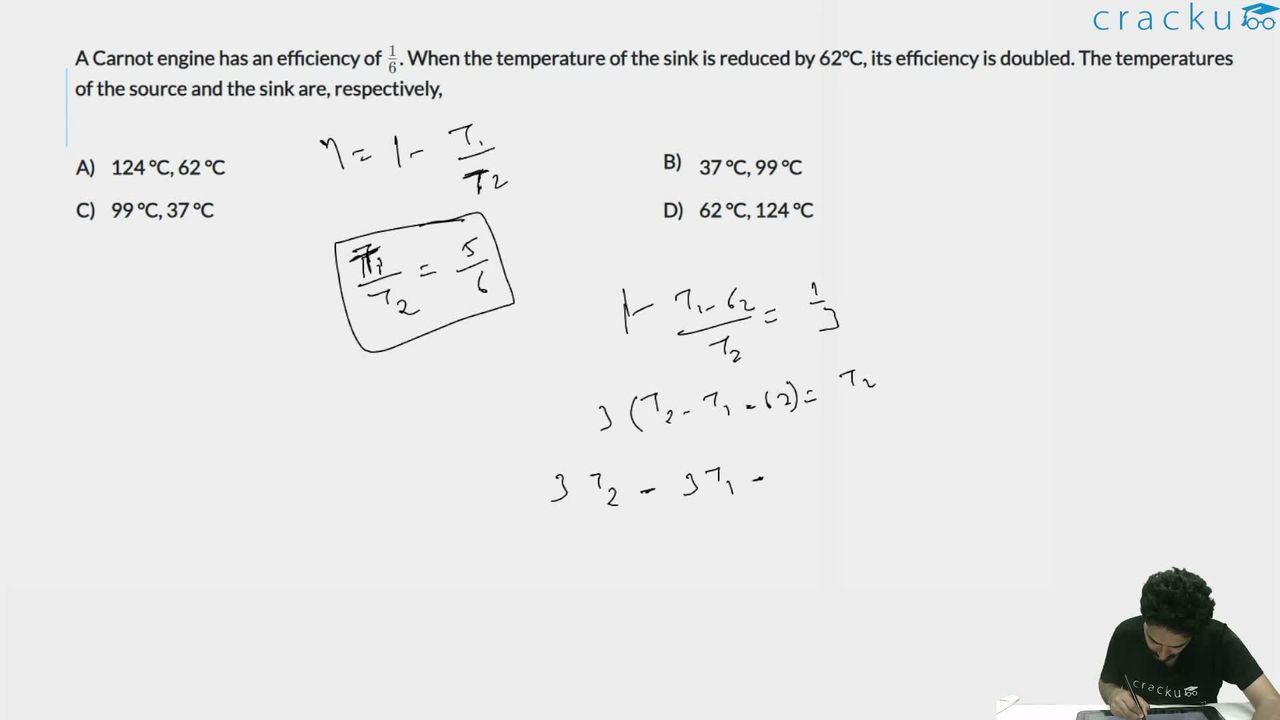
A Carnot engine has an efficiency of $$\frac{1}{6}$$. When the temperature of the sink is reduced by 62°C, its efficiency is doubled. The temperatures of the source and the sink are, respectively,
We are given that a Carnot engine has an efficiency of $$\frac{1}{6}$$, and when the temperature of the sink is reduced by $$62^\circ C$$, its efficiency is doubled.
Step 1: Set up equations using Carnot efficiency
The efficiency of a Carnot engine is given by:
$$\eta = 1 - \frac{T_2}{T_1}$$
where $$T_1$$ is the source temperature and $$T_2$$ is the sink temperature (both in Kelvin).
Step 2: First condition
$$\frac{1}{6} = 1 - \frac{T_2}{T_1}$$
$$\frac{T_2}{T_1} = 1 - \frac{1}{6} = \frac{5}{6}$$
$$T_2 = \frac{5}{6}T_1$$ $$-(1)$$
Step 3: Second condition
When the sink temperature is reduced by $$62^\circ C$$ (i.e., by 62 K), the new sink temperature is $$T_2 - 62$$ and the efficiency doubles to $$\frac{1}{3}$$:
$$\frac{1}{3} = 1 - \frac{T_2 - 62}{T_1}$$
$$\frac{T_2 - 62}{T_1} = \frac{2}{3}$$
$$T_2 - 62 = \frac{2}{3}T_1$$ $$-(2)$$
Step 4: Solve the equations
Substituting $$(1)$$ into $$(2)$$:
$$\frac{5}{6}T_1 - 62 = \frac{2}{3}T_1$$
$$\frac{5}{6}T_1 - \frac{2}{3}T_1 = 62$$
$$\frac{5T_1 - 4T_1}{6} = 62$$
$$\frac{T_1}{6} = 62$$
$$T_1 = 372 \text{ K}$$
From $$(1)$$:
$$T_2 = \frac{5}{6} \times 372 = 310 \text{ K}$$
Step 5: Convert to Celsius
$$T_1 = 372 - 273 = 99^\circ C$$ (source temperature)
$$T_2 = 310 - 273 = 37^\circ C$$ (sink temperature)
The temperatures of the source and sink are $$99^\circ C$$ and $$37^\circ C$$, respectively.
The correct answer is Option C.
Was this solution helpful?
Click on the Email ☝️ to Watch the Video Solution
Create a FREE account and get:
_1.webp)

Educational materials for JEE preparation

Ask our AI anything

AI can make mistakes. Please verify important information.
AI can make mistakes. Please verify important information.


