For the following questions answer them individually
A particle is moving with speed $$v = b\sqrt{x}$$ along positive x-axis. Calculate the speed of the particle at time $$t = \tau$$ (assume that the particle is at origin at t = 0)
Two particles are projected from the same point with the same speed u such that they have the same range R, but different maximum heights, h$$_1$$ and h$$_2$$. Which of the following is correct?
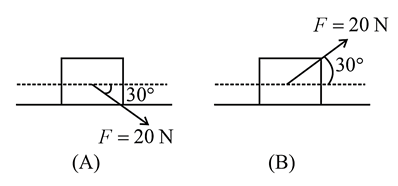
A block of mass 5 kg is (i) pushed in case (A) and (ii) pulled in case (B), by a force F = 20 N, making an angle of 30° with the horizontal, as shown in the figures. The coefficient of friction between the block and floor is $$\mu$$ = 0.2. The difference between the accelerations of the block, in case (B) and case (A) will be: (g = 10 m s$$^{-2}$$)
A spring whose unstretched length is $$l$$ has a force constant k. The spring is cut into two pieces of unstretched lengths $$l_1$$ and $$l_2$$ where, $$l_1 = nl_2$$ and n is an integer. The ratio $$k_1/k_2$$ of the corresponding force constants, k$$_1$$ and k$$_2$$ will be:
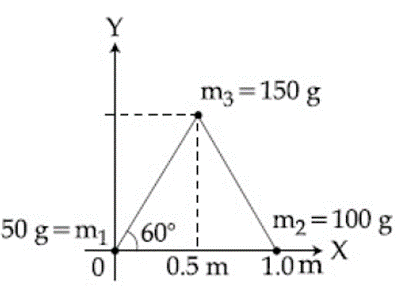
Three particles of masses 50 g, 100 g and 150 g are placed at the vertices of an equilateral triangle of side 1 m (as shown in the figure). The (x, y) coordinates of the centre of mass will be:
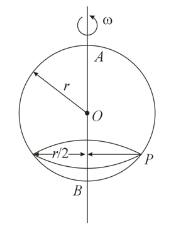
A smooth wire of length $$2\pi r$$ is bent into a circle and kept in a vertical plane. A bead can slide smoothly on the wire. When the circle is rotating with angular speed $$\omega$$ about the vertical diameter AB, as shown in figure, the bead is at rest with respect to the circular ring at position P as shown. Then the value of $$\omega^2$$ is equal to:
The ratio of the weights of a body on Earth's surface to that on the surface of a planet is 9:4. The mass of the planet is $$\frac{1}{9}$$th of that of the Earth. If R is the radius of the Earth, what is the radius of the planet? (Take the planets to have the same mass density)
A solid sphere, of radius R acquires a terminal velocity $$v_1$$ when falling (due to gravity) through a viscous fluid having a coefficient of viscosity $$\eta$$. The sphere is broken into 27 identical solid spheres. If each of these spheres acquires a terminal velocity, $$v_2$$, when falling through the same fluid, the ratio $$\left(\frac{v_1}{v_2}\right)$$ equals:
A uniform cylindrical rod of length L and radius r, is made from a material whose Young's modulus of Elasticity equals Y. When this rod is heated by temperature T and simultaneously subjected to a net longitudinal compressional force F, its length remains unchanged. The coefficient of volume expansion, of the material of the rod, is (nearly) equal to:
1 kg of water, at 20°C is heated in an electric kettle whose heating element has a mean (temperature averaged) resistance of 20 Ω. The rms voltage in the mains is 200 V. Ignoring heat loss from the kettle, time taken for water to evaporate fully is close to
[Specific heat of water = 4200 J kg$$^{-1}$$ °C$$^{-1}$$ Latent heat of water = 2260 kJ kg$$^{-1}$$]