
Join Our JEE Preparation Group
Prep with like-minded aspirants; Get access to free daily tests and study material.
Sign in
Please select an account to continue using cracku.in
↓ →
Join Our JEE Preparation Group
Prep with like-minded aspirants; Get access to free daily tests and study material.
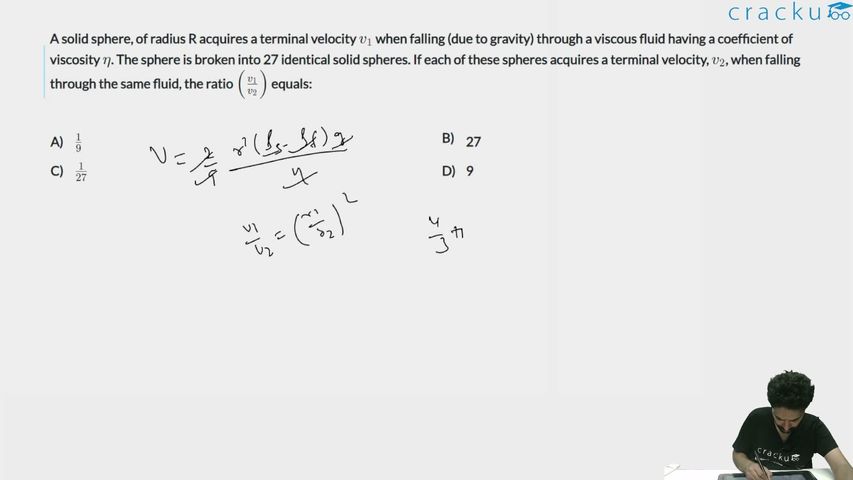
A solid sphere, of radius R acquires a terminal velocity $$v_1$$ when falling (due to gravity) through a viscous fluid having a coefficient of viscosity $$\eta$$. The sphere is broken into 27 identical solid spheres. If each of these spheres acquires a terminal velocity, $$v_2$$, when falling through the same fluid, the ratio $$\left(\frac{v_1}{v_2}\right)$$ equals:
For a small solid sphere moving slowly through a viscous fluid, we first recall Stokes’-law expression for the terminal (constant) velocity. The formula is
$$v = \frac{2}{9}\,\frac{r^{2}\,(\rho_{s}-\rho_{f})\,g}{\eta},$$
where $$r$$ is the radius of the sphere, $$\rho_{s}$$ its density, $$\rho_{f}$$ the density of the fluid, $$g$$ the acceleration due to gravity, and $$\eta$$ the coefficient of viscosity of the fluid.
When the original sphere of radius $$R$$ falls, its terminal velocity is therefore
$$v_{1}= \frac{2}{9}\,\frac{R^{2}\,(\rho_{s}-\rho_{f})\,g}{\eta}.$$
Now the same sphere is broken into 27 identical smaller spheres. Because mass (and therefore volume) is conserved, we equate the total volume before and after breaking.
The volume of the original sphere is
$$V_{\text{initial}} = \frac{4}{3}\pi R^{3}.$$
Each new sphere, of unknown radius $$r$$, has volume
$$V_{\text{one}} = \frac{4}{3}\pi r^{3}.$$
Since there are 27 such spheres, the total volume afterwards is
$$V_{\text{final}} = 27\left(\frac{4}{3}\pi r^{3}\right).$$
Setting the two volumes equal, we have
$$\frac{4}{3}\pi R^{3} = 27\left(\frac{4}{3}\pi r^{3}\right).$$
First we cancel the common factor $$\frac{4}{3}\pi$$ on both sides to obtain
$$R^{3}=27\,r^{3}.$$
Now taking the cube root of both sides, we get
$$R = 3\,r \quad\Longrightarrow\quad r = \frac{R}{3}.$$
Thus the radius of each small sphere is one-third that of the original sphere.
Applying Stokes’ law again, the terminal velocity of one of the small spheres is
$$v_{2}= \frac{2}{9}\,\frac{r^{2}\,(\rho_{s}-\rho_{f})\,g}{\eta}.$$
Substituting $$r = \dfrac{R}{3}$$ gives
$$v_{2}= \frac{2}{9}\,\frac{\left(\dfrac{R}{3}\right)^{2}\,(\rho_{s}-\rho_{f})\,g}{\eta}.$$
Evaluating the square, we have
$$\left(\dfrac{R}{3}\right)^{2}= \dfrac{R^{2}}{9},$$
so
$$v_{2}= \frac{2}{9}\,\frac{\dfrac{R^{2}}{9}\,(\rho_{s}-\rho_{f})\,g}{\eta} = \left(\frac{2}{9}\,\frac{R^{2}\,(\rho_{s}-\rho_{f})\,g}{\eta}\right)\frac{1}{9} = v_{1}\,\frac{1}{9}.$$
Finally, we form the requested ratio:
$$\frac{v_{1}}{v_{2}} = \frac{v_{1}}{v_{1}/9} = 9.$$
Hence, the correct answer is Option D.
Was this solution helpful?
Click on the Email ☝️ to Watch the Video Solution
Create a FREE account and get:
_1.webp)

Educational materials for JEE preparation

Ask our AI anything

AI can make mistakes. Please verify important information.
AI can make mistakes. Please verify important information.


