
Join Our JEE Preparation Group
Prep with like-minded aspirants; Get access to free daily tests and study material.
Sign in
Please select an account to continue using cracku.in
↓ →
Join Our JEE Preparation Group
Prep with like-minded aspirants; Get access to free daily tests and study material.
A spring whose unstretched length is $$l$$ has a force constant k. The spring is cut into two pieces of unstretched lengths $$l_1$$ and $$l_2$$ where, $$l_1 = nl_2$$ and n is an integer. The ratio $$k_1/k_2$$ of the corresponding force constants, k$$_1$$ and k$$_2$$ will be:
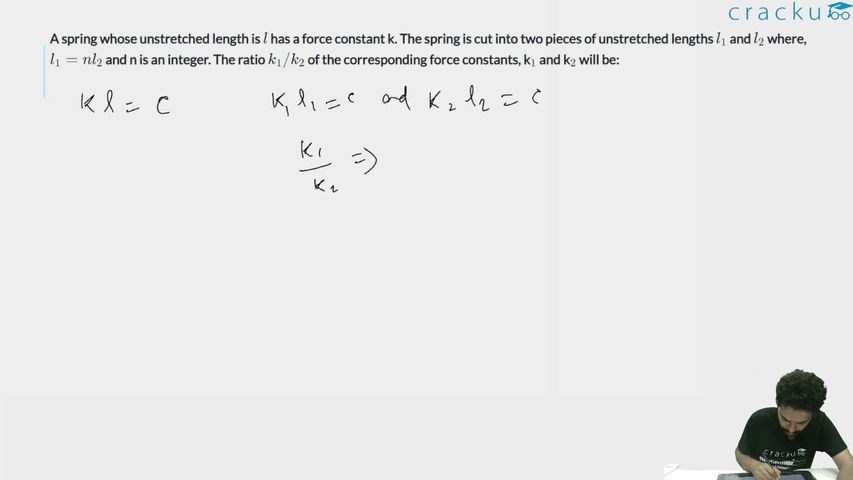
We begin with the basic property of a uniform spring: its force constant (spring constant) $$k$$ is inversely proportional to its natural or unstretched length $$l$$. In other words, for any piece cut from the same spring, the product $$k \, l$$ remains constant. We can write this as
$$k \, l = \text{constant} \qquad \text{(for a given uniform spring)}$$
Let this constant be denoted by $$C$$, so that for the original full spring we have
$$k \, l = C \quad -(1)$$
Now the spring is cut into two parts. Their natural lengths are stated to be $$l_1$$ and $$l_2$$, and the problem tells us that
$$l_1 = n \, l_2 \qquad \text{where } n \text{ is an integer.} \quad -(2)$$
Because both pieces come from the same original spring, each piece must satisfy the same relation (1). Hence for the first piece we can write
$$k_1 \, l_1 = C \quad -(3)$$
and for the second piece we can similarly write
$$k_2 \, l_2 = C. \quad -(4)$$
From equation (3) we isolate $$k_1$$:
$$k_1 = \dfrac{C}{l_1}. \quad -(5)$$
From equation (4) we isolate $$k_2$$:
$$k_2 = \dfrac{C}{l_2}. \quad -(6)$$
We are asked to find the ratio $$\dfrac{k_1}{k_2}$$. Dividing (5) by (6) we get
$$\dfrac{k_1}{k_2} = \dfrac{C/l_1}{C/l_2} = \dfrac{l_2}{l_1}. \quad -(7)$$
Now we substitute the relation between the lengths from equation (2). Because $$l_1 = n l_2$$, we can solve for $$l_2$$:
$$l_2 = \dfrac{l_1}{n}. \quad -(8)$$
Putting (8) into (7) gives
$$\dfrac{k_1}{k_2} = \dfrac{l_2}{l_1} = \dfrac{l_1/n}{l_1} = \dfrac{1}{n}. \quad -(9)$$
Thus the ratio of the spring constants of the two pieces is
$$\dfrac{k_1}{k_2} = \dfrac{1}{n}.$$
Comparing with the options provided, this matches Option D.
Hence, the correct answer is Option D.
Was this solution helpful?
Click on the Email ☝️ to Watch the Video Solution
Create a FREE account and get:
_1.webp)

Educational materials for JEE preparation

Ask our AI anything

AI can make mistakes. Please verify important information.
AI can make mistakes. Please verify important information.


