
Join Our JEE Preparation Group
Prep with like-minded aspirants; Get access to free daily tests and study material.
Sign in
Please select an account to continue using cracku.in
↓ →
Join Our JEE Preparation Group
Prep with like-minded aspirants; Get access to free daily tests and study material.
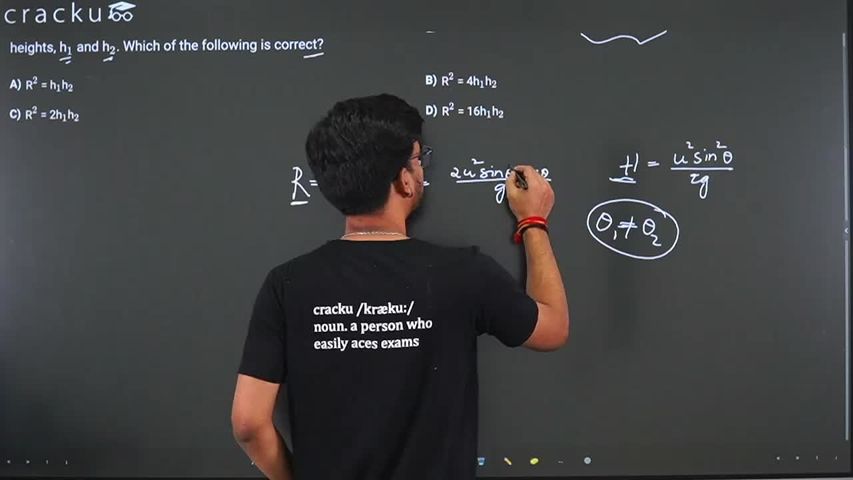
Two particles are projected from the same point with the same speed u such that they have the same range R, but different maximum heights, h$$_1$$ and h$$_2$$. Which of the following is correct?
Let the two particles be projected with the common speed $$u$$, one making an angle $$\theta$$ with the horizontal, and the other making the complementary angle $$90^\circ-\theta$$. Since the angles are complementary, the two projectiles automatically have the same horizontal range.
First, we recall the standard formula for the range of a projectile launched with speed $$u$$ at an angle $$\alpha$$:
$$R=\frac{u^{2}\sin 2\alpha}{g}\,.$$
Applying this to the angle $$\theta$$, we get
$$R=\frac{u^{2}\sin 2\theta}{g}\,.$$
For the complementary angle $$90^\circ-\theta$$ we have
$$R=\frac{u^{2}\sin 2(90^\circ-\theta)}{g} =\frac{u^{2}\sin(180^\circ-2\theta)}{g} =\frac{u^{2}\sin 2\theta}{g}\,,$$
which is clearly the same value, confirming that both projectiles indeed possess the same range $$R$$.
Next, we need the individual maximum heights. The well-known formula for the maximum height of a projectile launched with speed $$u$$ at angle $$\alpha$$ is
$$h=\frac{u^{2}\sin^{2}\alpha}{2g}\,.$$
Hence, for the first projectile launched at $$\theta$$, the maximum height is
$$h_1=\frac{u^{2}\sin^{2}\theta}{2g}\,.$$
For the second projectile launched at the angle $$90^\circ-\theta$$, we use $$\sin(90^\circ-\theta)=\cos\theta$$, giving
$$h_2=\frac{u^{2}\sin^{2}(90^\circ-\theta)}{2g} =\frac{u^{2}\cos^{2}\theta}{2g}\,.$$
We now form the product of the two maximum heights:
$$h_1h_2=\left(\frac{u^{2}\sin^{2}\theta}{2g}\right) \left(\frac{u^{2}\cos^{2}\theta}{2g}\right) =\frac{u^{4}\sin^{2}\theta\cos^{2}\theta}{4g^{2}}\,.$$
Let us keep this result in mind and move to the square of the common range. From the range expression we have already written,
$$R=\frac{u^{2}\sin 2\theta}{g} =\frac{u^{2}\cdot 2\sin\theta\cos\theta}{g} =\frac{2u^{2}\sin\theta\cos\theta}{g}\,.$$
Squaring this gives
$$R^{2} =\left(\frac{2u^{2}\sin\theta\cos\theta}{g}\right)^{2} =\frac{4u^{4}\sin^{2}\theta\cos^{2}\theta}{g^{2}}\,.$$
We now compare $$R^{2}$$ with $$h_1h_2$$. Observe that
$$h_1h_2=\frac{u^{4}\sin^{2}\theta\cos^{2}\theta}{4g^{2}}\,,$$
$$R^{2}=\frac{4u^{4}\sin^{2}\theta\cos^{2}\theta}{g^{2}}
=16\left(\frac{u^{4}\sin^{2}\theta\cos^{2}\theta}{4g^{2}}\right)
=16\,h_1h_2\,.$$
We have therefore arrived at the simple relation
$$R^{2}=16\,h_1h_2\,.$$
Hence, the correct answer is Option D.
Was this solution helpful?
Click on the Email ☝️ to Watch the Video Solution
Create a FREE account and get:
_1.webp)

Educational materials for JEE preparation

Ask our AI anything

AI can make mistakes. Please verify important information.
AI can make mistakes. Please verify important information.


