
Join Our JEE Preparation Group
Prep with like-minded aspirants; Get access to free daily tests and study material.
Sign in
Please select an account to continue using cracku.in
↓ →
Join Our JEE Preparation Group
Prep with like-minded aspirants; Get access to free daily tests and study material.
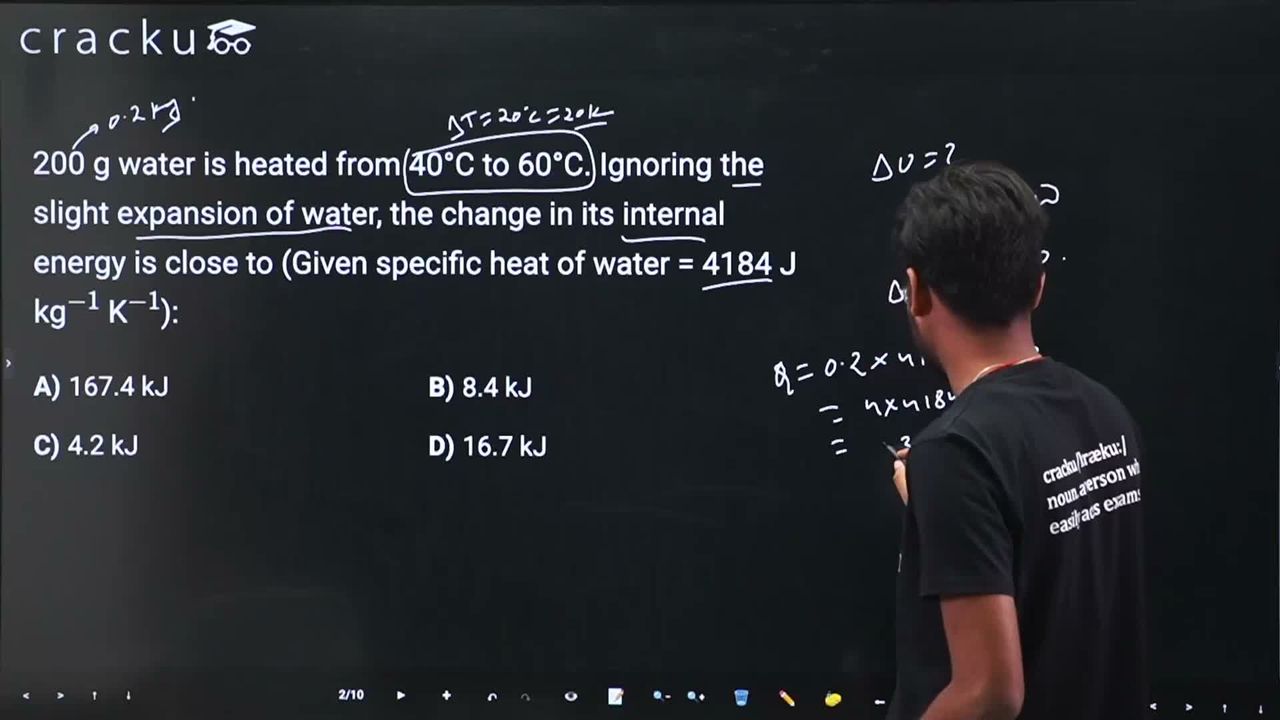
200 g water is heated from 40°C to 60°C. Ignoring the slight expansion of water, the change in its internal energy is close to (Given specific heat of water = 4184 J kg$$^{-1}$$ K$$^{-1}$$):
We have been asked to calculate the change in internal energy of water when its temperature rises from 40 °C to 60 °C. The mass of the water given is 200 g. We are told to ignore the very small volume expansion of water in this temperature interval, so we can safely treat the specific heat at constant pressure $$c_p$$ as effectively equal to the specific heat at constant volume $$c_v$$. That means the heat supplied translates directly into a change in internal energy.
First, we rewrite every quantity in convenient SI units.
The specific heat of water is supplied as
$$c = 4184\ \text{J kg}^{-1}\ \text{K}^{-1}.$$
The mass is 200 g. Since $$1\ \text{kg}=1000\ \text{g}$$, we convert:
$$m = 200\ \text{g} = \frac{200}{1000}\ \text{kg} = 0.2\ \text{kg}.$$
The temperature change is simply the difference between the final and the initial temperature. We note that a temperature interval in degrees Celsius is numerically the same as in kelvin, so
$$\Delta T = T_{\text{final}} - T_{\text{initial}} = 60^\circ\text{C} - 40^\circ\text{C} = 20\ \text{K}.$$
We now recall the relation connecting heat, specific heat and temperature change for a fixed mass of substance:
$$Q = m\,c\,\Delta T.$$
Because we are neglecting expansion, the heat $$Q$$ supplied goes entirely into increasing the internal energy $$\Delta U$$ of the water, so we can write
$$\Delta U = Q.$$
Substituting the known values, we get
$$\Delta U = m\,c\,\Delta T = (0.2\ \text{kg})(4184\ \text{J kg}^{-1}\ \text{K}^{-1})(20\ \text{K}).$$
Let us multiply step by step. First multiply the specific heat by the temperature change:
$$4184\ \text{J kg}^{-1}\ \text{K}^{-1} \times 20\ \text{K} = 83680\ \text{J kg}^{-1}.$$
Now multiply by the mass:
$$\Delta U = 0.2\ \text{kg} \times 83680\ \text{J kg}^{-1} = 16736\ \text{J}.$$
Finally, convert joules to kilojoules, since the answer choices are expressed that way. We know $$1\ \text{kJ}=1000\ \text{J}$$, so
$$\Delta U = \frac{16736\ \text{J}}{1000} = 16.736\ \text{kJ}.$$
Rounding to three significant figures, the change in internal energy is approximately $$16.7\ \text{kJ}$$.
Among the given options, this value matches Option D.
Hence, the correct answer is Option D.
Was this solution helpful?
Click on the Email ☝️ to Watch the Video Solution
Create a FREE account and get:
_1.webp)

Educational materials for JEE preparation

Ask our AI anything

AI can make mistakes. Please verify important information.
AI can make mistakes. Please verify important information.
