For the following questions answer them individually
In the following $$I$$ refers to current and other symbols have their usual meaning. Choose the option that corresponds to the dimensions of electrical conductivity:
A rocket is fired vertically from the earth with an acceleration of 2g, where g is the gravitational acceleration. On an inclined plane inside the rocket, making an angle $$\theta$$ with the horizontal, a point object of mass m is kept. The minimum coefficient of friction $$\mu_{min}$$ between the mass and the inclined surface such that the mass does not move is:
Which of the following option correctly describes the variation of the speed v and acceleration 'a' of a point mass falling vertically in a viscous medium that applies a force $$F = -kv$$, where 'k' is a constant, on the body? (Graphs are schematic and not drawn to scale)
A car of weight W is on an inclined road that rises by 100 m over a distance of 1 km and applies a constant frictional force $$\frac{W}{20}$$ on the car. While moving uphill on the road at a speed of 10 ms$$^{-1}$$, the car needs power P. If it needs power $$\frac{P}{2}$$ while moving downhill at speed v then the value of v is:
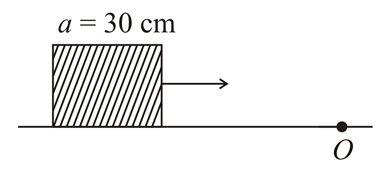
A cubical block of side 30 cm is moving with velocity 2 m s$$^{-1}$$ on a smooth horizontal surface. The surface has a bump at a point O as shown in the figure. The angular velocity (in rad/s) of the block immediately after it hits the bump, is:
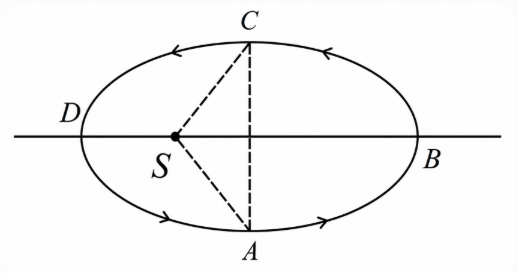
The figure shows an elliptical path $$ABCD$$ of a planet around the sun $$S$$ such that the area of triangle $$CSA$$ is $$\frac{1}{4}^\text{th}$$ the area of the ellipse (see the figure below) with $$DB$$ as the major axis, and $$CA$$ as the minor axis. If $$t_1$$ is the time taken for the planet to go over the path $$ABC$$ and $$t_2$$ for the path taken over $$CDA$$ then:
A uniformly tapering conical wire is made from a material of Young's modulus $$Y$$ and has a normal, unextended length $$L$$. The radii, at the upper and lower ends of this conical wire, have values $$R$$ and $$3R$$, respectively. The upper end of the wire is fixed to a rigid support and a mass $$M$$ is suspended from its lower end. The equilibrium extended length, of this wire, would equal:
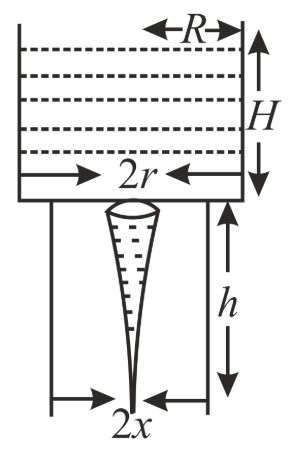
Consider a water jar of radius R that has water filled up to height H and is kept on a stand of height h. Through a hole of radius r (r << R) at its bottom, the water leaks out and the stream of water coming down towards the ground has a shape like a funnel as shown in the figure. If the radius of the cross-section of water stream when it hits the ground is x, then:
A simple pendulum made of a bob of mass m and a metallic wire of a negligible mass has a time period of 2 s at $$T = 0°C$$. If the temperature of the wire is increased, and the corresponding change in its time period is plotted against its temperature, the resulting graph is a line of slope $$S$$. If the coefficient of linear expansion of metal is $$\alpha$$, then the value of $$S$$ is
The ratio of work done by an ideal monoatomic gas to the heat supplied to it in an isobaric process is