
Join Our JEE Preparation Group
Prep with like-minded aspirants; Get access to free daily tests and study material.
Sign in
Please select an account to continue using cracku.in
↓ →
Join Our JEE Preparation Group
Prep with like-minded aspirants; Get access to free daily tests and study material.
A body travels 102.5 m in the $$n^{th}$$ second and 115.0 m in the $$(n+2)^{th}$$ second. The acceleration is:
A body travels 102.5 m in the $$n$$-th second and 115.0 m in the $$(n+2)$$-th second. We need to find the acceleration.
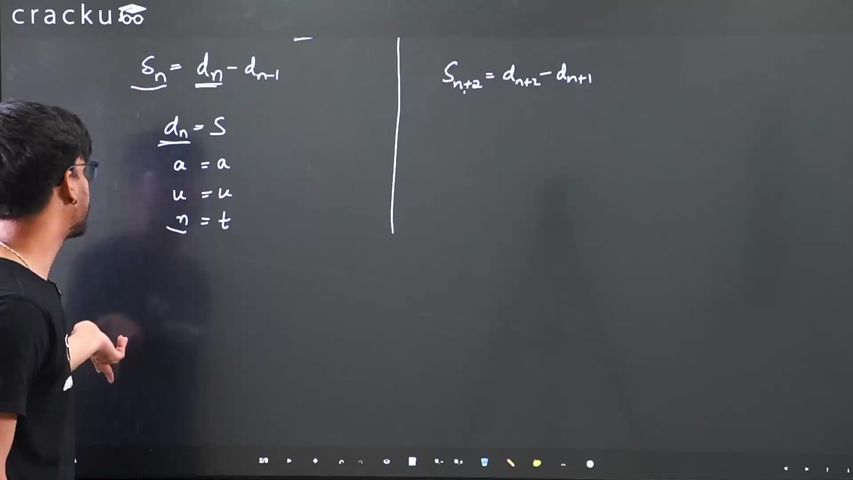
For a body with initial velocity $$u$$ and constant acceleration $$a$$, the distance covered in the $$n$$-th second (i.e., between $$t = n-1$$ and $$t = n$$) is given by $$ s_n = u + \frac{a}{2}(2n - 1)\,. $$ This formula follows from $$s_n = S(n) - S(n-1) = \left(un + \frac{1}{2}an^2\right) - \left(u(n-1) + \frac{1}{2}a(n-1)^2\right) = u + \frac{a}{2}(2n-1)\,. $$
Using the given data, for the $$n$$-th second we have $$ s_n = u + \frac{a}{2}(2n - 1) = 102.5\,, $$ and for the $$(n+2)$$-th second $$ s_{n+2} = u + \frac{a}{2}(2(n+2) - 1) = u + \frac{a}{2}(2n + 3) = 115.0\,. $$
Subtracting these two equations gives $$ s_{n+2} - s_n = \frac{a}{2}[(2n+3) - (2n-1)]\,, $$ so $$ 115.0 - 102.5 = \frac{a}{2}[2n + 3 - 2n + 1]\,, $$ which simplifies to $$ 12.5 = \frac{a}{2} \times 4 \quad\Longrightarrow\quad 12.5 = 2a\,. $$
Therefore, $$ a = \frac{12.5}{2} = 6.25 \text{ m/s}^2\,. $$ The correct answer is Option (1): 6.25 m/s2.
Was this solution helpful?
Click on the Email ☝️ to Watch the Video Solution
Create a FREE account and get:
_1.webp)

Educational materials for JEE preparation

Ask our AI anything

AI can make mistakes. Please verify important information.
AI can make mistakes. Please verify important information.
