
Join Our JEE Preparation Group
Prep with like-minded aspirants; Get access to free daily tests and study material.
Sign in
Please select an account to continue using cracku.in
↓ →
Join Our JEE Preparation Group
Prep with like-minded aspirants; Get access to free daily tests and study material.
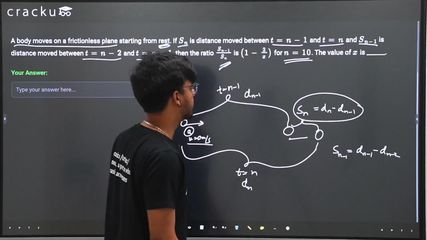
A body moves on a frictionless plane starting from rest. If $$S_n$$ is distance moved between $$t = n - 1$$ and $$t = n$$ and $$S_{n-1}$$ is distance moved between $$t = n - 2$$ and $$t = n - 1$$, then the ratio $$\frac{S_{n-1}}{S_n}$$ is $$\left(1 - \frac{2}{x}\right)$$ for $$n = 10$$. The value of $$x$$ is ______.
Correct Answer: 19
A body starts from rest on a frictionless plane. We are given the formula for the ratio $$\frac{S_{n-1}}{S_n} = \left(1 - \frac{2}{x}\right)$$ for $$n = 10$$, and we need to find $$x$$.
We first recall the distance covered in the $$n$$-th second under uniform acceleration.
For a body starting from rest (initial velocity $$u = 0$$) with uniform acceleration $$a$$, the distance covered from $$t = 0$$ to $$t = n$$ is:
$$ S(n) = \frac{1}{2}an^2 $$
The distance covered in the $$n$$-th second (between $$t = n-1$$ and $$t = n$$) is:
$$ S_n = S(n) - S(n-1) = \frac{1}{2}an^2 - \frac{1}{2}a(n-1)^2 $$
Expanding $$(n-1)^2 = n^2 - 2n + 1$$:
$$ S_n = \frac{a}{2}\left[n^2 - (n^2 - 2n + 1)\right] = \frac{a}{2}(2n - 1) $$
Similarly, replacing $$n$$ with $$n-1$$ in the formula gives:
$$ S_{n-1} = \frac{a}{2}(2(n-1) - 1) = \frac{a}{2}(2n - 3) $$
Next, we compute the ratio $$\frac{S_{n-1}}{S_n}$$.
$$ \frac{S_{n-1}}{S_n} = \frac{\frac{a}{2}(2n-3)}{\frac{a}{2}(2n-1)} = \frac{2n - 3}{2n - 1} $$
This fraction can be rewritten as:
$$ \frac{2n - 3}{2n - 1} = \frac{(2n-1) - 2}{2n - 1} = 1 - \frac{2}{2n - 1} $$
Since $$\frac{S_{n-1}}{S_n} = 1 - \frac{2}{x}$$, equating this to $$1 - \frac{2}{2n - 1}$$ gives:
$$ \frac{2}{x} = \frac{2}{2n - 1} $$
$$ x = 2n - 1 $$
Finally, substituting $$n = 10$$ gives:
$$ x = 2(10) - 1 = 20 - 1 = 19 $$
The value of $$x$$ is $$\boxed{19}$$.
Was this solution helpful?
Click on the Email ☝️ to Watch the Video Solution
Create a FREE account and get:
_1.webp)

Educational materials for JEE preparation

Ask our AI anything

AI can make mistakes. Please verify important information.
AI can make mistakes. Please verify important information.
