
Join Our JEE Preparation Group
Prep with like-minded aspirants; Get access to free daily tests and study material.
Sign in
Please select an account to continue using cracku.in
↓ →
Join Our JEE Preparation Group
Prep with like-minded aspirants; Get access to free daily tests and study material.
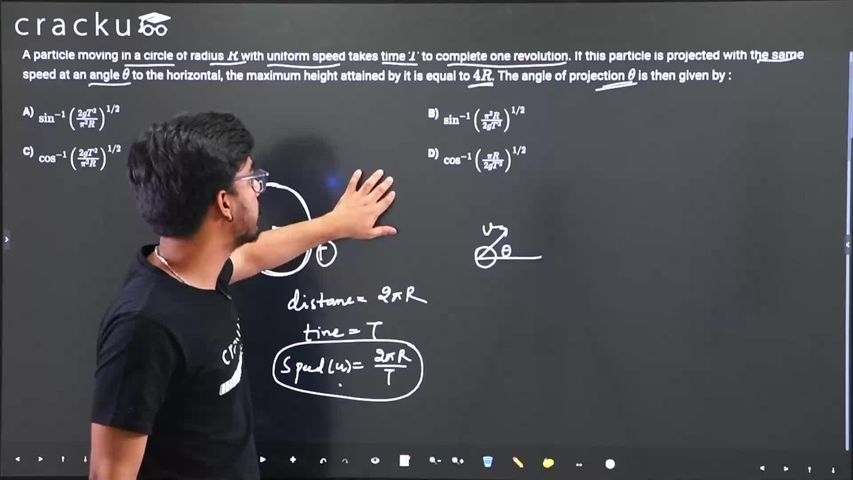
A particle moving in a circle of radius $$R$$ with uniform speed takes time $$T$$ to complete one revolution. If this particle is projected with the same speed at an angle $$\theta$$ to the horizontal, the maximum height attained by it is equal to $$4R$$. The angle of projection $$\theta$$ is then given by :
In uniform circular motion, speed $$v$$ is given by dividing the circumference by the period:
$$v = \frac{2\pi R}{T}$$ $$-(1)$$
The maximum height $$H$$ reached by a projectile with initial speed $$u$$ at angle $$\theta$$ is given by the formula:
Formula: $$H = \frac{u^2 \sin^2 \theta}{2g}$$.
Setting $$u = v$$, we have:
$$H = \frac{v^2 \sin^2 \theta}{2g}$$ $$-(2)$$.
Given that this height equals $$4R$$, substitute (1) into (2):
$$4R = \frac{\Bigl(\frac{2\pi R}{T}\Bigr)^2 \sin^2 \theta}{2g}$$.
Simplify the square:
$$\Bigl(\frac{2\pi R}{T}\Bigr)^2 = \frac{4\pi^2 R^2}{T^2}$$. Thus
$$4R = \frac{4\pi^2 R^2 \sin^2 \theta}{2g T^2} = \frac{2\pi^2 R^2 \sin^2 \theta}{g T^2}$$.
Divide both sides by $$R$$ and rearrange:
$$4 = \frac{2\pi^2 R \sin^2 \theta}{g T^2} \quad\Longrightarrow\quad \sin^2 \theta = \frac{4gT^2}{2\pi^2 R} = \frac{2g T^2}{\pi^2 R}$$ $$-(3)$$.
Taking the positive square root (angle is acute):
$$\sin \theta = \sqrt{\frac{2g T^2}{\pi^2 R}}\quad\Longrightarrow\quad \theta = \sin^{-1}\!\sqrt{\frac{2g T^2}{\pi^2 R}}\!.$$
Therefore, the required angle of projection is
$$\theta = \sin^{-1}\Bigl(\frac{2gT^2}{\pi^2R}\Bigr)^{1/2},$$ which corresponds to Option A.
Was this solution helpful?
Click on the Email ☝️ to Watch the Video Solution
Create a FREE account and get:
_1.webp)

Educational materials for JEE preparation

Ask our AI anything

AI can make mistakes. Please verify important information.
AI can make mistakes. Please verify important information.
