
Join Our JEE Preparation Group
Prep with like-minded aspirants; Get access to free daily tests and study material.
Sign in
Please select an account to continue using cracku.in
↓ →
Join Our JEE Preparation Group
Prep with like-minded aspirants; Get access to free daily tests and study material.
A particle is moving in one dimension (along $$x$$ axis) under the action of a variable force. Its initial position was $$16$$ m right of origin. The variation of its position $$x$$ with time $$t$$ is given as $$x = -3t^3 + 18t^2 + 16t$$, where $$x$$ is in m and $$t$$ is in s. The velocity of the particle when its acceleration becomes zero is _________ m s$$^{-1}$$.
Correct Answer: 52
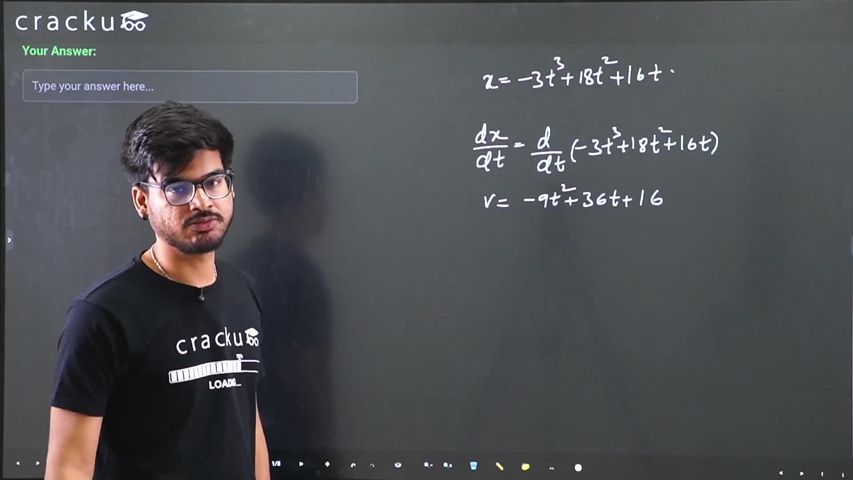
Given $$x = -3t^3 + 18t^2 + 16t$$, we want to find the velocity when the acceleration is zero.
Differentiating the position with respect to time gives the velocity: $$ v = \frac{dx}{dt} = \frac{d}{dt}(-3t^3 + 18t^2 + 16t) = -9t^2 + 36t + 16 $$.
Further differentiating the velocity yields the acceleration: $$ a = \frac{dv}{dt} = \frac{d}{dt}(-9t^2 + 36t + 16) = -18t + 36 $$.
Setting the acceleration to zero gives $$ -18t + 36 = 0 \implies 18t = 36 \implies t = 2 \text{ s} $$.
Substituting $$t = 2$$ s into the velocity expression gives $$ v(2) = -9(2)^2 + 36(2) + 16 = -9(4) + 72 + 16 = -36 + 72 + 16 = 52 \text{ m/s} $$.
The answer is 52 m/s.
Was this solution helpful?
Click on the Email ☝️ to Watch the Video Solution
Create a FREE account and get:
_1.webp)

Educational materials for JEE preparation

Ask our AI anything

AI can make mistakes. Please verify important information.
AI can make mistakes. Please verify important information.
