JEE WhatsApp Group




JEE Optics PYQs
JEE Optics PYQs are an important part of the JEE Physics section. These questions test how well you understand the basic concepts of optics used in different problem types like reflection, refraction, lenses, mirrors, prisms, optical instruments, wave optics, and ray diagrams.
You may get optics questions as direct formula-based numericals or as part of longer conceptual problems. The good thing is, these questions become much easier once your basics are clear and you know which formula or concept to apply. You do not need to make optics feel difficult. With clear fundamentals, regular practice, and careful calculation, you can solve most questions with confidence.
In this blog, you will find a simple formula PDF, a section for important JEE Optics PYQs in download format, a set of practice questions with answers, and some extra questions to solve on your own. You will also learn about common mistakes students make and a few easy tips to save time in the exam.
JEE Optics Important PYQs PDF
This PDF can include the most asked previous year questions from important optics topics such as reflection, refraction, ray diagrams, mirrors, lenses, prisms, optical instruments, interference, diffraction, and polarization. Solving these questions will help you understand the exam pattern better and improve your speed and accuracy.
Important Formulas for JEE Optics PYQs
You only need a few basic formulas to solve most optics questions in JEE. These formulas help you find image distance, focal length, magnification, refractive index, and other values used in mirrors, lenses, and wave optics.
You can download the full formula PDF from the link above. Here is a quick look at some of the main ones:
Concept | Formula |
Mirror Formula | 1/f = 1/v + 1/u |
Lens Formula | 1/f = 1/v - 1/u |
Magnification in Mirror | m = -v/u |
Magnification in Lens | m = v/u |
Refractive Index | n = c/v |
Snell’s Law | n₁ sin i = n₂ sin r |
Power of Lens | P = 1/f (in metre) |
Combination of Lenses | P = P₁ + P₂ + P₃ |
Critical Angle | sin C = 1/n |
Young’s Double Slit Fringe Width | β = λD/d |
These formulas are useful for solving questions on ray optics, wave optics, lenses, mirrors, prisms, interference, and other optics-based problems that often appear in JEE.
Top 5 Common Mistakes to Avoid in JEE Optics PYQs
Many students lose marks in optics not because the chapter is too hard, but because of small mistakes. Here are some common mistakes you should avoid:
Forgetting sign convention: In mirrors and lenses, sign convention is very important. A small sign mistake can give the wrong answer.
Using the wrong formula: First identify whether the question is based on a mirror, lens, prism, or wave optics before applying any formula.
Ignoring units: Always check whether focal length is given in cm or metre, especially in power of lens questions.
Drawing incorrect ray diagrams: In image-based questions, a wrong ray path can confuse the whole solution.
Not reading the question carefully: Sometimes the question asks for image position, sometimes magnification, and sometimes nature of image. Read properly before solving.
List of JEE Optics PYQs
Here’s a short set of JEE-style optics questions to help you practice. These include common question types from mirrors, lenses, refraction, interference, and optical instruments. Practice these regularly to become faster and more confident before your JEE exam.
Question 1
As shown in the diagram, when the incident ray is parallel to base of the prism, the emergent ray grazes along the second surface.
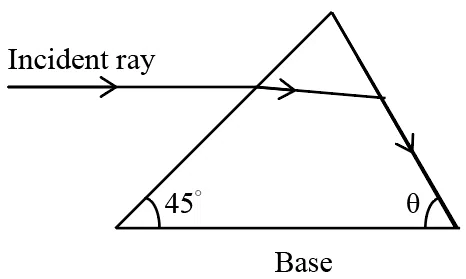
If refractive index of the material of prism is $$\sqrt{2}$$, the angle $$\theta$$ of prism is.
correct answer:- 2
Question 2
A collimated beam of light of diameter 2 mm is propagating along x-axis. The beam is required to be expanded in a collimated beam of diameter 14 mm using a system of two convex lenses. lf first lens has focal length 40 mm, then the focal length of second lens is ____ mm.
correct answer:- 280
Question 3
In a microscope the objective is having focal length $$f_{0}=2 \text{cm}$$ and eye-piece is having focal length $$f_{e} = 4 \text{cm}$$ The tube length is 32 cm. the magnification produced by this microscope for normal adjustment is _______.
correct answer:- 100
Question 4
In parallax method for the determination of focal length of a concave mirror, the object should always be placed:
correct answer:- 2
Question 5
Consider light travelling from a medium A to medium B separated by a plane interface. If the light undergoes total internal reflection during its travel from medium A to B and the speed of light in media A and B are $$2.4\times10^{8}m/s\text{ and }2.7\times10^{8}m/s$$ respecti vely, then the value of critical angle is :
correct answer:- 3

Question 6
A thin prism with angle 5° of refractive index 1.72 is combined with another prism of refractive index 1.9 to produce dispersion w ithout deviation. The angle of second prism is ____ .
correct answer:- 2
Question 7
Consider an equilateral prism (refractive index $$\sqrt{2}$$). A ray of light is incident on its one surface at a ce1tain angle $$i$$. If the emergent ray is found to graze along the other surface then the angle of refraction at the incident surface is close to ______.
correct answer:- 4
Question 8
A thin convex lens of focal length 5 cm and a thin concave lens of focal length 4 cm are combined together (without any gap) and this combination has magnification $$m_{1}$$ when an object is placed 10 cm before the convex lens. Keeping the positions of convex lens and object undisturbed a gap of 1 cm is introduced between the lenses by moving the concave lens away, which lead to a change in magnification of total lens system to $$m_{2}$$.
The value of $$ \mid\frac{m_{1}}{m_{2}}\mid $$ is______.
correct answer:- 5
Question 9
A parallel beam of light travelling in air (refractive index 1.0) is incident on a convex spherical glass surface of radius of curvature 50 cm. Refractive index of glass is 1.5. The rays converge to a point at a distance $$x$$ cm from the centre of the curvature of the spherical surface. The value of $$x$$ is ____ cm
correct answer:- 100
Question 10
Au unpolarised light is incident at an inteiface of two dielectric media having refractive indices of 2 (incident medium) and $$2\sqrt{3}$$ (medium) respectively. To satisfy the condition that reflected and refracted rays are perpendicular to each other, the angle of incidence is ___.
correct answer:- 3

Question 11
TI1e exit surface of a prism with refractive index n is coated with a material having refractive index $$\frac{n}{2}$$. When this prism is set for minimum angle of deviation, it exactly meets the condition of critical angle. The prism angle is ___ .
correct answer:- 1
Question 12
In a microscope of tube length 1O cm two convex lenses are arranged with focal length of 2 cm and 5 cm. Total magnification obtained with this system for normal adjustment is $$(5)^{k}$$ The value of k is ___.
correct answer:- 1
Question 13
Distance between an object and three times magnified real image is 40 cm. The focal length of the minor used is ___ cm.
correct answer:- 2
Question 14
Five persons $$P_{1},P_{2},P_{3},P{4}, \text{and} P_{5}$$ recorded object distance (u) and image distance (v) using same convex lens having powei· +5D as (25,96), (30,62), (35,37), (45,35)
and (50,32) respectively. Identify correct statement
correct answer:- 4
Question 15
The magnitudes of power of a biconvex lens (refractive index 1.5) and that of a piano-concave lens (refractive index = l.7) are same. If the curvature of plano-concave lens exactly matches with the curvature of back surface of the biconvex lens, then ratio of radius of curvature of front and back smface of the biconvex lens is________.
correct answer:- 2

Question 16
A convex lens of refractive index 1.5 and focal length f = 18 cm is immersed in water. The difference in focal lengths of the given lens when it is in water and in air is $$\alpha \times f$$. The value of$$\alpha$$ is______.
(refractive index of water = 4/3)
correct answer:- 3
Question 17
A prism of angle $$75^{o}$$ and refractive index $$\sqrt{3}$$ is coated with thin film of refractive index 1.5 only at the back exit surface. To have total internal reflection at the back exit surface the incident angle must be______.
($$\sin 15^{o}$$ = 0.25 and $$\sin 25^{o}$$ = 0.43)
correct answer:- 4
Question 18
The size of the images of an object, formed by a thin lens are equal when the object is placed at two different positions 8 cm and 24 cm from the lens. The focal length of the lens is _______ cm.
correct answer:- 16
Question 19
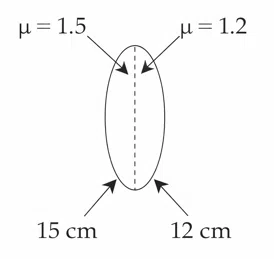
A biconvex lens is formed by using two thin planoconvex lenses, as shown in the figure. The refractive index and radius of curved surfaces are also mentioned in figure. When an object is placed on the left side of lens at a distance of 30 cm from the biconvex lens, the magnification of the image will be:
correct answer:- 2
Question 20
For a transparent prism, if the angle of minimum deviation is equal to its refracting angle, the refractive index n of the prism satisfies.
correct answer:- 4

Question 21
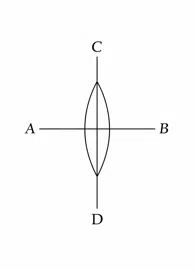
A symmetric thin biconvex lens is cut into four equal parts by two planes AB and CD as shown in figure. If the power of original lens is 4 D then the power of a part of the divided lens is
correct answer:- 3
Question 22
A transparent film of refractive index, 2.0 is coated on a glass slab of refractive index, 1.45. What is the minimum thickness of transparent film to be coated for the maximum transmission of Green light of wavelength 550 nm . [Assume that the light is incident nearly perpendicular to the glass surface.]
correct answer:- 1
Question 23
Given is a thin convex lens of glass (refractive index $$\mu$$) and each side having radius of curvature R. One side is polished for complete reflection. At what distance from the lens, an object be placed on the optic axis so that the image gets formed on the object itself ?
correct answer:- 4
Question 24
In the diagram given below, there are three lenses formed. Considering negligible thickness of each of them as compared to $$\mid R_1 \mid \text{ and } \mid R_2 \mid$$, i.e., the radii of curvature for upper and lower surfaces of the glass lens, the power of the combination is
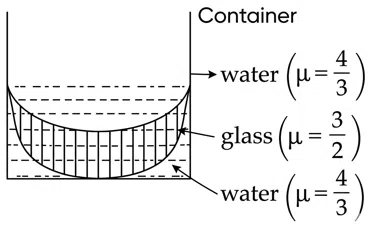
correct answer:- 4
Question 25
The driver sitting inside a parked car is watching vehicles approaching from behind with the help of his side view mirror, which is a convex mirror with radius of curvature R=2 m. Another car approaches him from behind with a uniform speed of 90 km/hr. When the car is at a distance of 24 m from him, the magnitude of the acceleration of the image of the car in the side view mirror is ' a '. The value of 100 a is ________ $$m/s^{2}$$.
correct answer:- 8

Question 26
A concave mirror of focal length $$f$$ in air is dipped in a liquid of refractive index $$\mu$$. Its focal length in the liquid will be:
correct answer:- 2
Question 27
5 The refractive index of the material of a glass prism is $$\sqrt{3}$$. The angle of minimum deviation is equal to the angle of the prism. What is the angle of the prism?
correct answer:- 1
Question 28
What is the relative decrease in focal length of a lens for an increase in optical power by $$0.1\,D$$ from $$2.5\,D? \quad [\text{'D' stands for dioptre}] $$
correct answer:- 2
Question 29
A thin plano convex lens made of glass of refractive index 1.5 is immersed in a liquid of refractive index 1.2. When the plane side of the lens is silver coated for complete reflection, the lens immersed in the liquid behaves like a concave mirror of focal length 0.2 m . The radius of curvature of the curved surface of the lens is
correct answer:- 4
Question 30
A plano-convex lens having radius of curvature of first surface $$2\,cm$$ exhibits focal length $$f_1$$ in air. Another plano-convex lens with first surface radius of curvature $$3\,cm$$ has focal length $$f_2$$ when it is immersed in a liquid of refractive index $$1.2.$$ If both the lenses are made of same glass of refractive index $$1.5,$$ then the ratio $$f_1:f_2$$ will be:
correct answer:- 2
Question 31
A photograph of a landscape is captured by a drone camera at a height of 18 km . The size of the camera film is $$ 2 cm \times 2 cm $$ and the area of the landscape photographed is $$ 400 km^{2} $$. The focal length of the lens in the drone camera is :
correct answer:- 1
Question 32
A thin prism $$P_{1}$$ with angle $$4^{\circ}$$ made of glass having refractive index 1.54 , is combined with another thin prism $$P_{2}$$ made of glass having refractive index 1.72 to get dispersion without deviation. The angle of the prism $$P_{2}$$ in degrees is
correct answer:- 1
Question 33
A hemispherical vessel is completely filled with a liquid of refractive index $$\mu$$. A small coin is kept at the lowest point (O) of the vessel as shown in figure. The minimum value of the refractive index of the liquid so that a person can see the coin from point E (at the level of the vessel) is
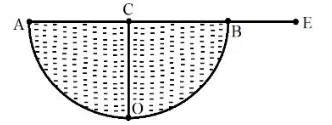
correct answer:- 4
Question 34
At the interface between two materials having refractive indices $$n_{1}$$ and $$n_{2}$$, the critical angle for reflection of an em wave is $$\theta_{1C}$$. The $$n_{2}$$ material is replaced by another material having refractive index $$n_{3}$$ such that the critical angle at the interface between $$n_{1}$$ and $$n_{3}$$ materials is $$\theta_{2C}$$. If $$n_{3} > n_{2} > n_{1};\frac{n_{2}}{n_{3}}=\frac{2}{5}$$ and $$\sin \theta_{2C}-\sin \theta_{1C}=\frac{1}{2}$$, then $$\theta_{1C}$$ is
correct answer:- 3
Question 35
Let u and $$\upsilon$$ be the distances of the object and the image from a lens of focal length $$f$$. The correct graphical representation of U and $$\upsilon$$ for a convex lens when $$|u| >$$, is
correct answer:- 3
Question 36
Two light beams fall on a transparent material block at point 1 and 2 with angle $$\theta_{1}$$ and $$\theta_{2}$$,respectively, as shown in figure. After refraction, the beams intersect at point 3 which is exactly on the interface at other end of the block. Given : the distance between 1 and 2, $$d = 4\sqrt{3} cm$$ and $$\theta_{1} = \theta_{2} = \cos^{-1}(\frac{n_{2}}{2n_{1}})$$, where refractive index of the block $$n_{2} > $$ refractive index of the outside medium $$n_{1}$$, then the thickness of the block is ________cm.
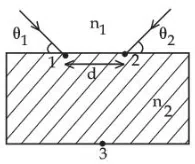
correct answer:- 6
Question 37
A spherical surface of radius of curvature R, separates air from glass (refractive index = 1.5). The centre of curvature is in the glass medium. A point object 'O' placed in air on the optic axis of the surface, so that its real image is formed at 'I' inside glass. The line OI intersects the spherical surface at P and PO=PI . The distance PO equals to
correct answer:- 1
Question 38
Given a thin convex lens (refractive index $$\mu_{2}$$), kept in a liquid (refractive index $$\mu_{1},\mu_{1}<\mu_{2}$$) having radii of curvatures $$|R_{1}|$$ and $$|R_{2}|$$ . Its second surface is silver polished. Where should an object be placed on the optic axis so that a real and inverted image is formed at the same place?
correct answer:- 1
Question 39
What is the lateral shift of a ray refracted through a parallel-sided glass slab of thickness 'h' in terms of the angle of incidence 'i' and angle of refraction 'r', if the glass slab is placed in air medium?
correct answer:- 2
Question 40
Two identical symmetric double convex lenses of focal length f are cut into two equal parts $$L_{1}, L_{2}$$ by AB plane and $$L_{3}, L_{4}$$ by XY plane as shown in figure respectively. The ratio of focal lengths of lenses $$L_{1}$$ and $$L_{3}$$ i
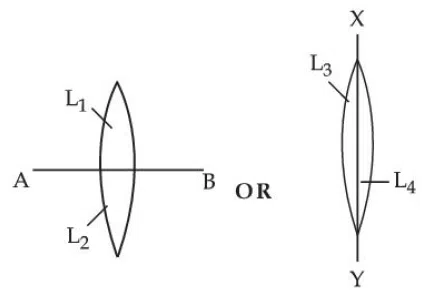
correct answer:- 2
Question 41
A convex lens made of glass (refractive index = 1.5) has focal length 24 cm in air. When it is totally immersed in water (refractive index 1.33), its focal length changes to
correct answer:- 2
Question 42
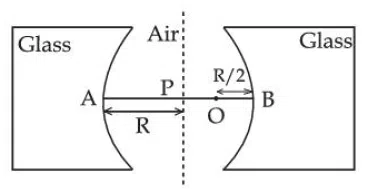
Two concave refracting surfaces of equal radii of curvature and refractive index 1.5 face each other in air as shown in figure. A point object O is placed midway, between P and B . The separation between the images of O , formed by each refracting surface is :
correct answer:- 4
Question 43
An effective power of a combination of 5 identical convex lenses which are kept in contact along the principal axis is 25D. Focal length of each of the convex lens is:
correct answer:- 1
Question 44
A concave mirror produces an image of an object such that the distance between the object and image is 20 cm . If the magnification of the image is ' -3 ', then the magnitude of the radius of curvature of the mirror is :
correct answer:- 3
Question 45
In a long glass tube, mixture of two liquids A and B with refractive indices 1.3 and 1.4 respectively, forms a convex refractive meniscus towards . If an object placed at 13 cm from the vertex of the meniscus in A forms an image with a magnification of '-2' then the radius of curvature of meniscus is :
correct answer:- 4
Question 46
Which of the following phenomena can not be explained by wave theory of light?
correct answer:- 1
Question 47
The distance between object and its $$3$$ times magnified virtual image as produced by a convex lens is $$20$$ cm. The focal length of the lens used is ________ cm.
correct answer:- 15
Question 48
If the refractive index of the material of a prism is $$\cot\left(\frac{A}{2}\right)$$, where $$A$$ is the angle of prism then the angle of minimum deviation will be
correct answer:- 1
Question 49
Two immiscible liquids of refractive indices $$\frac{8}{5}$$ and $$\frac{3}{2}$$ respectively are put in a beaker as shown in the figure. The height of each column is $$6$$ cm. A coin is placed at the bottom of the beaker. For near normal vision, the apparent depth of the coin is $$\frac{\alpha}{4}$$ cm. The value of $$\alpha$$ is _______.
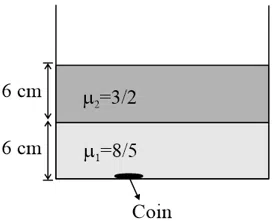
correct answer:- 31
Question 50
A convex mirror of radius of curvature $$30$$ cm forms an image that is half the size of the object. The object distance is :
correct answer:- 3
.webp)