
Join Our JEE Preparation Group
Prep with like-minded aspirants; Get access to free daily tests and study material.
Sign in
Please select an account to continue using cracku.in
↓ →
Join Our JEE Preparation Group
Prep with like-minded aspirants; Get access to free daily tests and study material.
As shown in the diagram, when the incident ray is parallel to base of the prism, the emergent ray grazes along the second surface.If refractive index of the material of prism is $$\sqrt{2}$$, the angle $$\theta$$ of prism is.
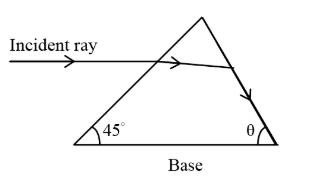
Let the refracting angle (apex angle) of the prism be $$A$$.
From the geometry of the triangle, the sum of the angles is $$180^\circ$$:
$$A + 45^\circ + \theta = 180^\circ$$
$$A = 135^\circ - \theta \quad \text{--- (Equation 1)}$$
1.Refraction at the first surface
The incident ray is parallel to the base. Because the left base angle is $$45^\circ$$, the angle between the incident ray and the prism face is $$45^\circ$$. Therefore, the angle of incidence $$i_1$$ with respect to the normal is:
$$i_1 = 90^\circ - 45^\circ = 45^\circ$$
Applying Snell's Law at the first interface (air to glass):
$$n_1 \sin i_1 = n_2 \sin r_1$$
$$1 \cdot \sin(45^\circ) = \sqrt{2} \cdot \sin(r_1)$$
$$r_1 = 30^\circ$$
2: Refraction at the second surface
The emergent ray grazes the second surface, meaning the angle of emergence $$e$$ is $$90^\circ$$.
Applying Snell's Law at the second interface (glass to air):
$$n_2 \sin r_2 = n_1 \sin e$$
$$\sqrt{2} \cdot \sin(r_2) = 1 \cdot \sin(90^\circ)$$
$$\sin(r_2) = \frac{1}{\sqrt{2}}$$
$$r_2 = 45^\circ$$
3: Calculating the angle $$\theta$$
For a prism, the apex angle $$A$$ is equal to the sum of the internal angles of refraction:
$$A = r_1 + r_2$$
$$A = 30^\circ + 45^\circ = 75^\circ$$
Substitute the value of $$A$$ back into Equation 1:
$$75^\circ = 135^\circ - \theta$$
$$\theta = 135^\circ - 75^\circ$$
$$\theta = 60^\circ$$
Was this solution helpful?
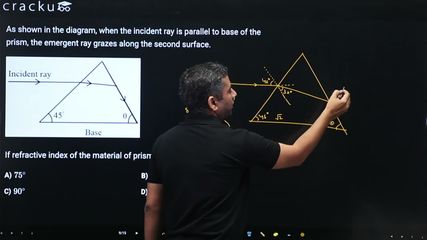
Click on the Email ☝️ to Watch the Video Solution
Create a FREE account and get:
_1.webp)

Educational materials for JEE preparation

Ask our AI anything

AI can make mistakes. Please verify important information.
AI can make mistakes. Please verify important information.
