
Join Our JEE Preparation Group
Prep with like-minded aspirants; Get access to free daily tests and study material.
Sign in
Please select an account to continue using cracku.in
↓ →
Join Our JEE Preparation Group
Prep with like-minded aspirants; Get access to free daily tests and study material.
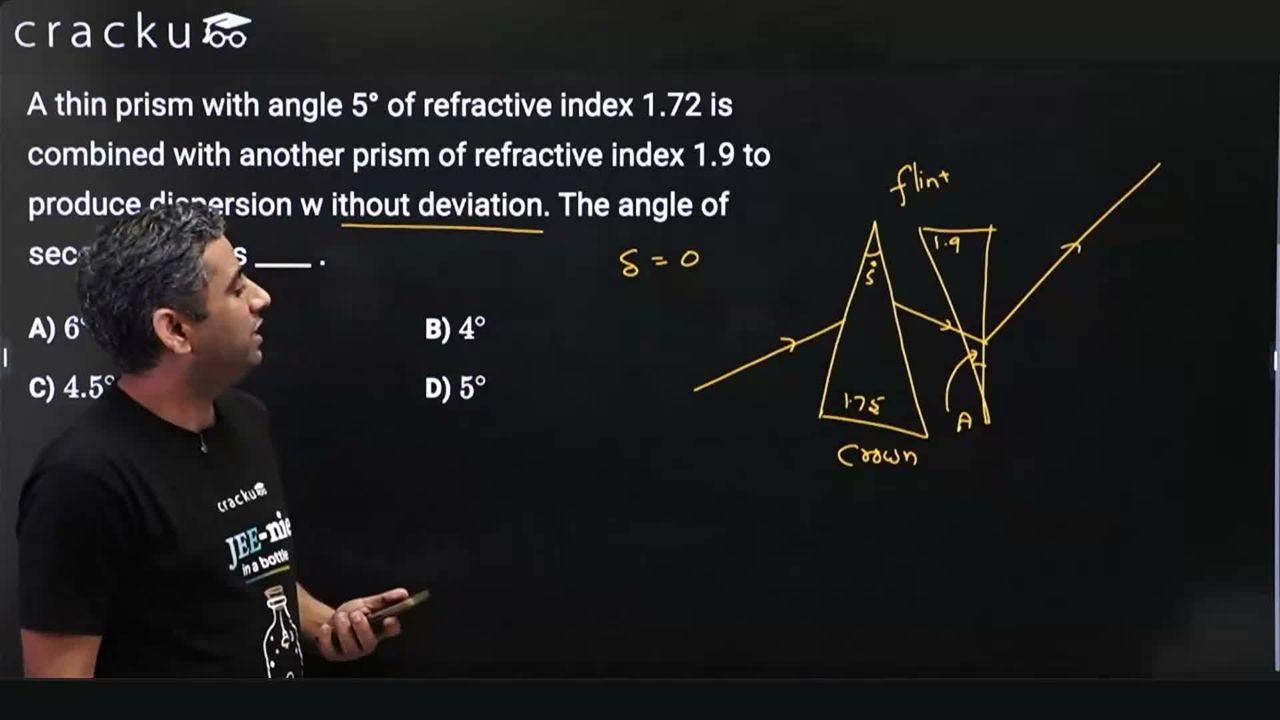
A thin prism with angle 5° of refractive index 1.72 is combined with another prism of refractive index 1.9 to produce dispersion w ithout deviation. The angle of second prism is ____ .
We need to find the angle of the second prism when two thin prisms are combined to produce dispersion without deviation.
We first state the deviation formula for a thin prism.
For a thin prism with small angle $$A$$ and refractive index $$n$$, the deviation is given by:
$$ \delta = (n - 1)A $$
This formula is derived from Snell's law under the small-angle approximation ($$\sin\theta \approx \theta$$).
Next, we set up the condition for zero net deviation.
When two prisms are combined in opposite orientations, their deviations act in opposite directions. For the net deviation to be zero:
$$ \delta_1 + \delta_2 = 0 $$
This implies:
$$ (n_1 - 1)A_1 = (n_2 - 1)A_2 $$
(The deviations must be equal in magnitude but opposite in direction.)
Substituting the given values $$n_1 = 1.72$$, $$A_1 = 5°$$, and $$n_2 = 1.9$$ into this equation gives:
$$ (1.72 - 1) \times 5 = (1.9 - 1) \times A_2 $$
$$ 0.72 \times 5 = 0.9 \times A_2 $$
$$ 3.6 = 0.9 \times A_2 $$
Solving for $$A_2$$ yields:
$$ A_2 = \frac{3.6}{0.9} = 4° $$
The correct answer is Option B: $$4°$$.
Was this solution helpful?
Click on the Email ☝️ to Watch the Video Solution
Create a FREE account and get:
_1.webp)

Educational materials for JEE preparation

Ask our AI anything

AI can make mistakes. Please verify important information.
AI can make mistakes. Please verify important information.
