
Join Our JEE Preparation Group
Prep with like-minded aspirants; Get access to free daily tests and study material.
Sign in
Please select an account to continue using cracku.in
↓ →
Join Our JEE Preparation Group
Prep with like-minded aspirants; Get access to free daily tests and study material.
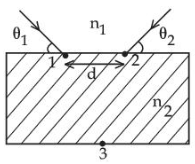
Two light beams fall on a transparent material block at point 1 and 2 with angle $$\theta_{1}$$ and $$\theta_{2}$$, respectively, as shown in figure. After refraction, the beams intersect at point 3 which is exactly on the interface at other end of the block. Given : the distance between 1 and 2, $$d = 4\sqrt{3} cm$$ and $$\theta_{1} = \theta_{2} = \cos^{-1}(\frac{n_{2}}{2n_{1}})$$, where refractive index of the block $$n_{2} > $$ refractive index of the outside medium $$n_{1}$$, then the thickness of the block is ________cm.
Correct Answer: 6
The angles $$\theta_1$$ and $$\theta_2$$ are given with respect to the surface interface.
$$\text{Angle of incidence}, \quad i_1 = i_2 = 90^\circ - \theta_1$$
$$\theta_1 = \cos^{-1}\left(\frac{n_2}{2n_1}\right) \implies \cos\theta_1 = \frac{n_2}{2n_1} \implies \sin i_1 = \frac{n_2}{2n_1}$$
Applying Snell's law at the first interface:
$$n_1 \sin i_1 = n_2 \sin r_1 \implies n_1 \left(\frac{n_2}{2n_1}\right) = n_2 \sin r_1$$
$$\frac{n_2}{2} = n_2 \sin r_1 \implies \sin r_1 = \frac{1}{2} \implies r_1 = 30^\circ$$
Let $$t$$ be the thickness of the block. From the symmetric ray geometry converging at point 3:
$$\tan r_1 = \frac{d/2}{t}$$
$$\tan(30^\circ) = \frac{4\sqrt{3}/2}{t} \implies \frac{1}{\sqrt{3}} = \frac{2\sqrt{3}}{t}$$
$$t = 2\sqrt{3} \times \sqrt{3} = 6\text{ cm}$$
Was this solution helpful?
Click on the Email ☝️ to Watch the Video Solution
Create a FREE account and get:
_1.webp)

Educational materials for JEE preparation

Ask our AI anything

AI can make mistakes. Please verify important information.
AI can make mistakes. Please verify important information.
