
Join Our JEE Preparation Group
Prep with like-minded aspirants; Get access to free daily tests and study material.
Sign in
Please select an account to continue using cracku.in
↓ →
Join Our JEE Preparation Group
Prep with like-minded aspirants; Get access to free daily tests and study material.
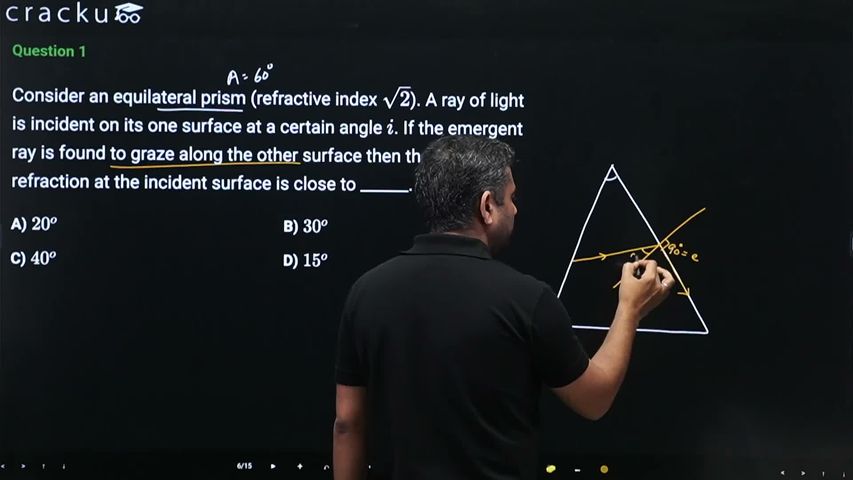
Consider an equilateral prism (refractive index $$\sqrt{2}$$). A ray of light is incident on its one surface at a certain angle $$i$$. If the emergent ray is found to graze along the other surface then the angle of refraction at the incident surface is close to ______.
We have an equilateral prism, so the prism angle $$A = 60^{\circ}$$, and the refractive index $$\mu = \sqrt{2}$$.
The emergent ray grazes along the second surface, which means the angle of emergence is $$e = 90^{\circ}$$. This means the angle of refraction at the second surface equals the critical angle $$C$$.
At the critical angle, $$\sin C = \frac{1}{\mu} = \frac{1}{\sqrt{2}}$$
So, $$C = 45^{\circ}$$
This means the angle of refraction at the second surface is $$r_2 = C = 45^{\circ}$$.
For a prism, the relation between the prism angle and the angles of refraction at the two surfaces is:
$$r_1 + r_2 = A$$
where $$r_1$$ is the angle of refraction at the incident surface and $$r_2$$ is the angle of refraction at the emergent surface.
So, $$r_1 = A - r_2 = 60^{\circ} - 45^{\circ} = 15^{\circ}$$
Hence, the angle of refraction at the incident surface is $$15^{\circ}$$, which corresponds to Option D.
Was this solution helpful?
Click on the Email ☝️ to Watch the Video Solution
Create a FREE account and get:
_1.webp)

Educational materials for JEE preparation

Ask our AI anything

AI can make mistakes. Please verify important information.
AI can make mistakes. Please verify important information.
