JEE WhatsApp Group



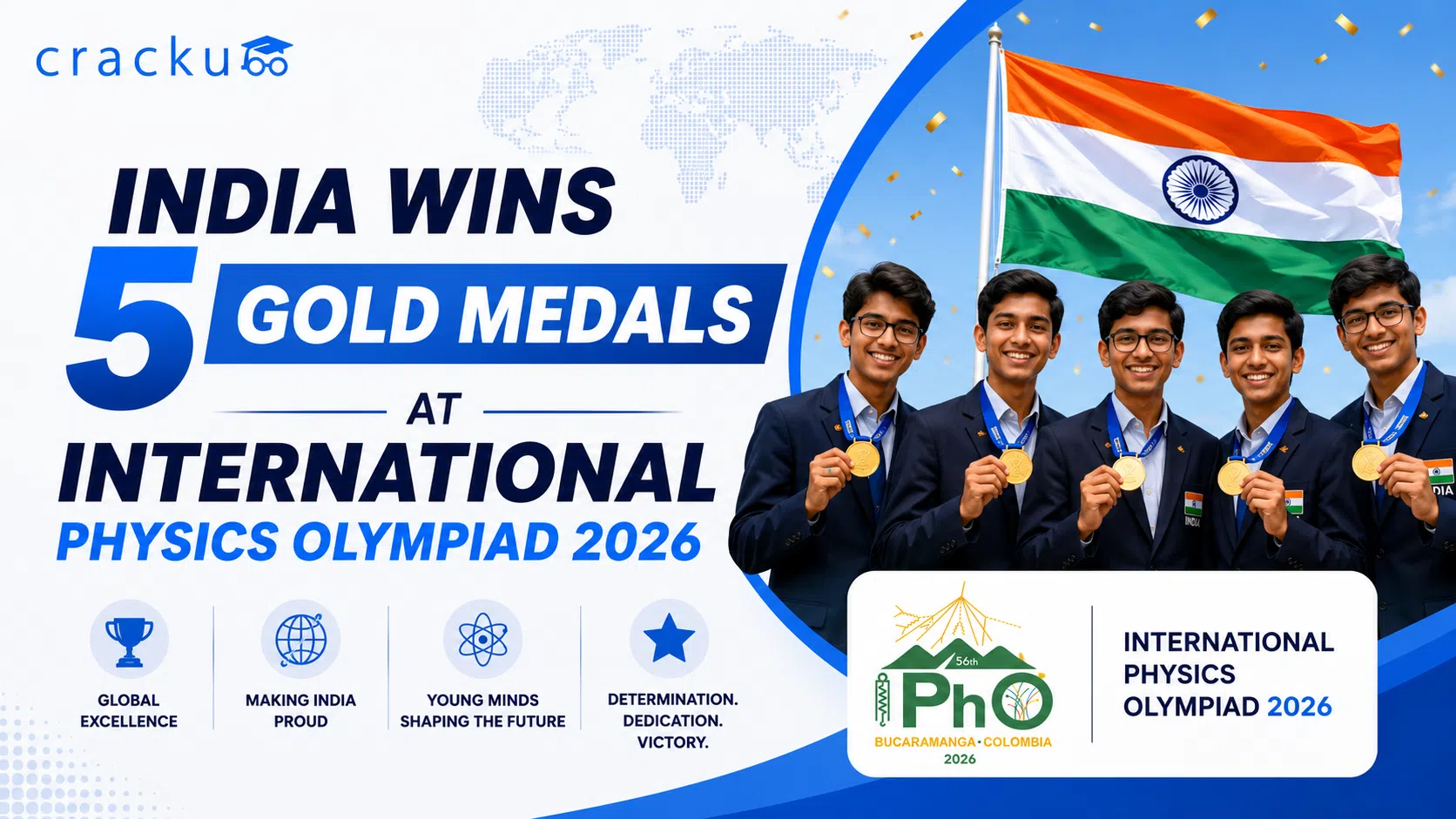
Five students. Five gold medals. Joint World No. 1 rank among 87 countries. On July 12, 2026, India completed a perfect sweep at the 56th International Physics Olympiad (IPhO) held in Bucaramanga, Colombia, matching its own 2018 record and joining an elite group of six countries at the top of the global standings. The 381-student competition featured the world's most gifted pre-university physics minds, and every single Indian team member came home with gold.
This is not a routine achievement. A clean sweep at IPhO places India among the highest echelon of science education nations, alongside China, Russia, and South Korea, countries that have invested in systematic physics talent identification for decades. The fact that India has now done it twice, in 2018 and 2026, suggests a system that is producing consistent results, not occasional luck.
India Wins 5 Gold Medals at International Physics Olympiad 2026
India's five-member team at IPhO 2026 achieved what only a handful of countries have managed in the competition's history: every team member earning a gold medal in the same year. The Indian contingent shared the joint World No. 1 rank with China, Kazakhstan, Russia, South Korea, and Taiwan, all of whom also fielded perfect five-gold teams. The complete statistics of the 2026 contest are below.
Statistic | Detail |
|---|---|
Edition | 56th International Physics Olympiad (IPhO) 2026 |
Host City and Country | Bucaramanga, Colombia |
Dates | July 5 to July 12, 2026 |
Total Participating Students | 381 |
Total Participating Countries | 87 |
India's Medal Count | 5 Gold medals (all five team members) |
India's Country Rank | Joint World No. 1 (shared with China, Kazakhstan, Russia, South Korea, Taiwan) |
Special Prize (Overall Winner) | South Korea |
India's Appearance Count at IPhO | 27th appearance |
Second time India won all 5 golds | Yes (first was in 2018) |
One number that often gets overlooked in the medal count is this: in India's 27 appearances at IPhO, 44 per cent of all Indian participants have won gold, 41 per cent silver, 10 per cent bronze, and 5 per cent honourable mentions. In the last ten years specifically, every Indian student has returned with either gold (62 per cent) or silver (38 per cent). There have been no bronze medals for India in the last decade. That is not a talent spike. That is a system working.
Also Read: Cracku's JEE Foundation WhatsApp Group 2027, Join Now
International Physics Olympiad 2026 Medal Winners from India
The five gold medallists represent five different cities across four states, which is itself a meaningful data point: Indian physics talent is not concentrated in one metropolitan hub. The winning team and its accompanying staff are listed below.
Gold Medallist | City | State |
|---|---|---|
Kanishk Jain | Pune | Maharashtra |
Riddhesh Anant Bendale | Indore | Madhya Pradesh |
Rishit Garg | Dwarka, New Delhi | Delhi |
Shresth Suraiya | Mumbai | Maharashtra |
Svarit Joshi | Ahmedabad | Gujarat |
The accompanying delegation that led and supported the team:
Role | Name | Institution |
|---|---|---|
Team Leader | Prof. Anwesh Mazumdar | HBCSE-TIFR, Mumbai |
Team Leader | Dr. Leena Joshi | St. Xavier's College, Mumbai |
Scientific Observer | Prof. Ananda Dasgupta | IISER Kolkata |
Scientific Observer | Nisha Kelkar | Gogate-Joglekar College, Ratnagiri |
64 per cent of IPhO medallists from India have chosen academic careers (defined by pursuing a PhD in any subject), and 32 per cent of all medallists have settled in India. These figures, shared by HBCSE, challenge the common assumption that Olympiad success primarily produces talent that leaves India.
Also Read: Is NCERT Enough for JEE Main and Advanced Preparation?
International Physics Olympiad 2026 Results and Country Rankings
The joint ranking reflects the structure of IPhO scoring: countries are ranked by the number of gold medals their team wins, with a maximum of five possible (one per team member). Six countries achieved the maximum in 2026, all sharing the top position. The South Korean student who won the special prize for the overall highest individual score added another dimension to their country's performance.
Joint Rank | Countries (All with 5 Gold Medals) |
|---|---|
Joint World No. 1 | India, China, Kazakhstan, Russia, South Korea, Taiwan |
India's result is significant in context. Among the six joint-rank-1 countries, China, Russia, Kazakhstan, and South Korea have histories of top-five IPhO finishes spanning multiple decades. India's consistent presence in this group over the past decade, culminating in a second perfect sweep, positions the country among the world's genuinely elite physics education nations rather than occasional high performers.
Also Read: Common Mistakes to Avoid in IIT JEE Preparation, Check Now
What Is the International Physics Olympiad (IPhO)?
The International Physics Olympiad is an annual academic competition for pre-university students, typically in the final two years of secondary school. It is one of the International Science Olympiads, alongside the International Mathematical Olympiad (IMO), International Chemistry Olympiad (IChO), and others. IPhO was first held in 1967 in Warsaw, Poland, and has grown from a small Eastern European competition to a genuinely global event.
Each participating country sends a team of five students, accompanied by two team leaders. The competition runs across two days of examinations: a theoretical paper and an experimental paper, each three hours long. The theoretical paper typically has three complex problems requiring deep conceptual understanding and mathematical modelling. The experimental paper requires students to design and execute an experiment in a novel setting, with limited time and equipment.
What makes IPhO distinctly hard: unlike most school physics exams, IPhO problems are not solvable by memorising formulas. They require the ability to model an unfamiliar physical situation from first principles, apply multiple branches of physics simultaneously, and perform precision experimental work under time pressure. A student who has only studied textbook physics will struggle; a student who understands physics deeply enough to derive rather than recall will find the problems accessible.
The problems are set by the host country and reviewed by team leaders before the competition. Medals are awarded on a percentile basis: the top approximately 8 per cent of individual scores receive gold, the next 17 per cent silver, and the next 25 per cent bronze.
The depth of conceptual understanding required for IPhO begins with NCERT textbooks, which form the foundation of every serious physics preparation path. Cracku's NCERT Solutions covers Physics, Chemistry, and Mathematics across Class 6 to 12, making it a reliable resource for students building the conceptual base from which Olympiad preparation branches out.
Also Read: How to Prepare for IMO Along with JEE Foundation
How Are Students Selected for the International Physics Olympiad from India?
India's IPhO selection is managed by the Homi Bhabha Centre for Science Education (HBCSE), a National Centre of the Tata Institute of Fundamental Research (TIFR), operating under the Department of Atomic Energy (DAE). HBCSE is India's nodal agency for all international science Olympiads. The process is rigorous, multi-stage, and nationwide.
Stage | What Happens |
|---|---|
Stage 1: National Standard Examination (NSE) | A written exam conducted by IAPT (Indian Association of Physics Teachers) across the country for Class 11 and 12 students; the top performers advance to Stage 2 |
Stage 2: Indian National Physics Olympiad (INPhO) | A deeper, problem-solving exam conducted by HBCSE; students who qualify this stage are called INPhO merit awardees |
Stage 3: Orientation Cum Selection Camp (OCSC) | A residential training camp at HBCSE, Mumbai, where top INPhO awardees are trained and the final 5-member team is selected through internal assessments |
Stage 4: Pre-departure Training | Intensive preparation for the experimental and theoretical components of IPhO; faculty from HBCSE and IISERs contribute to this training |
Stage 5: International Physics Olympiad | The final 5-member team represents India at the IPhO held annually in the host country |
The significance of starting early: The NSE, Stage 1, is open to students from Class 11 and 12. Many of the students who eventually make the IPhO team begin Olympiad preparation in Class 9 or 10, not because the material requires it but because the problem-solving depth and pattern-recognition skills that separate Olympiad-level students from strong-school-level students take years to develop. The training is not about memorising more; it is about thinking differently about problems.
Students in Class 8 to 10 who want to build the foundation for future Olympiad participation or JEE Advanced excellence can start with Cracku's JEE Foundation Course, which is specifically designed to build the deep conceptual understanding in Physics, Chemistry, and Mathematics that both Olympiad preparation and JEE Advanced require.
India's Performance in International Physics Olympiad Over the Years
India's 2026 performance is best understood against its own trajectory. The country first participated in IPhO in 1998 and has gradually moved from occasional podium appearances to consistent top-tier performance. The table below shows India's gold medal count at IPhO from 2018 to 2026, the period of most sustained excellence.
Year | Host Country | India's Gold Medals | Notable |
|---|---|---|---|
2018 | Portugal | 5 | First time India won all 5 gold; joint rank 1 |
2019 | Israel | 3 | |
2020 | Russia | 4 | Virtual edition due to COVID-19 |
2021 | Lithuania | 4 | Hybrid edition |
2022 | Switzerland | 2 | |
2023 | Japan | 3 | |
2024 | Iran | 4 | |
2025 | UK | 3 | |
2026 | Colombia | 5 | Second time India won all 5 gold; joint rank 1 with 5 other countries |
Three patterns emerge from this data. First, India has never fallen below 2 golds in the last nine years. Second, the 2026 clean sweep is not an isolated peak but the culmination of a period where 4-gold years were becoming routine. Third, India's participation in IPhO has now reached 27 years, long enough to produce a generation of mentors who were themselves Olympiad alumni, a flywheel effect that HBCSE has deliberately cultivated.
What the HBCSE system actually does differently: The training at HBCSE is not accelerated textbook coverage. The orientation camps expose students to research-level problems, experimental design under uncertainty, and the kind of physics that is done in laboratories rather than classrooms. Faculty from IISERs and IITs contribute to the training. The result is that the five students who represent India at IPhO each year have been exposed to a style of physics thinking that is genuinely rare at the pre-university level anywhere in the world.
India Wins 5 Gold Medals at International Physics Olympiad 2026: Conclusion
India's outstanding performance at the International Physics Olympiad 2026 reflects the country's growing excellence in advanced science education. Winning all five gold medals and securing the Joint World No.1 position among 87 participating nations is a remarkable achievement that highlights the effectiveness of India's Olympiad training ecosystem. The success of Kanishk Jain, Riddhesh Anant Bendale, Rishit Garg, Shresth Suraiya, and Svarit Joshi will inspire thousands of aspiring physicists across the country.
For students aiming to represent India at future International Physics Olympiads or excel in competitive exams like JEE Advanced, building strong conceptual foundations from an early stage is essential. With disciplined preparation, problem-solving practice, and guidance through the HBCSE selection process, talented students can aspire to achieve similar international success and contribute to India's growing legacy in global science competitions.
.webp)