JEE WhatsApp Group


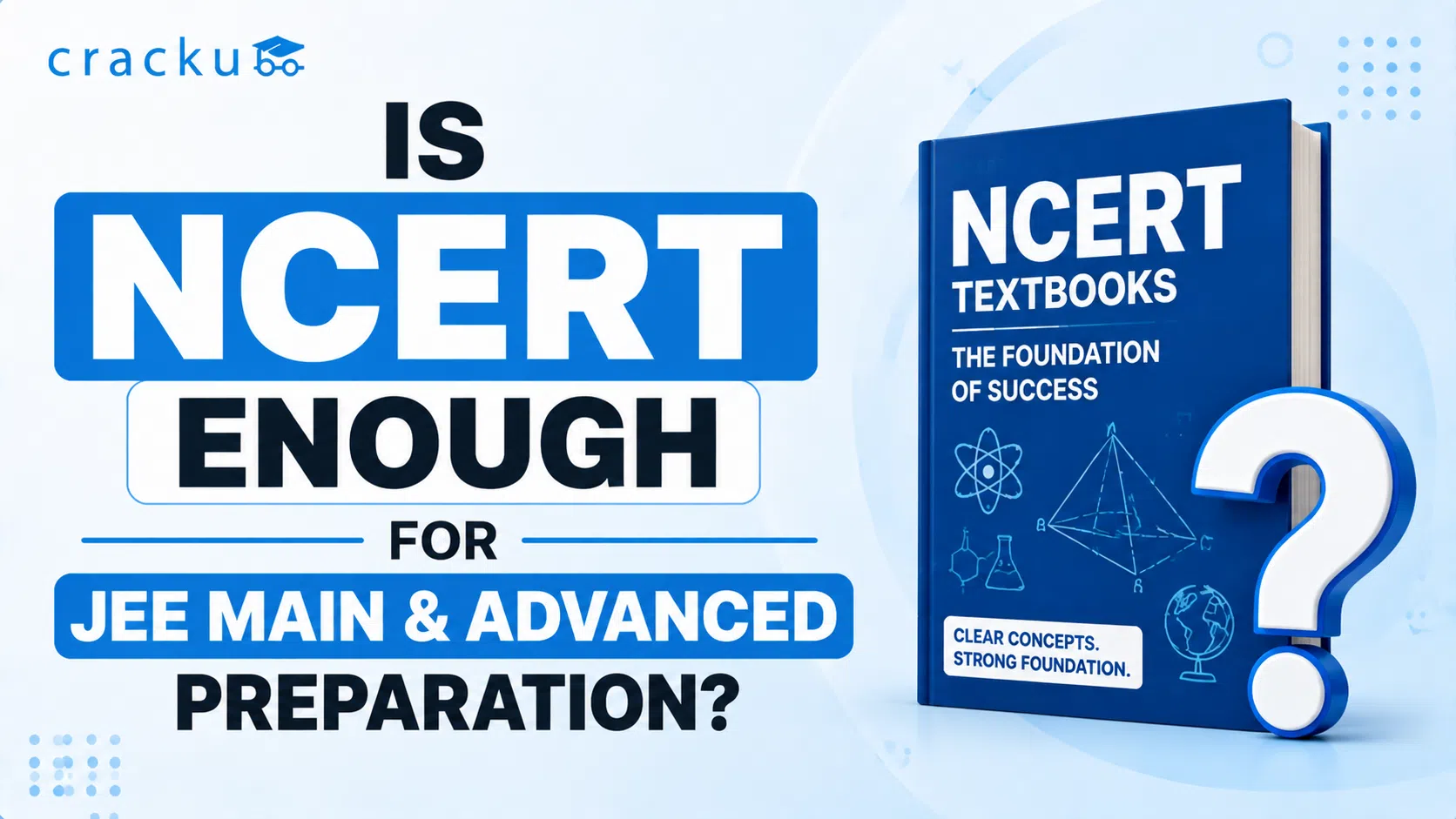
Importance of NCERT in JEE Foundation: For most JEE aspirants, the journey begins with a single question: where do I start? The answer given by toppers, teachers, and coaching institutes almost universally points to NCERT books. Whether you are building a JEE Foundation in Class 9 or 10, or preparing for JEE Main and Advanced in Classes 11 and 12, NCERT forms the bedrock of your study plan. This article explains the importance of NCERT for JEE Foundation, how to use these books smartly, and when you need to go beyond them.
Importance of NCERT in JEE Foundation
NCERT books are developed by the National Council of Educational Research and Training and form the official curriculum base for CBSE students. For JEE preparation, these books hold special value because they present core concepts in a clear, structured, and progressive manner.
When students begin their JEE Foundation preparation in Classes 9 and 10, the primary goal is to build strong conceptual clarity in Physics, Chemistry, and Mathematics. NCERT books serve this purpose effectively. The language is simple, examples are relatable, and every topic is introduced from the ground up.
JEE questions, particularly in JEE Main, test conceptual understanding rather than rote knowledge. NCERT builds exactly this kind of understanding. Topics like basic algebra, coordinate geometry, chemical reactions, and laws of motion are explained through definitions, derivations, and solved examples that serve as the foundation for harder JEE-level problems in later classes.
Key Benefits of NCERT for JEE Foundation
Benefit | Details |
|---|---|
Conceptual Clarity | Topics explained from basics with clear definitions and solved examples |
CBSE Alignment | Covers Class 9-12 syllabus that directly overlaps with JEE Foundation topics |
Accessibility | Freely available online via the official ncert.nic.in website |
Simple Language | Student-friendly writing style that is easy to understand |
Reliability | Official government curriculum with thoroughly vetted content |
Is NCERT Enough for JEE Foundation?
Many students and parents ask: is NCERT enough for JEE Foundation? For the foundation stage covering Classes 9 and 10, NCERT is largely sufficient to build a strong conceptual base. However, it is not enough on its own to develop the problem-solving speed and depth that competitive exams demand.
NCERT covers theoretical concepts thoroughly, but the number of practice problems included is relatively limited. JEE aspirants need exposure to a wider range of question types, including multiple choice questions, assertion-reason problems, and numerical value-based questions. For this, supplementary resources become necessary.
A practical strategy is to first master NCERT completely, then practise with curated JEE-level question sets. Cracku's JEE Question Bank provides chapter-wise questions at different difficulty levels, helping students apply NCERT concepts directly to exam-style problems.
NCERT vs Additional Resources for JEE Foundation
Parameter | NCERT | Additional Resources |
|---|---|---|
Concept Building | Excellent | Moderate (varies by book) |
Problem Variety | Limited | High |
JEE-Style MCQs | Very few | Extensive |
Difficulty Level | Class-level | JEE Foundation to Advanced |
Cost | Free (official) | Paid or free (varies) |
Why NCERT is the First Step for JEE Foundation
The JEE Foundation syllabus for Classes 9 and 10 maps directly onto NCERT topics. Chapters covering polynomials, quadratic equations, triangles, and basic trigonometry in Mathematics appear in NCERT Class 9 and 10. In Science, topics such as atoms and molecules, motion, work and energy, and carbon compounds closely align with core JEE syllabus themes.
Starting with NCERT ensures that students do not develop misconceptions early in their preparation. Many advanced reference books assume students already have a solid grasp of foundational concepts. If the basics are unclear, students often struggle with harder content without being able to identify the root cause.
NCERT also acts as a reliable revision guide. Before any mock test or practice session, revisiting the NCERT helps consolidate knowledge quickly because the content is concise and logically organized.
Consistent daily practice alongside NCERT study is equally important. Tools like Cracku's JEE Daily Target provide structured daily practice aligned with the JEE syllabus, making it easy to complement NCERT study in a systematic and time-efficient way.
Check Now: JEE Mains Previous Papers
Is NCERT Enough for JEE Main and Advanced Preparation?
As students move into Classes 11 and 12, the question shifts from foundation building to JEE Main and Advanced preparation. At this stage, NCERT remains important, but it is clearly not sufficient on its own.
For JEE Main, many direct questions are based on NCERT concepts, especially in Chemistry. Topics like p-block elements, coordination compounds, biomolecules, and chemical bonding are thoroughly covered in NCERT Class 11 and 12 Chemistry books. Students who study NCERT carefully tend to find it easier to score in the Chemistry section of JEE Main.
JEE Advanced, on the other hand, demands a much deeper level of understanding and application. The questions are multi-concept, multi-step, and require strong analytical skills. NCERT alone does not prepare students for this level. Advanced reference books and rigorous problem-solving practice are essential at this stage.
A balanced approach works best: use NCERT to understand and revise core concepts, then use advanced materials and mock tests to build the problem-solving ability required for JEE Advanced.
Role of NCERT Across JEE Preparation Stages
Exam Stage | NCERT Role | Additional Preparation Needed |
|---|---|---|
JEE Foundation (Class 9-10) | Primary resource for concept building | Light supplementary problem practice |
JEE Main (Class 11-12) | Core concept base and revision reference | Reference books, mock tests, past papers |
JEE Advanced (Class 12) | Revision reference for fundamentals | High-level problem practice essential |
Common Mistakes Students Make While Studying NCERT for JEE
Even though NCERT is the most recommended starting point, many students do not use it as effectively as they could. Here are five common mistakes to avoid:
Skipping NCERT Completely
Some students jump directly to advanced reference books, assuming NCERT is too basic for JEE. This leads to gaps in fundamental understanding. Most JEE toppers consistently recommend completing NCERT before moving to higher-level books.
Only Reading Without Solving Examples
NCERT solved examples are an underutilised resource. They demonstrate step-by-step approaches to standard problem types. Many students read the theory but skip these examples, which is a significant missed opportunity for learning problem structure.
Ignoring NCERT Exemplar Problems
NCERT Exemplar books contain higher-order thinking questions based on the same syllabus. These problems are closer to JEE-level difficulty and are frequently overlooked by students who only focus on the main NCERT textbook.
Not Revising NCERT Regularly
Students often study NCERT once and then move on without revisiting it. Regular revision is necessary to retain concepts, formulas, and definitions, especially for Chemistry where factual recall is important.
Treating NCERT as Fully Sufficient
Especially at the JEE Advanced level, relying on NCERT alone is a significant strategic mistake. Always use NCERT as the foundation and build additional depth through curated supplementary practice and advanced problem sets.
Check Now: JEE Advanced Previous Year Question Papers
Importance of NCERT in JEE Foundation: Conclusion
NCERT books are an essential starting point for every JEE aspirant. For JEE Foundation preparation in Classes 9 and 10, they provide the conceptual clarity and topic coverage needed to build a solid academic base. For JEE Main and Advanced, they serve as a reliable reference for core concepts, particularly in Chemistry. The key is to use NCERT smartly: read every chapter with focus, solve all worked examples, practise with NCERT Exemplar quenced apprstions, and then supplement your preparation with JEE-level problem sets. This balanced approach gives students the conceptual depth and exam readiness needed to succeed in one of India's most competitive entrance examinations.