
 Group
Group
 Group
Group


 Preferred Source

 Google Discover
JEE Advanced 2027
JEE Advanced 2027 is the second stage of the IIT entrance process and is conducted for admission into prestigious Indian Institutes of Technology. Only the top candidates from JEE Main 2027 are eligible to appear for this exam.
As per the latest official pattern and recent JEE Advanced 2026 updates, the exam continues to be conducted as a computer-based test with two compulsory papers, making it one of the toughest engineering entrance exams in India.
Particular | Details |
Exam Name | JEE Advanced 2027 |
Conducting Body | To be announced |
Exam Level | National Level |
Mode | Computer-Based Test (CBT) |
Papers | Paper 1 & Paper 2 (both compulsory) |
Purpose | Admission to IITs |
Eligible Candidates | Top 2.5 lakh JEE Main qualifiers |
JEE Advanced 2027 Important Dates
The official schedule will be released on the JEE Advanced website, but based on recent IIT timelines, the JEE Advanced 2027 Important Dates are mentioned below
Event | Expected Date |
JEE Main 2027 Result | April 2027 |
JEE Advanced Registration | April 2027 (last week) |
Admit Card Release | May 2027 |
Exam Date | May 2nd–3rd week, 2027 |
Response Sheet | May 2027 |
Final Answer Key | June 2027 |
Result Declaration | June 2027 |
JoSAA Counselling | June–July 2027 |
JEE Advanced 2027 Eligibility Criteria
The JEE Advanced 2027 eligibility criteria will be announced by the Joint Admission Board (JAB) along with the official information brochure. Until the 2027 notification is released, candidates can refer to the latest eligibility criteria prescribed for JEE Advanced 2026, as major changes are generally announced only through the official brochure
Particulars | Details |
Performance in JEE Main 2027 | Candidates must be among the top 2,50,000 successful candidates in the JEE Main 2027 B.E./B.Tech (Paper 1) examination. The shortlisted candidates are selected based on the category-wise distribution, which includes 10% GEN-EWS, 27% OBC-NCL, 15% SC, 7.5% ST, and 40.5% Open category candidates. A 5% horizontal reservation is applicable for PwD candidates within each category. |
Age Criteria | Candidates must meet the age requirements specified in the official JEE Advanced 2027 notification. As per the latest eligibility guidelines, candidates belonging to the SC, ST, and PwD categories are eligible for a five-year relaxation in the age limit. |
Previous Admission to IITs | Candidates who have already accepted or been admitted to an IIT through JoSAA in earlier years are generally not eligible to appear for JEE Advanced again. Any exceptions will be mentioned in the official information brochure. |
Number of Attempts | A candidate can appear for JEE Advanced a maximum of two times in two consecutive years, provided all other eligibility conditions are fulfilled. |
Eligibility for JEE Advanced AAT 2027 | Candidates aspiring for admission to the B.Arch. programme at IIT (BHU) Varanasi must first qualify JEE Advanced 2027 and then appear for and qualify the Architecture Aptitude Test (AAT) 2027. |
JEE Advanced 2027 Registration Process
The JEE Advanced 2027 registration process is expected to begin in April 2027, shortly after the declaration of the JEE Main 2027 results. Only candidates who qualify for JEE Main and meet the JEE Advanced eligibility criteria will be allowed to register.
Step 1: Go to the official JEE Advanced portal and click on the registration link.
Step 2: Sign in using your JEE Main 2027 application number, password, and security pin. Only eligible candidates will be able to access the application form.
Step 3: Verify the pre-filled personal and academic details. Enter any additional information required, including communication details and category information, if applicable.
Step 4: Upload the scanned copies of the required documents in the prescribed format and size specified in the official information brochure.
Step 5: Complete the payment using online modes such as debit card, credit card, net banking, or UPI. The application will be considered complete only after the successful payment of the registration fee.
Step 6: After successful submission, download and print the confirmation page for future reference.
Also Read: JEE Mains vs JEE Advanced, Exam Pattern, Eligibility & Syllabus
JEE Advanced 2027 Exam Pattern
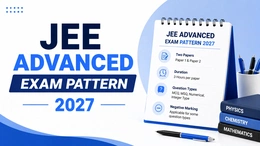
The official JEE Advanced 2027 exam pattern will be released along with the information brochure on the official website. The exam will be conducted in Computer-Based Test (CBT) mode and will consist of two compulsory papers for Paper 1 and Paper 2. Understanding the exam pattern is essential for candidates as it provides details about the exam mode, duration, sections, marking scheme, and the number of questions. Check the expected JEE Advanced 2027 exam pattern below:
Particulars | Details |
Mode of Examination | Computer-Based Test (CBT) |
Medium of Examination | English and Hindi |
Number of Papers | Two compulsory papers – Paper 1 and Paper 2 |
Duration | 3 hours for each paper (4 hours for PwD candidates eligible for compensatory time) |
Sections | Both Paper 1 and Paper 2 include three sections: Physics, Chemistry, and Mathematics |
Total Questions | The number of questions varies every year (18 questions from each subject). The exact number may vary as per the official paper pattern. |
Marking Scheme | The marking scheme varies across question types and may include full marks, partial marks, zero marks, and negative marking. The detailed scheme will be specified in the official question paper. |
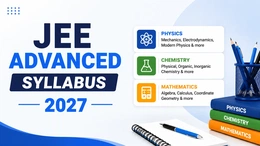
JEE Advanced 2027 Syllabus
The JEE Advanced 2027 syllabus is expected to remain the same as the JEE Advanced 2026 syllabus unless the Joint Admission Board (JAB) announces any changes in the official information brochure. The syllabus covers topics from Class 11 and Class 12 in Physics, Chemistry, and Mathematics and is designed to assess candidates' conceptual understanding, analytical thinking, and problem-solving skills.
Candidates should prepare all topics thoroughly, as JEE Advanced questions often integrate concepts from multiple chapters.
JEE Advanced 2027 Syllabus: Subject-wise Topics
Subject | Important Topics |
Physics | General Physics, Units and Dimensions, Mechanics, Thermal Physics, Electricity and Magnetism, Optics, Modern Physics, Waves and Oscillations |
Chemistry | Physical Chemistry, Organic Chemistry, Inorganic Chemistry, Atomic Structure, Chemical Bonding, Thermodynamics, Equilibrium, Coordination Compounds, Hydrocarbons, Biomolecules |
Mathematics | Sets, Relations and Functions, Algebra, Matrices and Determinants, Probability, Calculus, Coordinate Geometry, Vector Algebra, Three-Dimensional Geometry |
JEE Advanced 2027 Preparation Tips
Cracking JEE Advanced requires a well-planned preparation strategy, conceptual clarity, and consistent practice. Unlike JEE Main, the exam tests candidates' analytical thinking, problem-solving skills, and the ability to apply multiple concepts in a single question. Aspirants should begin their preparation early, complete the syllabus on time, and dedicate sufficient time to revision and mock tests.
1. Understand the Latest Exam Pattern and Syllabus
Before starting your preparation, thoroughly review the latest JEE Advanced syllabus and exam pattern. Familiarity with the topics, question types, and marking scheme will help you create an effective study plan and prioritize important chapters.
2. Build Strong Conceptual Clarity
JEE Advanced focuses on conceptual understanding rather than rote. Ensure that you have a strong grasp of the fundamentals in Physics, Chemistry, and Mathematics before attempting advanced-level problems. Regularly revise basic concepts and clear your doubts promptly.
3. Create a Realistic Study Plan
Prepare a daily and weekly study schedule that covers all three subjects. Allocate more time to topics you find difficult while maintaining regular revision of stronger areas. A balanced timetable helps improve consistency and prevents last-minute stress.
4. Practice Advanced-Level Questions
After completing the theory, solve topic-wise advanced problems and numerical questions. Since JEE Advanced often combines multiple concepts in a single question, practicing high-quality problems is essential to develop analytical thinking.
5. Solve Previous Years' Question Papers
Previous years' papers are one of the best resources for JEE Advanced preparation. They help candidates understand the exam's difficulty level, frequently tested concepts, and question patterns. Try solving at least the last 10 years' papers under exam-like conditions.
Best Books for JEE Advanced 2027
Selecting the Best Books for JEE Advanced 2027 for JEE Advanced preparation. Candidates should first complete the NCERT textbooks, especially for Chemistry, and then move on to standard reference books for advanced-level concepts and problem-solving. Instead of using multiple resources, it is advisable to master a few reliable books for each subject.
Subject-wise Best Books for JEE Advanced 2027
Subject | Book Name | Author |
Physics | Concepts of Physics (Vol. 1 & 2) | H.C. Verma |
Understanding Physics Series | D.C. Pandey | |
Fundamentals of Physics | Halliday, Resnick & Walker | |
Chemistry | NCERT Chemistry (Class 11 & 12) | NCERT |
Problems in Physical Chemistry | Narendra Awasthi | |
Organic Chemistry | Morrison & Boyd | |
Mathematics | Cengage Mathematics Series | G. Tewani |
Skills in Mathematics Series | Amit M. Agarwal | |
Problems in Calculus of One Variable | I.A. Maron |
JEE Advanced 2027 Previous Year Question Papers
Solving JEE Advanced previous year question papers is one of the most effective ways to understand the difficulty level, question trends, and marking scheme. Candidates should also attempt a JEE Advanced Mock Test regularly to assess their preparation under real exam conditions.
Additionally, practising topic-wise questions from a comprehensive JEE Question Bank can help strengthen conceptual understanding and imp
| Year | Paper 1 | Paper 2 |
|---|---|---|
| 2026 | Paper 1 | Paper 2 |
| 2025 | Paper 1 | Paper 2 |
| 2024 | Paper 1 | Paper 2 |
| 2023 | Paper 1 | Paper 2 |
| 2022 | Paper 1 | Paper 2 |
| 2021 | Paper 1 | Paper 2 |
| 2020 | Paper 1 | Paper 2 |
JEE Advanced 2027 Cutoff
The JEE Advanced 2027 cutoff will be released by the conducting IIT along with the result on the official website. The cutoff is the minimum score required for candidates to be included in the JEE Advanced rank list and become eligible for IIT admissions through JoSAA Counselling 2027.
To qualify, candidates must secure both the minimum aggregate marks and the minimum marks in each subject (Physics, Chemistry, and Mathematics). The cutoff varies every year depending on factors such as the difficulty level of the exam, the number of candidates appearing, and the availability of seats.
JEE Advanced 2027: Conclusion
JEE Advanced 2027 will be one of the most important exams for students aiming for admission into the IITs. Since only the top JEE Main 2027 qualifiers can appear for this exam, aspirants should understand the eligibility criteria, exam pattern, syllabus, registration process, important dates, and cutoff requirements well in advance. The exam is expected to continue as a computer-based test with two compulsory papers covering Physics, Chemistry, and Mathematics.
.webp)