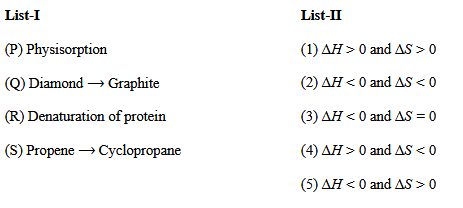
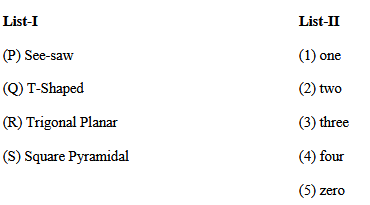
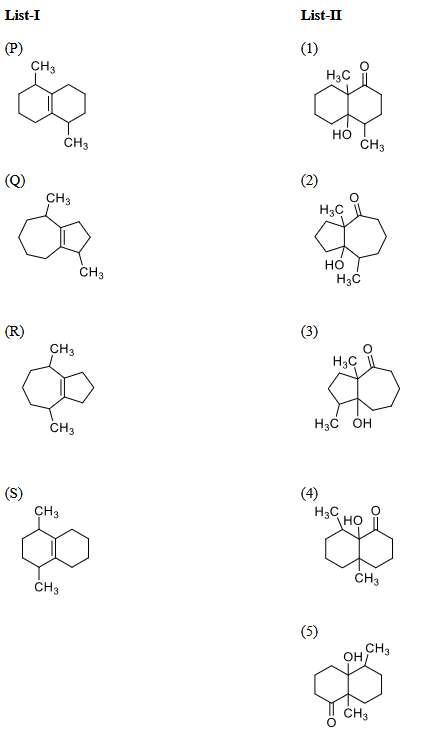
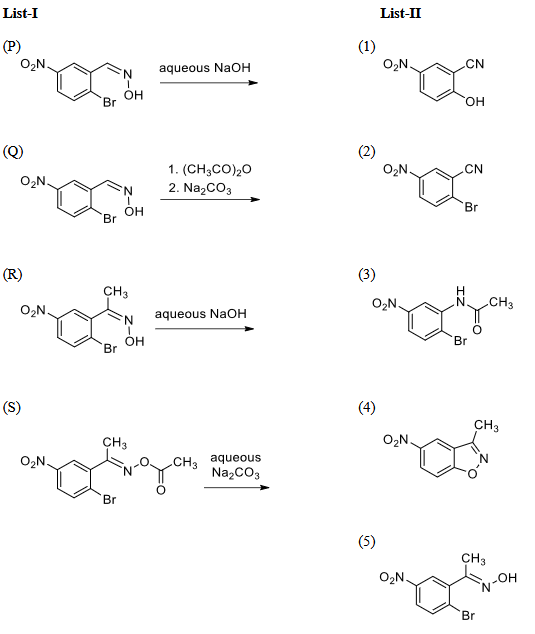
For the following questions answer them individually
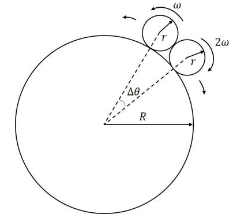
Consider a large disk of radius $$R$$ and two smaller disks, each of radius $$r=R/50$$, lying on its circumference, as shown in the figure. The smaller disks are initially in contact with each other, with an angular separation $$\Delta\theta$$ between their centers. They are made to roll without slipping in opposite directions, with constant angular velocities $$\omega$$ and $$2\omega$$ while the large disk is held stationary. The time $$\tau$$ at which the smaller disks are again in contact is:
[Use $$\sin(\Delta\theta)=\Delta\theta$$ and ignore gravity.]
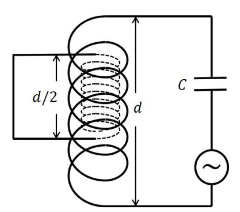
Consider a circuit consisting of a capacitor of capacitance $$C$$ and a coil with $$N$$ turns per unit length, cross sectional area $$S$$ and length $$d$$, where $$d^2\gg S$$. There is another coil of length $$d/2$$, cross sectional area $$S/2$$ and $$2N$$ turns per unit length completely inside the larger coil, as shown in the figure. The ends of this smaller coil are connected with each other by an insulated conducting wire. The self-inductance of the larger coil is $$L$$. Neglecting edge effects and all the Ohmic resistances, the resonant frequency of the circuit is:
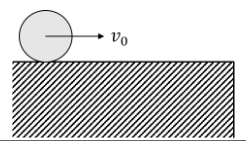
A solid cylinder of radius $$R$$ rolls without slipping with a center of mass speed $$v_0=\sqrt{\dfrac{gR}{3}}$$ on a horizontal surface with a vertical edge, as shown in the figure. Here, $$g$$ is the acceleration due to the gravity. At the moment when the cylinder loses contact with the surface due to rotation around the corner, the speed of its center of mass is:
A double convex lens made of glass of refractive index $$1.5$$ and radii of curvature of the curved surfaces $$20\,\mathrm{cm}$$ each is immersed in a liquid of refractive index $$n_L$$. The correct plot showing the variation of the power, in the units of diopter ($$D$$), as a function of $$n_L$$ is:
Consider a hydrogen atom with $$v_k$$, $$r_k$$, and $$K_k$$ denoting the velocity, orbital radius and kinetic energy of the electron in the $$k^{\text{th}}$$ orbit, respectively. The electron undergoes a transition from the $$n^{\text{th}}$$ orbit, emitting radiation corresponding to the Lyman series. Considering $$h$$ to be the Planck's constant and $$\epsilon_0$$ the permittivity of the free space, the correct statement(s) is(are):
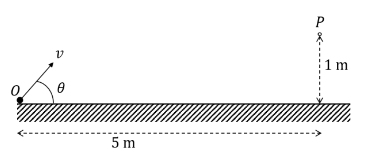
A particle is thrown with a speed $$v$$ from a point $$O$$ at an angle $$\theta$$ with the horizontal plane such that it passes through the point $$P$$ at a height of $$1\,\mathrm{m}$$ and horizontal distance of $$5\,\mathrm{m}$$ from $$O$$, as shown in the figure. If acceleration due to gravity is $$g\,\mathrm{ms^{-2}}$$, then the correct statement(s) is(are):
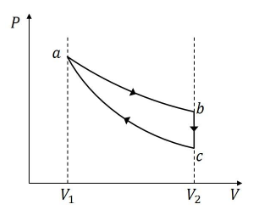
A quasi-static cycle of a monoatomic ideal gas contains an isothermal process ($$\boldsymbol{ab}$$), followed by an isochoric process ($$\boldsymbol{bc}$$) and an adiabatic process ($$\boldsymbol{ca}$$) as shown in the figure. The volumes of the gas are $$V_1$$ and $$V_2$$ at $$\boldsymbol{a}$$ and $$\boldsymbol{b}$$, respectively. If the cycle has heat input $$Q_{\text{in}}$$ and output $$Q_{\text{out}}$$, then the efficiency of the cycle is defined as $$\eta=\dfrac{Q_{\text{in}}-Q_{\text{out}}}{Q_{\text{in}}}$$. The correct statement(s) is(are):
[Given: $$\ln 2\approx 0.7$$]
The electric field associated with an electromagnetic wave travelling in vacuum is given by $$E_0\sin(3y+4z+\omega t)\hat{i}$$, where $$\omega$$ is the angular frequency. All quantities are in SI units. The correct statement(s) about this wave is(are):
[Given: speed of light in vacuum $$c=3\times 10^8\,\mathrm{ms^{-1}}$$.]
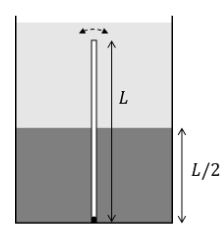
A tank contains two immiscible liquids of densities $$6\rho$$ and $$2\rho$$. The higher density liquid is filled up to a height $$L/2$$ from the bottom. A thin rod of density $$\rho$$ and length $$L$$ is fully immersed and hinged at the bottom so that it can oscillate freely, as shown in the figure. If the rod is slightly disturbed from its equilibrium, the time period of small oscillations is $$\dfrac{2\pi}{n}\sqrt{\dfrac{L}{g}}$$, where $$g$$ is the acceleration due to gravity. The value of $$n$$ is:
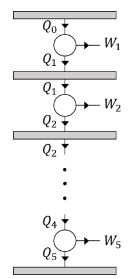
As shown in the figure, five Carnot engines, each with efficiency $$\eta$$ and same number of cycles per unit time, are operating between six heat reservoirs. The amount of heat released per cycle by one engine is completely absorbed by the next engine. Consider $$Q_0$$ to be the amount of heat absorbed per cycle by the first engine and $$W$$ as the amount of total work done by all the engines per cycle, then the net efficiency of the system is found to be $$\eta_{\text{net}}=\dfrac{W}{Q_0}=\dfrac{211}{243}$$. The value of $$\eta$$ is: