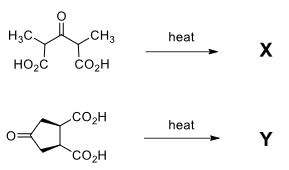
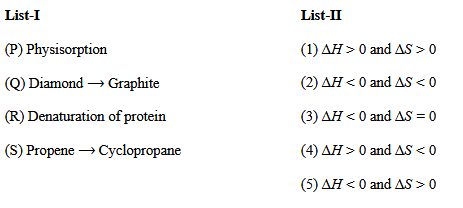
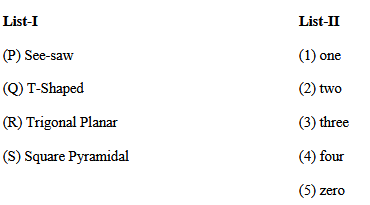
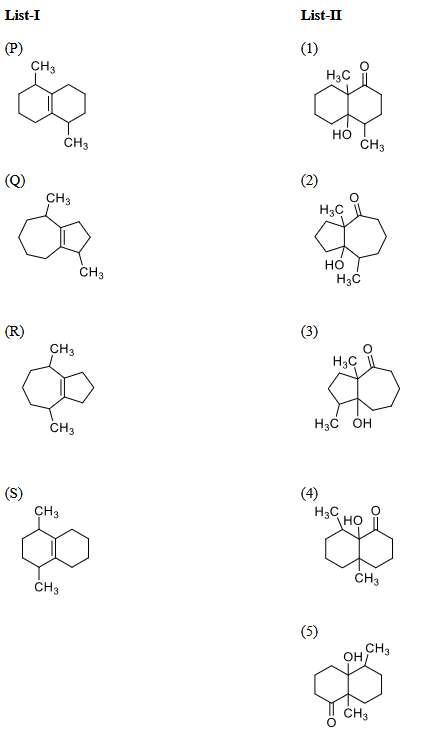
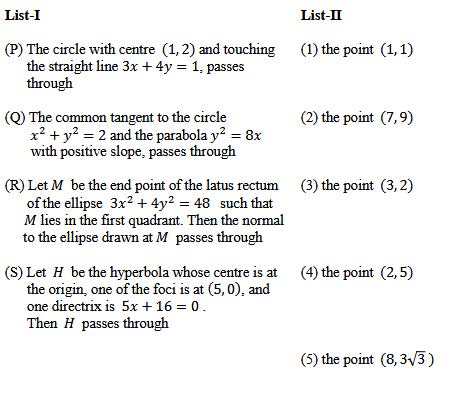
For the following questions answer them individually
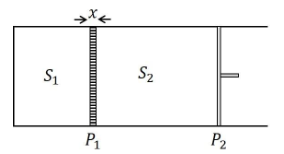
As shown in the figure, an insulated container is fitted with a thermally conducting but immovable partition ($$P_1$$) and a freely movable but thermally insulated piston ($$P_2$$). The partition $$P_1$$ with thermal conductivity $$K$$, cross sectional area $$A$$ and width $$x$$ divides the container into two sections, $$S_1$$ and $$S_2$$, each containing one mole of a monoatomic gas. The piston $$P_2$$ moves freely such that the gas in $$S_2$$ is always at the atmospheric pressure. Initially, the difference between the temperatures of $$S_1$$ and $$S_2$$ is $$\Delta T_0$$. The time it takes for the temperature difference to become $$\dfrac{\Delta T_0}{2}$$ is $$nxR/KA$$, where $$R$$ is the universal gas constant. The value of $$n$$ is:
[ Given: $$\ln 2\approx 0.7$$ ]
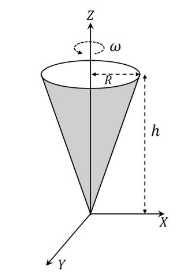
A hollow, right circular cone of base radius $$R$$ and height $$h$$, with its tip at the origin is rotating about the $$Z$$-axis with an angular velocity $$\omega$$, as shown in the figure. The cone carries a total charge $$Q$$ uniformly distributed on its curved surface. The magnitude of magnetic field at a point $$(0,0,z)$$, where $$z\gg R$$ and $$z\gg h$$, is $$\dfrac{n\mu_0}{4\pi}\dfrac{QR^2\omega}{z^3}$$. The value of $$n$$ is:
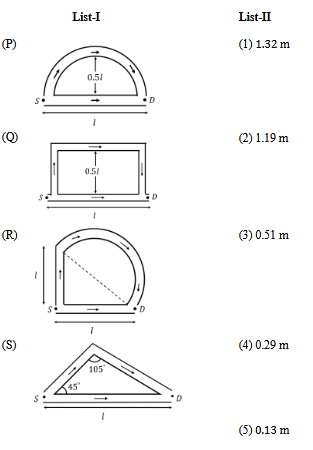
List-I shows four configurations made of straight and semi-circular narrow tubes containing air. A sound wave of wavelength $$\lambda=0.29\,\mathrm{m}$$ enters these structures at the point $$S$$ and a sound detector is placed at $$D$$. Between the points $$S$$ and $$D$$, the sound travels only through the tubes. List-II contains the possible smallest values of $$l$$ (refer to the figures) for which the detector $$D$$ records maximum amplitude. Ignore effects of sharp corners. [Given $$\cos(15^\circ)=0.97$$]
Choose the option that best describes the match between the entries in List-I to those in List-II.
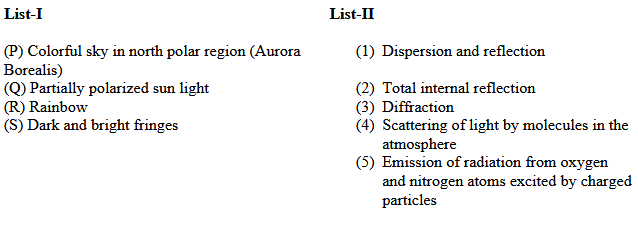
In the List-I, four optical effects are mentioned. The physical phenomena of light which are essential to describe these optical effects are given in List-II. Choose the option which describes the correct match between the entries in List-I to those in List-II.
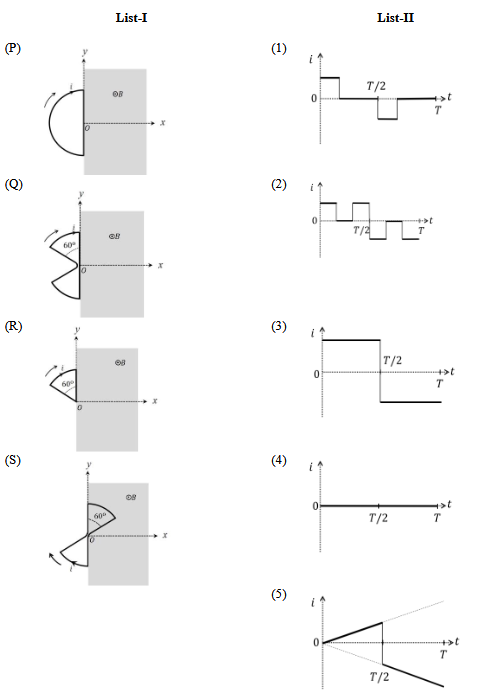
List-I contains four conducting loops lying in the $$XY$$ plane, as shown in the figures. The loops are rotating about $$Z$$ axis passing through the point $$O$$ with time period $$T$$ in clockwise direction. The region $$x>0$$ contains a uniform magnetic field $$B$$ in the $$+z$$ direction. List-II contains the qualitative variation of the induced current $$i(t)$$ for each of these loops. Choose the option which describes the correct match between the entries in List-I to those in List-II.
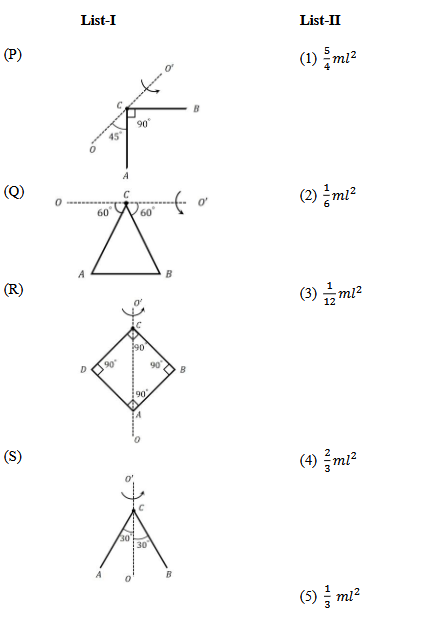
List-I shows four planar structures made of uniform solid rods each of mass $$m$$ and length $$l$$. In the List-II the possible moment of inertia of these structures about an axis $$OCO'$$, which lies in the plane of the structures, are given. Choose the option that describes the correct match between the entries in List-I to those in List-II.
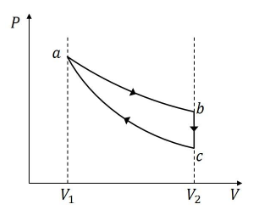
An ideal gas $$(0.5\ \mathrm{mol})$$, initially at $$2$$ bar pressure, is compressed at a constant temperature of $$600\ \mathrm{K}$$ in two steps: first, against a constant external pressure of $$P$$ bar $$(2 \lt P \lt 8)$$, and then against constant external pressure of $$8$$ bar. At each step, the compression is stopped only when the pressure of the gas becomes equal to the external pressure. The total work done on the gas in these steps is $$W$$. Considering all possible values of $$P$$ $$(2 \lt P \lt 8)$$ and taking the gas constant as $$R$$ (in $$\mathrm{J\ K^{-1}\ mol^{-1}}$$), the minimum value of $$|W|$$ (in $$\mathrm{J}$$) is
For a reversible reaction $$\mathbf{R}\rightleftharpoons\mathbf{P}$$, at constant temperature, both the forward and the backward reactions are first order elementary reactions with rate constants $$k_f$$ and $$k_b$$, respectively. At time zero, the concentration of $$\mathbf{R}$$ is $$[\mathbf{R}]_0$$ and the concentration of $$\mathbf{P}$$ is zero. At any given time, $$[\mathbf{R}]$$ and $$[\mathbf{P}]$$ are the concentrations of $$\mathbf{R}$$ and $$\mathbf{P}$$, respectively. If $$k_b=4k_f$$, the correct graphical representation of the reaction is
The correct order of dipole moments for the given species is
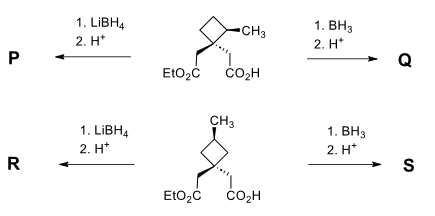
Considering $$LiBH_4$$ reduces an ester group to the corresponding alcohol and does not reduce a carboxylic acid group, the correct statement about the major products $$\mathbf{P}$$, $$\mathbf{Q}$$, $$\mathbf{R}$$ and $$\mathbf{S}$$ is