
Join Our JEE Preparation Group
Prep with like-minded aspirants; Get access to free daily tests and study material.
Sign in
Please select an account to continue using cracku.in
↓ →
Join Our JEE Preparation Group
Prep with like-minded aspirants; Get access to free daily tests and study material.
Considering $$LiBH_4$$ reduces an ester group to the corresponding alcohol and does not reduce a carboxylic acid group, the correct statement about the major products $$\mathbf{P}$$, $$\mathbf{Q}$$, $$\mathbf{R}$$ and $$\mathbf{S}$$ is
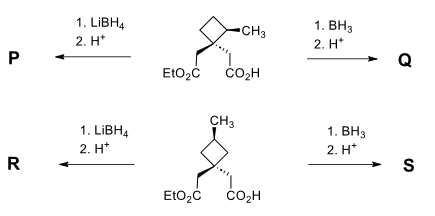
LiBH4 is a “chemoselective” hydride reagent.
• It comfortably reduces an ester $$\;-COOR$$ to a primary alcohol $$\;-CH_2OH$$.
• It does not reduce a free carboxylic acid $$\;-COOH$$ under the same conditions.
The substrate supplied in the question (shown in the paper) contains
• one ester group and one carboxylic-acid group on **adjacent** carbon atoms,
• an already existing stereogenic centre at the carbon bearing the -COOH group.
After LiBH4 treatment only the ester carbonyl is reduced, so:
$$\text{Ester carbon (sp}^2) \;\xrightarrow[\text{LiBH}_4]{\text{reduction}}\; \text{CH}_2\text{OH (sp}^3)}$$
Thus a **new** stereogenic centre is generated at the carbon that now carries -CH2OH. Because hydride can approach the planar ester carbonyl from either the Re or the Si face with almost equal ease, two diastereomeric alcohols are produced:
Case 1: Hydride attack from the Re face → product **P**.
Case 2: Hydride attack from the Si face → product **Q**.
The configuration at the pre-existing chiral carbon (bearing -COOH) remains unchanged during reduction. Hence **P** and **Q** differ at only ONE of the two stereogenic centres. This makes them **diastereomers** (they are neither identical nor enantiomeric).
In the second step (described in the original problem) the -COOH group of both P and Q is esterified (MeOH / H+) to give methyl esters **R** and **S**. Esterification does not disturb either stereogenic centre; therefore:
• R originates from P, S originates from Q.
• R and S likewise differ at just one of the two stereogenic centres.
Hence **R** and **S** are also diastereomers.
To summarise:
- P & Q: diastereomeric pair.
- R & S: diastereomeric pair.
Therefore the correct statement is:
Option C: P & Q are diastereomers, and R & S are diastereomers.
Was this solution helpful?
Create a FREE account and get:
_1.webp)

Educational materials for JEE preparation

Ask our AI anything

AI can make mistakes. Please verify important information.
AI can make mistakes. Please verify important information.
