
Join Our JEE Preparation Group
Prep with like-minded aspirants; Get access to free daily tests and study material.
Sign in
Please select an account to continue using cracku.in
↓ →
Join Our JEE Preparation Group
Prep with like-minded aspirants; Get access to free daily tests and study material.
Consider a large disk of radius $$R$$ and two smaller disks, each of radius $$r=R/50$$, lying on its circumference, as shown in the figure. The smaller disks are initially in contact with each other, with an angular separation $$\Delta\theta$$ between their centers. They are made to roll without slipping in opposite directions, with constant angular velocities $$\omega$$ and $$2\omega$$ while the large disk is held stationary. The time $$\tau$$ at which the smaller disks are again in contact is:
[Use $$\sin(\Delta\theta)=\Delta\theta$$ and ignore gravity.]
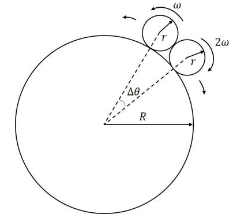
For pure rolling on a stationary circular track, the angular velocity of the center of a rolling object about the track's center is related to its spin angular velocity by $$\Omega = \frac{\omega_{\text{spin}} r}{R + r}$$.
Given: $$r = \frac{R}{50} \implies R = 50r$$, $$\omega_1 = \omega$$, $$\omega_2 = 2\omega$$
Radius of the path traced by the centers of the small disks: $$R_c = R + r = 51r$$
Initial angular separation between the centers subtended at the center of the large disk:
$$\Delta\theta = \frac{2r}{R_c} = \frac{2r}{51r} = \frac{2}{51}\text{ rad}$$
Angular velocities of the centers of the two disks about the track's center:
$$\Omega_1 = \frac{\omega r}{51r} = \frac{\omega}{51}$$
$$\Omega_2 = \frac{2\omega r}{51r} = \frac{2\omega}{51}$$
Relative angular velocity of the centers since they move in opposite directions:
$$\Omega_{\text{rel}} = \Omega_1 + \Omega_2 = \frac{3\omega}{51}$$
Total angular distance to be covered for the next contact:
$$\theta_{\text{total}} = 2\pi - 2\Delta\theta = 2\pi - \frac{4}{51}$$
Finding the time taken $$\tau$$:
$$\tau = \frac{\theta_{\text{total}}}{\Omega_{\text{rel}}} = \frac{2\pi - \frac{4}{51}}{\frac{3\omega}{51}} = 51 \times \frac{\left(2\pi - \frac{4}{51}\right)}{3\omega}$$
Was this solution helpful?
Create a FREE account and get:
_1.webp)

Educational materials for JEE preparation

Ask our AI anything

AI can make mistakes. Please verify important information.
AI can make mistakes. Please verify important information.
