
Join Our JEE Preparation Group
Prep with like-minded aspirants; Get access to free daily tests and study material.
Sign in
Please select an account to continue using cracku.in
↓ →
Join Our JEE Preparation Group
Prep with like-minded aspirants; Get access to free daily tests and study material.
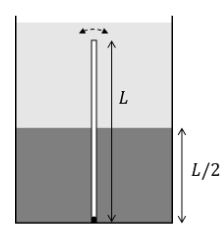
A tank contains two immiscible liquids of densities $$6\rho$$ and $$2\rho$$. The higher density liquid is filled up to a height $$L/2$$ from the bottom. A thin rod of density $$\rho$$ and length $$L$$ is fully immersed and hinged at the bottom so that it can oscillate freely, as shown in the figure. If the rod is slightly disturbed from its equilibrium, the time period of small oscillations is $$\dfrac{2\pi}{n}\sqrt{\dfrac{L}{g}}$$, where $$g$$ is the acceleration due to gravity. The value of $$n$$ is:
Correct Answer: 1.73
The time period of small oscillations for a hinged rod under buoyant and gravitational forces is determined by the net restoring torque equation $$\tau_{\text{net}} = -I\alpha = -\left(\tau_B - \tau_g\right)$$, leading to $$T = 2\pi\sqrt{\frac{I}{\kappa_{\text{torsional}}}}$$.
Given: $$\text{Rod length} = L$$, $$\text{Rod density} = \rho$$, $$\text{Lower liquid layer } \left(0 \le y \le \frac{L}{2}\right) = 6\rho$$, $$\text{Upper liquid layer } \left(\frac{L}{2} \le y \le L\right) = 2\rho$$
Let $$A$$ be the cross-sectional area of the rod.
Moment of inertia of the rod about the bottom hinge:
$$I = \frac{1}{3}ML^2 = \frac{1}{3}(\rho A L)L^2 = \frac{1}{3}\rho A L^3$$
For a small angular displacement $$\theta$$, finding the restoring torque contributions about the hinge:
$$\tau_g = Mg \cdot \frac{L}{2}\theta = (\rho A L)g \frac{L}{2}\theta = \frac{1}{2}\rho A g L^2\theta$$
$$\tau_{B1} \text{ (due to lower liquid)} = (6\rho A \frac{L}{2})g \cdot \frac{L}{4}\theta = \frac{3}{4}\rho A g L^2\theta$$
$$\tau_{B2} \text{ (due to upper liquid)} = (2\rho A \frac{L}{2})g \cdot \frac{3L}{4}\theta = \frac{3}{4}\rho A g L^2\theta$$
Total buoyant torque:
$$\tau_B = \tau_{B1} + \tau_{B2} = \frac{3}{4}\rho A g L^2\theta + \frac{3}{4}\rho A g L^2\theta = \frac{3}{2}\rho A g L^2\theta$$
Net restoring torque:
$$\tau_{\text{net}} = \tau_B - \tau_g = \left(\frac{3}{2} - \frac{1}{2}\right)\rho A g L^2\theta = \rho A g L^2\theta$$
$$\omega_0 = \sqrt{\frac{\kappa}{I}} = \sqrt{\frac{\rho A g L^2}{\frac{1}{3}\rho A L^3}} = \sqrt{\frac{3g}{L}}$$
$$T = \frac{2\pi}{\omega_0} = \frac{2\pi}{\sqrt{3}}\sqrt{\frac{L}{g}}$$
$$n = \sqrt{3} \approx 1.73$$
Was this solution helpful?
Create a FREE account and get:
_1.webp)

Educational materials for JEE preparation

Ask our AI anything

AI can make mistakes. Please verify important information.
AI can make mistakes. Please verify important information.
