
Join Our JEE Preparation Group
Prep with like-minded aspirants; Get access to free daily tests and study material.
Sign in
Please select an account to continue using cracku.in
↓ →
Join Our JEE Preparation Group
Prep with like-minded aspirants; Get access to free daily tests and study material.
A solid cylinder of radius $$R$$ rolls without slipping with a center of mass speed $$v_0=\sqrt{\dfrac{gR}{3}}$$ on a horizontal surface with a vertical edge, as shown in the figure. Here, $$g$$ is the acceleration due to the gravity. At the moment when the cylinder loses contact with the surface due to rotation around the corner, the speed of its center of mass is:
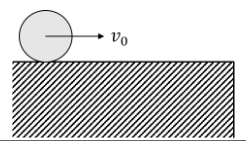
Angular momentum about the corner is conserved during the collision transition, followed by conservation of mechanical energy during rotation about the corner until the normal force becomes zero.
Given: $$v_0 = \sqrt{\frac{gR}{3}}$$, $$I_{\text{cm}} = \frac{1}{2}MR^2$$
From conservation of angular momentum about the corner $$P$$:
$$L_i = L_f$$
$$Mv_0R + I_{\text{cm}}\omega_0 = I_P\omega_1$$
$$Mv_0R + \left(\frac{1}{2}MR^2\right)\left(\frac{v_0}{R}\right) = \left(\frac{1}{2}MR^2 + MR^2\right)\omega_1$$
$$\frac{3}{2}Mv_0R = \frac{3}{2}MR^2\omega_1 \implies \omega_1 = \frac{v_0}{R}$$
At the moment it loses contact at angle $$\theta$$ from the vertical:
$$N = 0 \implies Mg\cos\theta = \frac{Mv^2}{R} \implies MgR\cos\theta = Mv^2$$
From conservation of mechanical energy during rotation about the corner:
$$K_i + U_i = K_f + U_f$$
$$\frac{1}{2}I_P\omega_1^2 + MgR = \frac{1}{2}I_P\left(\frac{v}{R}\right)^2 + MgR\cos\theta$$
$$\frac{1}{2}\left(\frac{3}{2}MR^2\right)\left(\frac{v_0}{R}\right)^2 + MgR = \frac{1}{2}\left(\frac{3}{2}MR^2\right)\left(\frac{v}{R}\right)^2 + Mv^2$$
$$\frac{3}{4}Mv_0^2 + MgR = \frac{7}{4}Mv^2$$
Substituting $$gR = 3v_0^2$$:
$$\frac{3}{4}Mv_0^2 + M(3v_0^2) = \frac{7}{4}Mv^2$$
$$\frac{15}{4}v_0^2 = \frac{7}{4}v^2 \implies v^2 = \frac{15}{7}v_0^2 = \frac{15}{7}\left(\frac{gR}{3}\right) = \frac{5gR}{7}$$
$$v = \sqrt{\frac{5gR}{7}}$$
Was this solution helpful?
Create a FREE account and get:
_1.webp)

Educational materials for JEE preparation

Ask our AI anything

AI can make mistakes. Please verify important information.
AI can make mistakes. Please verify important information.
