
Join Our JEE Preparation Group
Prep with like-minded aspirants; Get access to free daily tests and study material.
Sign in
Please select an account to continue using cracku.in
↓ →
Join Our JEE Preparation Group
Prep with like-minded aspirants; Get access to free daily tests and study material.
In the following reaction sequence, $$\mathbf{Q}$$, $$\mathbf{R}$$, $$\mathbf{S}$$ and $$\mathbf{T}$$ are the major products.
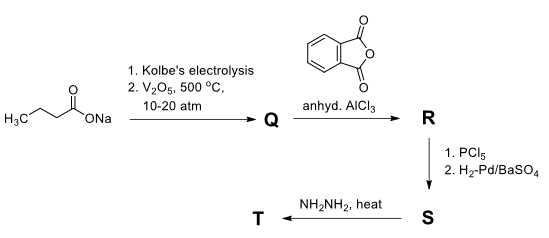
The correct statement(s) about $$\mathbf{Q}$$, $$\mathbf{R}$$, $$\mathbf{S}$$ and $$\mathbf{T}$$ is(are)
The reagents used at each stage and the structures obtained are summarised first and then analysed with respect to the four statements.
Case 1: Formation of $$\mathbf{Q}$$ Benzene is treated with $$CH_3Cl$$ in the presence of anhydrous $$AlCl_3$$ (Friedel-Crafts alkylation). The methyl group substitutes one hydrogen of benzene to give toluene, $$C_6H_5CH_3$$. Hence $$\mathbf{Q}$$ = toluene.
Case 2: Formation of $$\mathbf{R}$$ Oxidation of any alkyl side-chain on an aromatic ring by alkaline, hot $$KMnO_4$$ converts the entire side-chain to a carboxyl group. Therefore toluene is oxidised to benzoic acid, $$C_6H_5COOH$$. Hence $$\mathbf{R}$$ = benzoic acid.
Case 3: Formation of $$\mathbf{S}$$ Benzoic acid is converted to its acid chloride with $$SOCl_2$$: $$C_6H_5COOH \xrightarrow{SOCl_2} C_6H_5COCl$$ The acid chloride is then subjected to Rosenmund reduction ( $$H_2/Pd{-}BaSO_4$$ ), which stops at the aldehyde stage: $$C_6H_5COCl \xrightarrow[\text{Poisoned}\;Pd]{H_2} C_6H_5CHO$$ Thus $$\mathbf{S}$$ = benzaldehyde.
Case 4: Formation of $$\mathbf{T}$$ Benzaldehyde undergoes benzoin condensation in the presence of catalytic $$KCN$$/ethanol to give benzoin: $$2\,C_6H_5CHO \xrightarrow{KCN/EtOH} C_6H_5CH(OH)COC_6H_5$$ Benzoin contains two benzene rings joined by $$-CH(OH)-CO-$$, but no hetero-atom in a ring. Hence $$\mathbf{T}$$ = benzoin (a non-heterocyclic acyloin).
Now each assertion is examined.
Option A “$$\mathbf{S}$$ on warming with ammoniacal $$AgNO_3$$ results in the formation of a silver mirror.” Tollens’ reagent, $$[Ag(NH_3)_2]^+$$, oxidises aldehydes to acids while reducing itself to metallic silver. Since $$\mathbf{S}$$ is benzaldehyde (an aldehyde), it gives a positive silver-mirror test. Hence Option A is TRUE.
Option B “$$\mathbf{Q}$$ on treatment with $$Cl_2$$(excess)/UV gives gammaxane.” Gammaxane (lindane, $$C_6H_6Cl_6$$) is obtained by photochemical addition of chlorine to benzene, not to toluene. $$\mathbf{Q}$$ is toluene, and side-chain/ring chlorination products are formed instead of BHC. Hence Option B is FALSE.
Option C “$$\mathbf{T}$$ is a heterocyclic compound.” $$\mathbf{T}$$ (benzoin) is an open-chain acyloin; it contains no ring that has a hetero-atom as a member. Hence Option C is FALSE.
Option D “$$\mathbf{R}$$ on acid-catalysed intramolecular cyclisation followed by $$Zn{-}Hg/HCl$$ gives $$9,10$$-dihydroxy-anthracene.” $$\mathbf{R}$$ is benzoic acid, which possesses only one carbonyl group and therefore cannot furnish the two adjacent carbonyls required to produce anthraquinone (the precursor of 9,10-dihydroxy-anthracene). Consequently the sequence described cannot occur, so the statement is incorrect. Hence Option D is FALSE.
Thus, the only correct statement is:
Option A which is: $$\mathbf{S}$$ on warming with ammoniacal $$AgNO_3$$ results in the formation of silver mirror.
Was this solution helpful?
Create a FREE account and get:
_1.webp)

Educational materials for JEE preparation

Ask our AI anything

AI can make mistakes. Please verify important information.
AI can make mistakes. Please verify important information.
